Medical Research Council Unit The Gambia at the London, School of Hygiene and Tropical Medicine, Banjul, The Gambia.
Department of Biosciences, Durham University, Durham, UK.
Parasit Vectors. 2022 Nov 17;15(1):435. doi: 10.1186/s13071-022-05557-4.
Vector control interventions in sub-Saharan Africa rely on insecticide-treated nets and indoor residual spraying. Insecticide resistance, poor coverage of interventions, poor quality nets and changes in vector behavior threaten the effectiveness of these interventions and, consequently, alternative tools are needed. Mosquitoes die after feeding on humans or animals treated with ivermectin (IVM). Mass drug administration (MDA) with IVM could reduce vector survival and decrease malaria transmission. The entomological impact of MDA of combined IVM and dihydroartemisinin-piperaquine was assessed in a community-based, cluster-randomized trial.
A cluster-randomized trial was implemented in 2018 and 2019 in 32 villages in the Upper River Region, The Gambia. The with the inhabitants of 16 intervention villages eligible to receive three monthly rounds of MDA at the beginning of the malaria transmission season. Entomological surveillance with light traps and human landing catches (HLC) was carried out during a 7- to 14-day period after each round of MDA, and then monthly until the end of the year. The mosquitocidal effect of IVM was determined by direct membrane feeding assays.
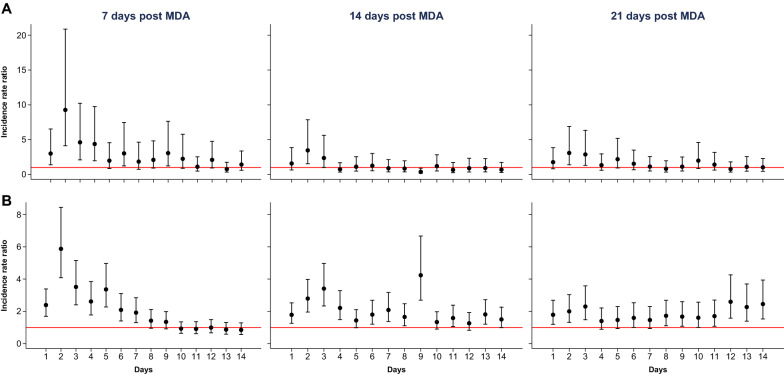
Of the 15,017 mosquitoes collected during the study period, 99.65% (n = 14,965) were Anopheles gambiae sensu lato (An. gambiae s.l.), comprising Anopheles arabiensis (56.2%), Anopheles coluzzii (24.5%), Anopheles gambiae sensu stricto (An. gembiae s.s.; 16.0%) and Anopheles funestus sensu lato (An. funestus s.l.; 0.35%). No effect of the intervention on vector parity was observed. Vector density determined on light trap collections was significantly lower in the intervention villages in 2019 (adjusted incidence rate ratio: 0.39; 95% confidence interval [CI]: 0.20, 0.74; P = 0.005) but not in 2018. However, vector density determined in HLC collections was similar in both the intervention and control villages. The entomological inoculation rate was significantly lower in the intervention villages than in the control villages (odds ratio: 0.36, 95% CI: 0.19, 0.70; P = 0·003). Mosquito mortality was significantly higher when blood fed on IVM-treated individuals up to 21 days post-treatment, particularly in adults and individuals with a higher body mass index.
Mass drug administration with IVM decreased vector density and the entomological inoculation rate while the effect on vector parity was less clear. Survival of mosquitoes fed on blood collected from IVM-treated individuals was significantly lower than that in mosquitoes which fed on controls. The influence of host characteristics on mosquito survivorship indicated that dose optimization could improve IVM efficacy. Future detailed entomological evaluation trials in which IVM is administered as stand-alone intervention may elucidate the contribution of this drug to the observed reduction in transmission.
撒哈拉以南非洲的病媒控制干预措施依赖于经杀虫剂处理的蚊帐和室内滞留喷洒。杀虫剂耐药性、干预措施覆盖范围差、网质量差以及病媒行为的变化,都威胁着这些干预措施的有效性,因此需要替代工具。伊维菌素(IVM)处理过的人类或动物,蚊子在吸食后会死亡。大规模药物给药(MDA)用 IVM 可以降低媒介物的存活率并减少疟疾传播。在一项基于社区的、集群随机试验中,评估了 MDA 联合 IVM 和双氢青蒿素-哌喹对蚊虫的昆虫学影响。
2018 年至 2019 年期间,在冈比亚上河区的 32 个村庄实施了一项集群随机试验。该试验开始时,16 个干预村的居民有资格接受三轮每月一轮的 MDA。在 MDA 后 7-14 天内,通过灯光诱捕和人体降落捕捉(HLC)进行昆虫学监测,然后每月监测一次,直到年底。通过直接膜喂食测定 IVM 的杀蚊效果。
在研究期间收集的 15017 只蚊子中,99.65%(n=14965)为冈比亚按蚊亚种(An. gambiae s.l.),包括阿拉伯按蚊(An. arabiensis)(56.2%)、库蚊(An. coluzzii)(24.5%)、冈比亚按蚊亚种(An. gambiae s.s.)(16.0%)和按蚊(An. funestus s.l.)(0.35%)。干预措施对媒介物的生殖力没有影响。2019 年,灯光诱捕收集的媒介密度在干预村显著降低(调整发病率比:0.39;95%置信区间[CI]:0.20,0.74;P=0.005),但 2018 年没有。然而,干预村和对照村的 HLC 收集的媒介密度相似。干预村的昆虫接种率明显低于对照村(比值比:0.36,95%CI:0.19,0.70;P=0.003)。与对照组相比,用 IVM 处理过的个体的血液喂养蚊子的死亡率明显更高,尤其是在成年人和体重指数较高的个体中。
大规模药物给药(MDA)用 IVM 降低了媒介密度和昆虫接种率,而对媒介物生殖力的影响则不太清楚。从 IVM 治疗个体收集的血液中喂养的蚊子的存活率明显低于从对照组中喂养的蚊子。宿主特征对蚊子存活率的影响表明,剂量优化可以提高 IVM 的疗效。未来在单独使用 IVM 作为干预措施的详细昆虫学评估试验中,可能会阐明该药物对观察到的传播减少的贡献。