Gendron William A C, Raban Robyn, Mondal Agastya, M Sánchez C Héctor, Smidler Andrea L, Zilberman David, Ilboudo Patrick G C, D'Alessandro Umberto, Marshall John M, Akbari Omar S
School of Biological Sciences, Department of Cell and Developmental Biology, University of California, San Diego, La Jolla, California, United States of America.
Divisions of Epidemiology & Biostatistics, School of Public Health, University of California, Berkeley, California, United States of America.
PLOS Glob Public Health. 2025 Jul 18;5(7):e0004903. doi: 10.1371/journal.pgph.0004903. eCollection 2025.
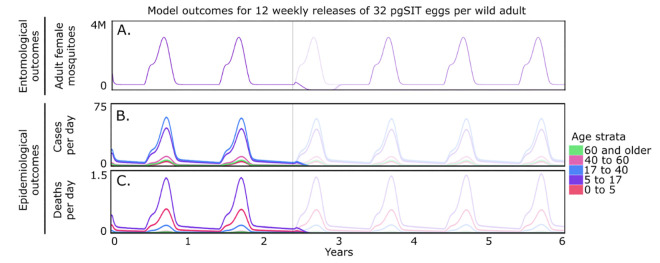
Mosquito control has successfully reduced the burden of malaria globally, but current vector control technologies cannot achieve malaria elimination. Precision guided sterile insect technique (pgSIT) is one of the most promising interventions being developed for malaria elimination. Mass release of genetically sterile males can act as a chemical-free species-specific insecticide. Before translating pgSIT from the bench to the field, however, it is essential to understand the potential costs and capabilities of this technology in a malaria-endemic region to determine if further investment into research and development of this technology is worthwhile. Therefore, we estimated the health outcomes and costs of a pgSIT program working jointly with current interventions to control the Anopheles gambiae malaria vector in the Upper River region of The Gambia. The pgSIT intervention in this region is predicted to prevent approximately 230 deaths and about 48,000 sick days per year. We have provided a range of costs that include risks associated with research and development, the facility, mass rearing efficiency, and distribution. This intervention should save disability-adjusted life years (DALY) at 11-94 USD per year and will prevent cases at 10-86 USD per infection. These estimates predict that pgSIT will cost 0.36-3.03 USD per person in the treated region annually. The cost per DALY shows life-saving at a cost comparable to current interventions in the Upper River region.
蚊虫控制已成功减轻了全球疟疾负担,但目前的病媒控制技术无法实现消除疟疾的目标。精准制导不育昆虫技术(pgSIT)是目前正在开发的最有前景的消除疟疾干预措施之一。大规模释放基因不育雄蚊可作为一种无化学物质的物种特异性杀虫剂。然而,在将pgSIT从实验室应用到实地之前,必须了解该技术在疟疾流行地区的潜在成本和能力,以确定对该技术的研发进一步投资是否值得。因此,我们估计了在冈比亚上河区与当前干预措施联合开展的pgSIT项目的健康结果和成本。预计该地区的pgSIT干预措施每年可预防约230例死亡和约48000个患病日。我们提供了一系列成本,包括与研发、设施、大规模饲养效率和分发相关的风险。这种干预措施每年应能以11 - 94美元的成本节省伤残调整生命年(DALY),并以每例感染10 - 86美元的成本预防病例。这些估计表明,在受治疗地区,pgSIT每年人均成本为0.36 - 3.03美元。每DALY的成本显示出其挽救生命的成本与上河区目前的干预措施相当。