Dechasa Mesay, Chelkeba Legese, Jorise Amente, Sefera Birbirsa, Melaku Tsegaye
Department of Clinical Pharmacy, School of Pharmacy, College of Health and Medical Sciences, Haramaya University, P.O. Box 235, Harar, Ethiopia.
Department of Clinical Pharmacy, School of Pharmacy, Institute of Health Sciences, Jimma University, PO. Box 378, Jimma, Ethiopia.
J Pharm Policy Pract. 2022 Nov 17;15(1):84. doi: 10.1186/s40545-022-00490-4.
An irrational antibiotic use is a common problem in developing countries like Ethiopia, which makes empiric antibiotics use difficult. It is considered to be the greatest health problem in our time and future unless intervened. Therefore, this study aimed to assess the patterns of antibiotics use among hospitalized adult patients to pave the way for antimicrobial stewardship.
A hospital-based prospective observational study was conducted at Jimma Medical Center, southwestern Ethiopia, from 30 October 2020 to 29 January 2021 with 360 adult hospitalized patients participating. A semi-structured questionnaire and consecutive sampling technique was used for data collection. The data were collected through medical record reviews and patient interviews. The collected data were entered into Epi-data and exported to SPSS version 23.0 for analysis. Days of therapy (DOT) and essential medicine lists "Access, Watch, and Reserve (AWaRe)" antibiotics classification were used to assess antibiotic use pattern among participants.
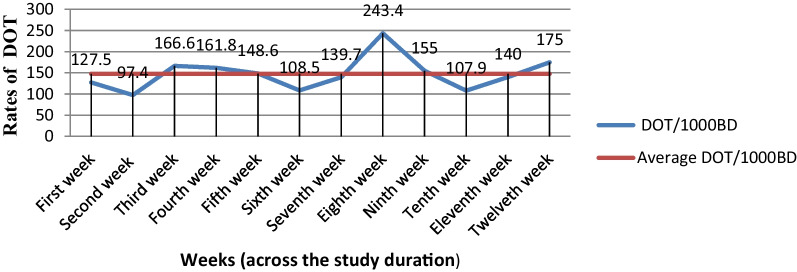
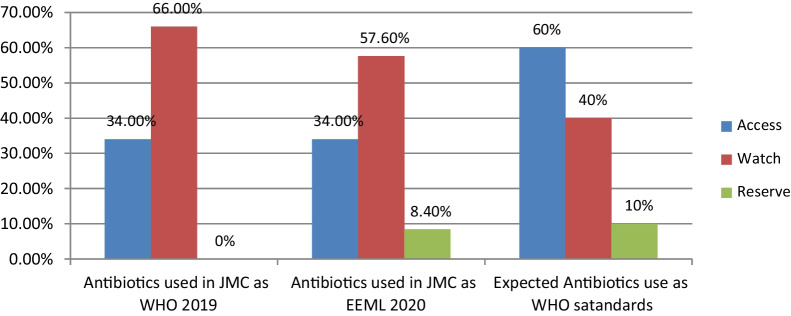
The majority of study participants were females (55.3%), attended formal education (59.4%), and live in rural areas (61.4%) with mean age ± (SD) of 37.65 ± (16.75). The overall rate of antibiotics consumption during the study was 111 days of therapy per 100 bed-days and about two-thirds (66%) of the prescribed antibiotics were from the "Watch" group antibiotics. The indicator level of antibiotics use for "Access" group antibiotics was 34% in this study based on the World Health Organization Essential Medicine List. Cephalosporins were the most commonly used class of antibiotics (93.9%).
Higher antibiotics exposure and their consumption frequently observed among adult hospitalized patients in the study setting. There was a rapid increase in "Watch" group antibiotics use and about two-thirds of the prescribed antibiotics were from this group. The third-generation cephalosporin were the most commonly used class of antibiotics. Generally, higher consumption and inappropriate antibiotics use among hospitalized adult patients showed the need for urgent interventions by implementing Antimicrobial Stewardship Programs in hospitals.
在埃塞俄比亚等发展中国家,不合理使用抗生素是一个常见问题,这使得经验性使用抗生素变得困难。除非加以干预,否则它被认为是我们这个时代以及未来最大的健康问题。因此,本研究旨在评估住院成年患者的抗生素使用模式,为抗菌药物管理铺平道路。
2020年10月30日至2021年1月29日,在埃塞俄比亚西南部的吉马医疗中心进行了一项基于医院的前瞻性观察研究,有360名成年住院患者参与。采用半结构化问卷和连续抽样技术收集数据。通过病历审查和患者访谈收集数据。将收集到的数据录入Epi - data,并导出到SPSS 23.0版本进行分析。使用治疗天数(DOT)和基本药物清单“获取、观察和储备(AWaRe)”抗生素分类来评估参与者的抗生素使用模式。
大多数研究参与者为女性(55.3%),接受过正规教育(59.4%),居住在农村地区(61.4%),平均年龄±(标准差)为37.65±(16.75)。研究期间抗生素的总体消耗率为每100床日111个治疗日,约三分之二(66%)的处方抗生素来自“观察”组抗生素。根据世界卫生组织基本药物清单,本研究中“获取”组抗生素的使用指标水平为34%。头孢菌素是最常用的抗生素类别(93.9%)。
在研究环境中,成年住院患者中经常观察到较高的抗生素暴露及其消耗。“观察”组抗生素的使用迅速增加,约三分之二的处方抗生素来自该组。第三代头孢菌素是最常用的抗生素类别。总体而言,住院成年患者中较高的消耗量和不适当的抗生素使用表明,有必要通过在医院实施抗菌药物管理计划进行紧急干预。