Lin Hsi-Hsin, Mendez-Perez Daniel, Park Jimin, Wang Xi, Cheng Yan, Huo Jiajie, Mukhopadhyay Aindrila, Lee Taek Soon, Shanks Brent H
Department of Chemical and Biological Engineering, Iowa State University, Ames, IA, 50011, USA.
Center for Biorenewable Chemicals (CBiRC), Iowa State University, Ames, IA, 50011, USA.
Biotechnol Biofuels Bioprod. 2022 Nov 17;15(1):126. doi: 10.1186/s13068-022-02226-7.
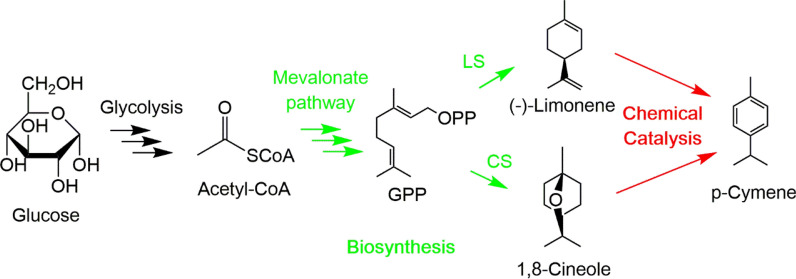
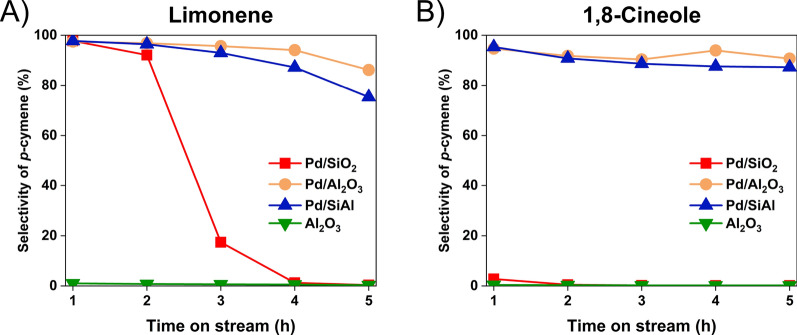
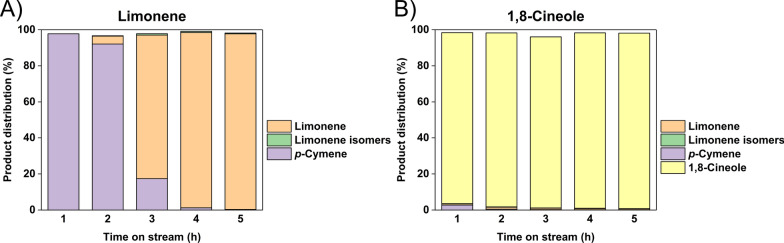
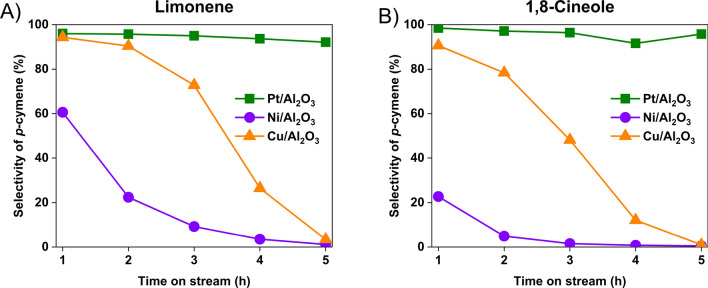
The strategy of synergistic application of biological and chemical catalysis is an important approach for efficiently converting renewable biomass into chemicals and fuels. In particular, the method of determining the appropriate intermediate between the two catalytic methods is critical. In this work, we demonstrate p-cymene production through the integration of biosynthesis and heterogenous catalysis and show how a preferred biologically derived precursor could be determined. On the biological side, we performed the limonene and 1,8-cineole production through the mevalonate pathway. Titers of 0.605 g/L and a 1.052 g/L were achieved, respectively. This difference is in agreement with the toxicity of these compounds toward the producing microorganisms, which has implications for subsequent development of the microbial platform. On the heterogeneous catalysis side, we performed the reaction with both biological precursors to allow for direct comparison. Using hydrogenation/dehydrogenation metals on supports with acid sites, both limonene and 1,8-cineole were converted to p-cymene with similar yields under equivalent reaction conditions. Thus, we could determine that the most promising strategy would be to target 1,8-cineole, the higher titer and lower toxicity bio-derived precursor with subsequent catalytic conversion to p-cymene. We further optimized the biological production of 1,8-cineole via fed-batch fermentation and reached the titer of 4.37 g/L which is the highest known 1,8-cineole titer from microbial production. This work provides a valuable paradigm for early stage considerations to determine the best route for the high-efficiency production of a target biobased molecule using an integration of biology and chemistry.
生物催化与化学催化协同应用策略是将可再生生物质高效转化为化学品和燃料的重要途径。特别是,确定两种催化方法之间合适中间体的方法至关重要。在本工作中,我们展示了通过生物合成与多相催化相结合生产对异丙基甲苯,并展示了如何确定一种更优的生物衍生前体。在生物方面,我们通过甲羟戊酸途径进行了柠檬烯和1,8 - 桉叶素的生产。分别获得了0.605 g/L和1.052 g/L的滴度。这种差异与这些化合物对生产微生物的毒性一致,这对微生物平台的后续开发有影响。在多相催化方面,我们使用两种生物前体进行反应以便直接比较。在具有酸性位点的载体上使用加氢/脱氢金属,在相同反应条件下,柠檬烯和1,8 - 桉叶素均以相似产率转化为对异丙基甲苯。因此,我们可以确定最有前景的策略是以1,8 - 桉叶素为目标,它是滴度较高且毒性较低的生物衍生前体,随后通过催化转化为对异丙基甲苯。我们通过补料分批发酵进一步优化了1,8 - 桉叶素的生物生产,达到了4.37 g/L的滴度,这是微生物生产中已知的最高1,8 - 桉叶素滴度。这项工作为早期考虑提供了一个有价值的范例,以确定使用生物学和化学相结合的方法高效生产目标生物基分子的最佳途径。