Health Management Center, Union Hospital, Tongji Medical College, Huazhong University of Science and Technology, Wuhan, China.
Obstetrics and Gynecology Department, Tongji Hospital, Tongji Medical College, Huazhong University of Science and Technology, Wuhan, China.
Medicine (Baltimore). 2022 Nov 11;101(45):e31370. doi: 10.1097/MD.0000000000031370.
This study aims to investigate the current situation of pelvic floor muscle (PFM) in the second trimester postpartum 42 days by detecting the electrophysiological indexes of PFM on pelvic floor rehabilitation after 2 months.
In total, 198 cases of second child puerpera were selected, who were delivered in our hospital between June 1, 2020, and December 10, 2020, and underwent outpatient reexamination 42 days after delivery.
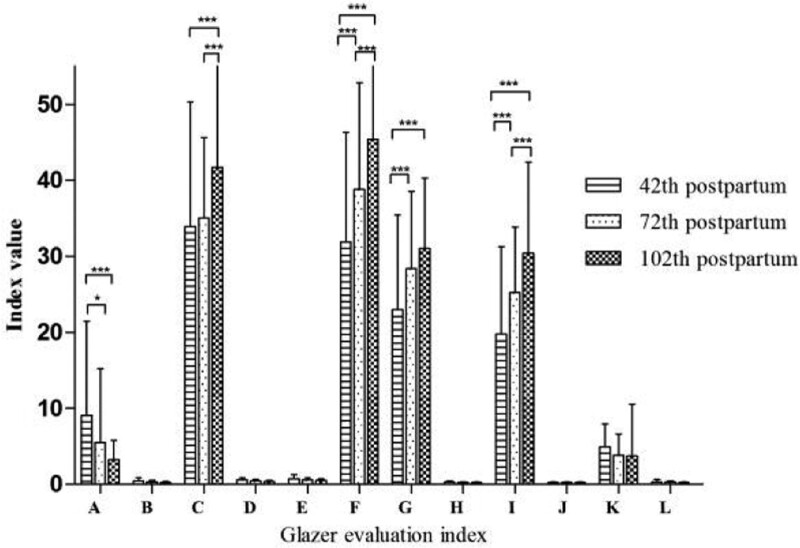
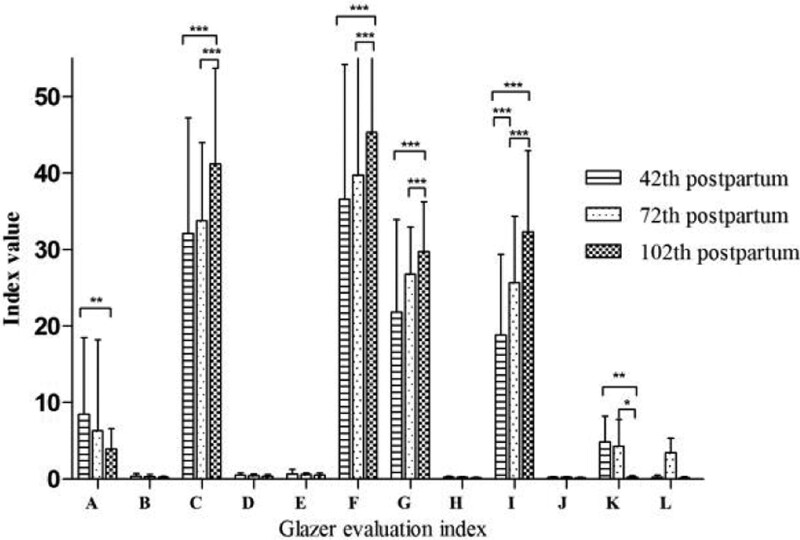
Except for the rest post-baseline stage values, the pelvic floor surface electromyography evaluation values significantly differed from each other at the considered time points in group A, P < .05; on day 72 in group B, no obvious improvement in the evaluation values was observed as than those on day 42 (P > .05) except for the endurance contractions stage values. However, on day 102, all values were markedly different at each considered time point (P < .05). On day 102 postpartum, the evaluation values of group A in the rest pre-baseline stage, the time before and after peak of phasic (flick) contractions stage, and the endurance contractions stage were significantly improved to those in group B with all P < .05. On day 42 after parturition, each index of the tonic contractions stage was higher after spontaneous labor than that after cesarean; the differences were all significant, P < .05, but on day 102 postpartum, all of the values exhibited no difference between the 2 modes. In only the phasic (flick) contractions stage at 42th, were the values of younger mothers obviously higher, P = .025; the other stage values for different ages of women during different time periods were not statistically significant, P > .05.
In the short term, the effect of biofeedback plus electrical stimulation on the PFM function in second pregnant women was better than that of the Kegel exercise, but with time, there was no significant difference between the 2 training methods on the recovery of the PFM.
通过检测产后 2 个月行盆底康复治疗后盆底肌(PFM)的电生理指标,了解产后 42 天第 2 胎产妇的 PFM 现状。
选择 2020 年 6 月 1 日至 12 月 10 日在我院分娩、产后 42 天门诊复查的第 2 胎产妇 198 例。
A 组各观察时间点的盆底表面肌电图评估值除静息后基线期值外,其余各值间比较差异均有统计学意义(P <0.05);B 组在第 72 天,除耐力收缩期评估值与第 42 天比较差异无统计学意义(P >0.05)外,其余各观察时间点评估值较前均无明显改善;而在第 102 天,各观察时间点的评估值均较前差异有统计学意义(P <0.05)。产后第 102 天,A 组静息后基线期、峰相(轻颤)收缩期前、后及耐力收缩期评估值均明显优于 B 组,差异均有统计学意义(P <0.05)。产后第 42 天,自然分娩产妇各时相收缩期的各项指标均高于剖宫产,差异均有统计学意义(P <0.05),但产后第 102 天,2 种分娩方式的各值间差异均无统计学意义。仅在第 42 天的峰相(轻颤)收缩期,年轻产妇的数值明显更高,P =0.025;不同年龄段的女性在不同时间的其他时相值差异均无统计学意义(P >0.05)。
短期内,生物反馈联合电刺激对第 2 胎产妇 PFM 功能的作用优于 Kegel 运动,但随着时间的推移,2 种训练方法对 PFM 恢复的效果无明显差异。