Healthcare Sciences and e-Health, Department of Women's and Children's Health, Uppsala University, Uppsala, Sweden.
Cancer Med. 2023 Mar;12(5):6225-6243. doi: 10.1002/cam4.5377. Epub 2022 Nov 20.
Parents of children treated for cancer may experience mental health difficulties, such as depression and anxiety. There is a lack of evidence-based psychological interventions for parents, with psychological support needs unmet. An internet-administered, guided, low-intensity cognitive behavioral therapy-based (LICBT) self-help intervention may provide a solution.
The feasibility and acceptability of such an intervention was examined using a single-arm feasibility trial (ENGAGE). Primary objectives examined: (1) estimates of recruitment and retention rates; (2) feasibility and acceptability of data collection instruments and procedures; and (3) intervention feasibility and acceptability. Clinical outcomes were collected at baseline, post-treatment (12 weeks), and follow-up (6 months).
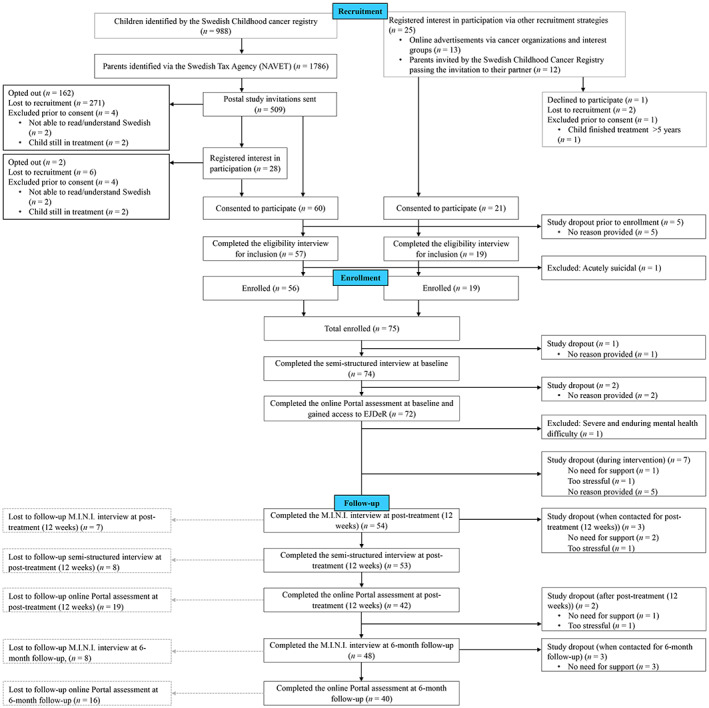
The following progression criteria were met: sample size was exceeded within 5 months, with 11.0% enrolled of total population invited, study dropout rate was 24.0%, intervention dropout was 23.6%, missing data remained at ≤10% per measure, and no substantial negative consequences related to participation were reported. Intervention adherence was slightly lower than progression criteria (47.9%).
Findings suggest an internet-administered, guided, LICBT self-help intervention may represent a feasible and acceptable solution for parents of children treated for cancer. With minor study protocol and intervention modifications, progression to a pilot randomized controlled trial (RCT) and subsequent superiority RCT is warranted.
接受癌症治疗的儿童的父母可能会经历心理健康问题,如抑郁和焦虑。针对父母的循证心理干预措施不足,心理支持需求未得到满足。基于认知行为疗法的互联网管理、指导、低强度自助干预可能是一种解决方案。
采用单臂可行性试验(ENGAGE)来检验这种干预措施的可行性和可接受性。主要目的是:(1)评估招募和保留率的估计值;(2)评估数据收集工具和程序的可行性和可接受性;(3)评估干预的可行性和可接受性。临床结果在基线、治疗后(12 周)和随访(6 个月)时收集。
达到了以下进展标准:在 5 个月内超过了样本量,总邀请人群中有 11.0%的人入组,研究脱落率为 24.0%,干预脱落率为 23.6%,每个测量指标的缺失数据仍保持在≤10%,且未报告与参与相关的实质性负面后果。干预依从性略低于进展标准(47.9%)。
研究结果表明,基于认知行为疗法的互联网管理、指导、低强度自助干预可能是癌症治疗儿童父母的可行且可接受的解决方案。只需对研究方案和干预措施进行微小修改,就可以推进到一项先导性随机对照试验(RCT)和随后的优越性 RCT。