Woodford Joanne, Wikman Anna, Cernvall Martin, Ljungman Gustaf, Romppala Amanda, Grönqvist Helena, von Essen Louise
Clinical Psychology in Healthcare, Department of Women's and Children's Health, Uppsala University, Uppsala, Sweden.
Paediatric Oncology, Department of Women's and Children's Health, Uppsala University, Uppsala, Sweden.
BMJ Open. 2018 Jun 14;8(6):e023708. doi: 10.1136/bmjopen-2018-023708.
A subgroup of parents of children previously treated for cancer report long-term psychological distress after end of treatment. However, needs for psychological support are commonly unmet and there is a lack of evidence-based treatments tailored to the specific needs of this population. An internet-administered, guided, cognitive-behavioural therapy-based, self-help intervention (ENGAGE) for parents of children previously treated for cancer may provide a solution. The aim is to examine the feasibility and acceptability of the intervention ENGAGE and the study procedures for a future controlled trial.
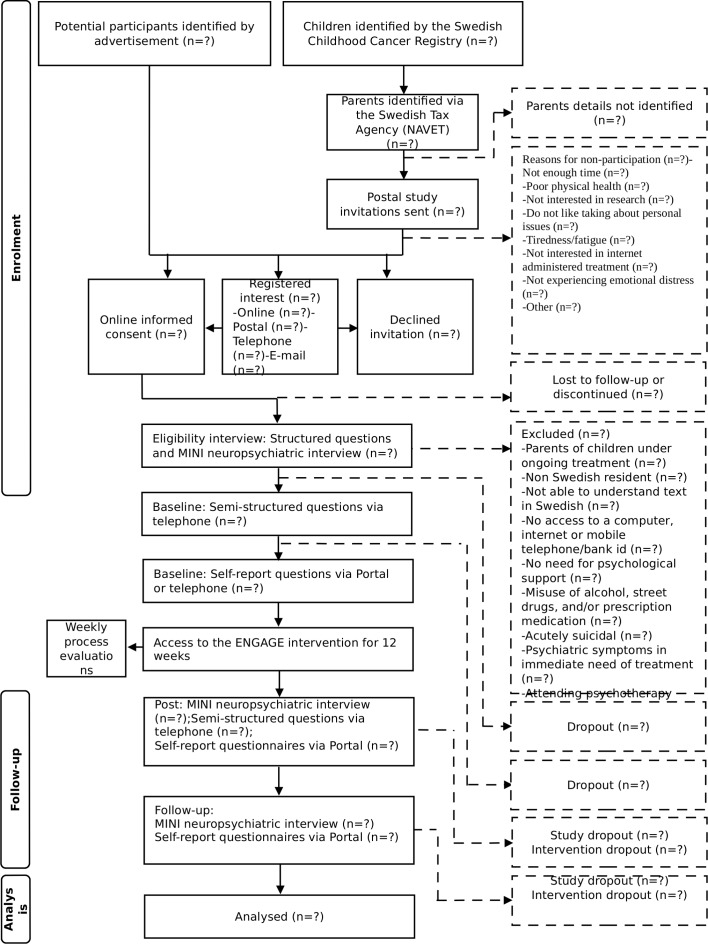
The study has an uncontrolled within-group design with an embedded qualitative and quantitative process evaluation. Potential participants are parents of children previously treated for cancer, living in Sweden, recruited via their child's personal identification number (via the Swedish Childhood Cancer Registry and the Swedish Tax Agency). Parents are invited randomly with information packs sent to home addresses. Further interest in participating can be registered via information on relevant websites. The study aims to recruit 50 parents who will receive the intervention ENGAGE which is designed to be delivered over a 10-week period, and comprises one introductory chapter followed by up to 10 intervention modules addressing key concerns identified for the population. Consistent with feasibility study objectives, primary outcomes relate to recruitment, attrition, data collection, study resources, intervention delivery and acceptability. Clinical outcomes (post-traumatic stress, depression, anxiety, fear of cancer recurrence, psychological inflexibility and experiential avoidance, depressed inactivity, fatigue, quality of life and self-compassion) will be measured at baseline, post-treatment (12 weeks) and 6-month follow-up.
The Regional Ethical Review Board in Uppsala, Sweden has granted approval for the study (Dnr: 2017/527). Results will be disseminated to relevant healthcare and patient communities, in peer-reviewed and popular science journals, and at scientific and clinical conferences.
ISRCTN57233429; Pre-results.
曾接受过癌症治疗的儿童的部分家长报告称,在治疗结束后长期存在心理困扰。然而,心理支持需求通常未得到满足,且缺乏针对这一人群特殊需求的循证治疗方法。一种基于认知行为疗法的、由互联网管理的、有指导的自助干预措施(ENGAGE)或许能为曾接受过癌症治疗的儿童的家长提供解决方案。目的是检验ENGAGE干预措施及未来对照试验的研究程序的可行性和可接受性。
本研究采用非对照的组内设计,并进行定性和定量的过程评估。潜在参与者为居住在瑞典、其子女曾接受过癌症治疗的家长,通过其子女个人身份号码(通过瑞典儿童癌症登记处和瑞典税务局)招募。随机向家长发送信息包至其家庭住址进行邀请。可通过相关网站上 的信息登记进一步参与意向。本研究旨在招募50名家长,他们将接受ENGAGE干预措施,该干预措施计划在10周内实施,包括一个介绍章节,随后有多达10个干预模块,涉及针对该人群确定的关键问题。与可行性研究目标一致,主要结局涉及招募、损耗、数据收集、研究资源、干预实施和可接受性。临床结局(创伤后应激、抑郁、焦虑、对癌症复发的恐惧、心理灵活性和经验性回避、抑郁性不活动、疲劳、生活质量和自我同情)将在基线、治疗后(12周)和6个月随访时进行测量。
瑞典乌普萨拉地区伦理审查委员会已批准本研究(编号:2017/527)。研究结果将在同行评审和科普期刊以及科学和临床会议上向相关医疗保健和患者群体传播。
ISRCTN57233429;预结果。