Dirirsa Dejene Edosa, Awol Salo Mukemil, Gudeta Mogos Beya, Kelbessa Merga Eticha, Lammi Mengistu Bekele
Department of Midwifery, College of Health and Medical Sciences, Salale University, Fiche, Ethiopia.
Department of Midwifery, College of Health and Medical Sciences, Kotebe University of Education, Addis Ababa, Ethiopia.
SAGE Open Med. 2022 Nov 14;10:20503121221136763. doi: 10.1177/20503121221136763. eCollection 2022.
This study aimed to identify the determinants of early discontinuation of long-acting and reversible contraceptive methods among women within childbearing age in Ethiopia, 2019.
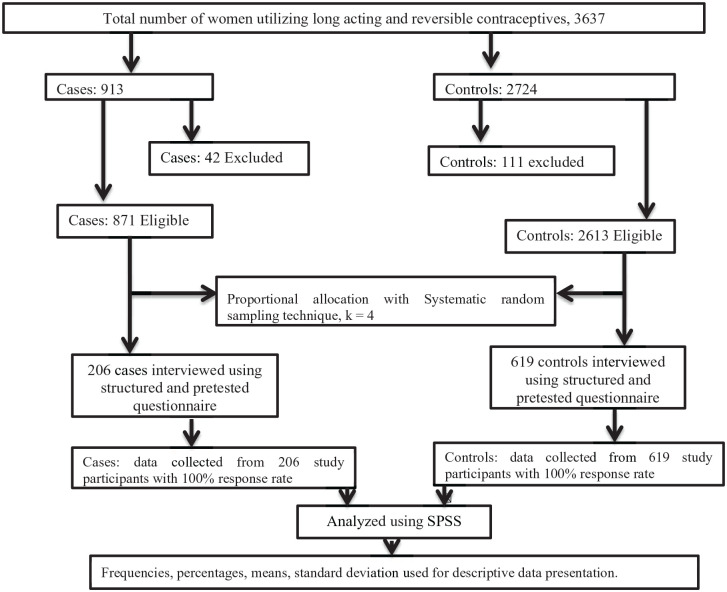
The institutional-based case-control study design was implemented from June to August 2019. Eligible study participants were sampled using systematic random sampling technique. Data were collected using structured and pre-tested questionnaire and entered into Epi Info and exported to SPSS version 20 for further analysis. All variables with a p value of <0.05 at odds ratio of 95% confidence interval in multivariable logistic regression analysis were considered as determinants of early discontinuation of long-acting and reversible contraceptive methods.
A total of 825 study participants (206 cases and 619 controls) were included in the study. Decision-making on the use of contraception (adjusted odds ratio: 4.8, 95% confidence interval: 1.4-16.8 and adjusted odds ratio: 5.6, 95% confidence interval: 1.7-18.8), the women who got counseled about side effects of contraceptive methods being 84% less likely to discontinue long-acting and reversible contraceptive methods compared to the women of their counterpart (adjusted odds ratio: 0.16, 95% confidence interval: 0.15-0.4), having two or more children (adjusted odds ratio: 10, 95% confidence interval: 3.7-28), and desire to be pregnant (adjusted odds ratio = 0.15 95% confidence interval: 0.06-0.4) were determinants of early discontinuation of long-acting and reversible contraceptive methods.
According to the findings of this study, decision-maker on utilization of contraceptive methods, being counseled on side effects of contraception, number of children, and desire of woman to be pregnant were found to be determinants of discontinuation of long-acting and reversible contraceptive methods. Health care providers should strengthen providing pre-insertion counseling in accordance with the national guideline for family planning services, with an emphasis on potential contraceptive side effects and consideration of counseling on decision-making.
本研究旨在确定2019年埃塞俄比亚育龄妇女中长效可逆避孕方法早期停用的决定因素。
2019年6月至8月实施了基于机构的病例对照研究设计。使用系统随机抽样技术对符合条件的研究参与者进行抽样。通过结构化且经过预测试的问卷收集数据,并录入Epi Info,然后导出到SPSS 20版本进行进一步分析。在多变量逻辑回归分析中,所有在95%置信区间比值比下p值<0.05的变量均被视为长效可逆避孕方法早期停用的决定因素。
本研究共纳入825名研究参与者(206例病例和619例对照)。避孕使用决策(调整后比值比:4.8,95%置信区间:1.4 - 16.8;调整后比值比:5.6,95%置信区间:1.7 - 18.8),与未接受避孕方法副作用咨询的女性相比,接受过避孕方法副作用咨询的女性停用长效可逆避孕方法的可能性降低84%(调整后比值比:0.16,95%置信区间:0.15 - 0.4),生育两个或更多子女(调整后比值比:10,95%置信区间:3.7 - 28),以及怀孕意愿(调整后比值比 = 0.15,95%置信区间:0.06 - 0.4)是长效可逆避孕方法早期停用的决定因素。
根据本研究结果,避孕方法的使用决策者、接受避孕副作用咨询情况、子女数量以及女性的怀孕意愿是长效可逆避孕方法停用的决定因素。医疗保健提供者应按照国家计划生育服务指南加强提供插入前咨询,重点关注潜在的避孕副作用并考虑决策咨询。