Zhang Zhuolin, Jiang Yiling, Li Xue, Shi Dandan, Ma Ting, Zhou Ruolin, Zhang Caixia
Department of Epidemiology, School of Public Health, Sun Yat-sen University, Guangzhou, China.
Guangdong Provincial Key Laboratory of Food, Nutrition and Health, School of Public Health, Sun Yat-sen University, Guangzhou, China.
Front Nutr. 2022 Nov 3;9:990755. doi: 10.3389/fnut.2022.990755. eCollection 2022.
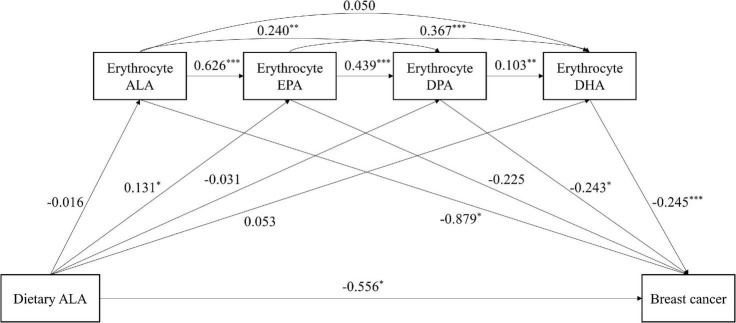
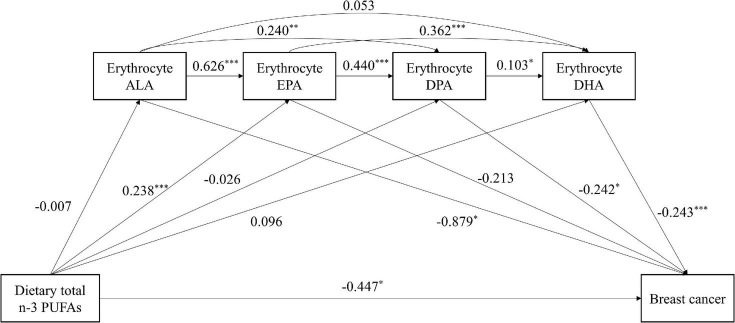
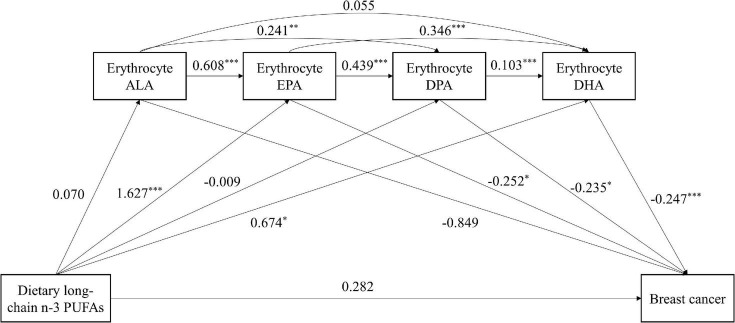
Dietary 3 polyunsaturated fatty acids (PUFAs) were found to be inversely associated with breast cancer risk; however, the underlying pathways between them remain uncertain. We aimed to explore serial mediatory roles of erythrocyte 3 PUFAs in association between dietary 3 PUFAs and breast cancer risk.
Using a case-control study, 850 cases and 861 controls completed structured questionnaires with dietary information. Erythrocyte 3 PUFAs were measured by gas chromatography. Odds ratios (ORs) and 95% confidence intervals (CIs) were obtained using multiple unconditional logistic regression models to examine association between dietary 3 PUFAs and breast cancer risk. Mediation analyses with bootstrapping were conducted to investigate indirect effects.
Higher intake of dietary ALA, long-chain 3 PUFAs and total 3 PUFAs was associated with lower risk of breast cancer. The adjusted OR (95% CI) was 0.70 (0.55, 0.90) for ALA, 0.76 (0.60, 0.97) for long-chain 3 PUFAs and 0.74 (0.58, 0.94) for total 3 PUFAs, respectively. Mediation analysis showed that erythrocyte long-chain 3 PUFAs served as sequential mediators in the relationship between dietary long-chain or total 3 PUFAs and breast cancer risk. In particular, erythrocyte long-chain 3 PUFAs completely mediated the association between dietary long-chain 3 PUFAs and breast cancer risk [indirect effect (95% CI) = -0.982 (-1.529, -0.508)]. The relationship between dietary total 3 PUFAs and breast cancer risk was partly mediated by erythrocyte long-chain 3 PUFAs [indirect effect (95% CI) = -0.107 (-0.216, -0.014)], accounting for 19.31%. However, the serial mediation model in dietary ALA and risk of breast cancer was not statistically significant [indirect effect (95% CI) = -0.042 (-0.144, 0.049)].
This study highlights the complexity and inaccuracy in using a simple analysis of individual dietary 3 PUFAs to examine their associations with breast cancer risk without considering the variety of metabolic processes. Interventions aimed at increasing erythrocyte long-chain 3 PUFAs may represent a promising strategy for breast cancer prevention.
膳食中的ω-3多不饱和脂肪酸(PUFAs)被发现与乳腺癌风险呈负相关;然而,它们之间的潜在途径仍不明确。我们旨在探讨红细胞ω-3 PUFAs在膳食ω-3 PUFAs与乳腺癌风险关联中的系列中介作用。
采用病例对照研究,850例病例和861例对照完成了包含饮食信息的结构化问卷。通过气相色谱法测定红细胞ω-3 PUFAs。使用多个无条件逻辑回归模型获得比值比(ORs)和95%置信区间(CIs),以检验膳食ω-3 PUFAs与乳腺癌风险之间的关联。进行了带有自抽样法的中介分析以研究间接效应。
较高的膳食α-亚麻酸(ALA)、长链ω-3 PUFAs和总ω-3 PUFAs摄入量与较低的乳腺癌风险相关。ALA的调整后OR(95%CI)为0.70(0.55,0.90),长链ω-3 PUFAs为0.76(0.60,0.97),总ω-3 PUFAs为0.74(0.58,0.94)。中介分析表明,红细胞长链ω-3 PUFAs在膳食长链或总ω-3 PUFAs与乳腺癌风险的关系中起系列中介作用。特别是,红细胞长链ω-3 PUFAs完全介导了膳食长链ω-3 PUFAs与乳腺癌风险之间的关联[间接效应(95%CI)=-0.982(-1.529,-0.508)]。膳食总ω-3 PUFAs与乳腺癌风险之间的关系部分由红细胞长链ω-3 PUFAs介导[间接效应(95%CI)=-0.107(-0.216,-0.014)],占19.31%。然而,膳食ALA与乳腺癌风险的系列中介模型无统计学意义[间接效应(95%CI)=-0.042(-0.144,0.049)]。
本研究强调了在不考虑各种代谢过程的情况下,使用简单的个体膳食ω-3 PUFAs分析来检验其与乳腺癌风险关联的复杂性和不准确性。旨在增加红细胞长链ω-3 PUFAs的干预措施可能是预防乳腺癌的一种有前景的策略。