Sainz-Santamaria Jaime, Moctezuma Daniela, Martinez-Cruz Adan L, Téllez Eric S, Graff Mario, Miranda-Jiménez Sabino
Department of Public Administration, Centro de Investigacion y Docencia Economicas (CIDE) Sede Región Centro, Aguascalientes, Mexico.
Laboratorio Nacional de GeoInteligencia Territorial, Centro de Investigación en Ciencias de Información Geoespacial (CentroGEO), Aguascalientes, Mexico.
Cities. 2023 Jan;132:104094. doi: 10.1016/j.cities.2022.104094. Epub 2022 Nov 10.
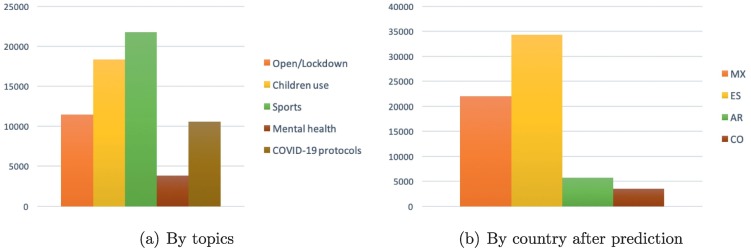
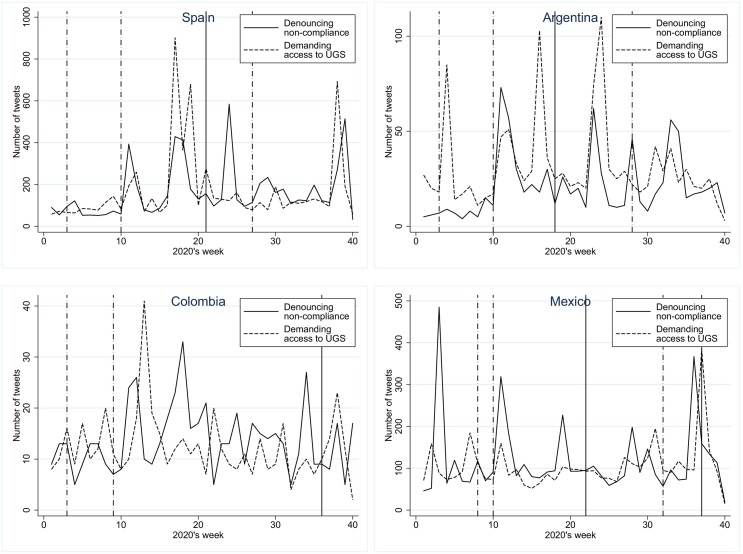
Positive sentiments towards urban green spaces (UGS) unequivocally increased worldwide amid COVID-19. In contrast, this paper documents that views on mobility restrictions applicable to UGS are of a contested nature. That is, while residents unambiguously report positive sentiments towards UGS, they do not share views on how to administer access to UGS-which is a matter of public policy. These contesting views reflect opposite demands that managers of UGS had to balance during the pandemic as they faced the challenge of reducing risk of spread while providing services that support physical and mental health of residents. The empirical analysis in this paper relies on views inferred through a text classification algorithm implemented on Twitter messages posted from January to October 2020, by urban residents in three Latin American countries-Argentina, Colombia, and Mexico-and Spain. The focus on Latin America is motivated by the documented lack of compliance with mobility restrictions; Spain works as a comparison point to learn differences with respect to other regions. Understanding and following in real-time the evolution of contesting views amid a pandemic is useful for managers and city planners to inform adaptation measures-e.g. communication strategies can be tailored to residents with specific views.
在新冠疫情期间,全球范围内对城市绿地(UGS)的积极情绪无疑有所增加。相比之下,本文记录了对适用于城市绿地的流动限制的看法具有争议性。也就是说,虽然居民明确表达了对城市绿地的积极情绪,但他们对于如何管理城市绿地的使用并没有达成一致看法——这是一个公共政策问题。这些相互矛盾的观点反映了城市绿地管理者在疫情期间必须平衡的相反需求,因为他们面临着降低传播风险的挑战,同时还要提供支持居民身心健康的服务。本文的实证分析依赖于通过对2020年1月至10月期间阿根廷、哥伦比亚、墨西哥这三个拉丁美洲国家以及西班牙的城市居民在推特上发布的消息实施文本分类算法推断出的观点。对拉丁美洲的关注是由于有记录表明该地区存在对流动限制的不遵守情况;西班牙作为一个比较点,用于了解与其他地区的差异。在疫情期间实时了解和跟踪相互矛盾观点的演变,有助于管理者和城市规划者制定适应措施——例如,可以针对持有特定观点的居民量身定制沟通策略。