Sainz-Santamaria Jaime, Martinez-Cruz Adan L
Department of Public Administration, Centro de Investigacion y Docencia Economicas (CIDE), Mexico.
Department of Forest Economics and Centre for Environmental and Resource Economics (CERE), Swedish University of Agricultural Sciences (SLU), Sweden.
Urban For Urban Green. 2022 Aug;74:127629. doi: 10.1016/j.ufug.2022.127629. Epub 2022 Jun 7.
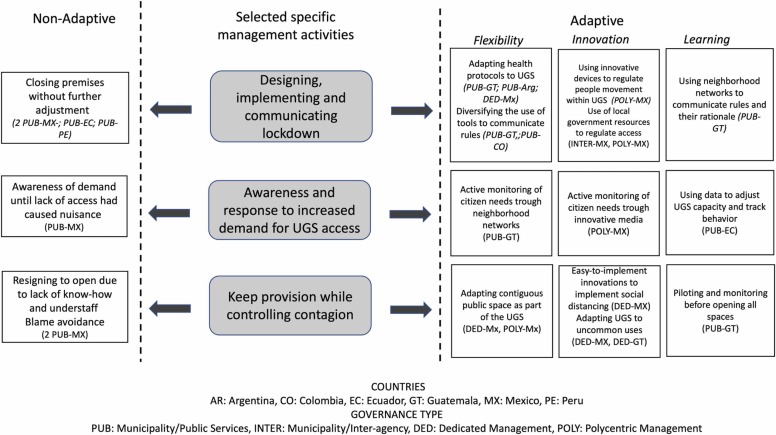
Urban green spaces' well documented role as a hub for physical and mental health was enhanced by restrictions to mobility issued worldwide as a response to COVID-19. In this context, managers of urban green spaces (UGS) were prompted to provide controlled access under safety protocols. This unprecedented challenge required planning and operational strengths reflecting flexibility, innovation and learning. These management features are essential for an adaptive governance - an underdeveloped research topic within the study of UGS. Using eighteen semi-structured interviews from six countries, we analyze adaptive governance as reflected by UGS managers' responses across Latin America - a region where access to UGS is a matter of public health and of environmental justice. We document responses that can be categorized based on the governance arrangement in place. On one hand, both polycentric and dedicated-management governances have been able to learn through piloting ideas, adapting personnel roles and the function of UGS infrastructure, and adjusting their decision-making process. On the other hand, managers within municipal public services areas - the most prevalent governance arrangement across Latin America - report difficulty to adapt - likely due to their dependence on political will, limited autonomy, insufficient budgets, absence of formal paths to self-funding, shortage of technical know-how, and insufficient citizens' involvement. We discuss implications of UGS adaptive governance in terms of capacity to deal with future public health, climate-related or other types of shocks.
城市绿地作为身心健康枢纽的作用已有充分记载,而全球范围内因应对新冠疫情而实施的出行限制进一步强化了这一作用。在此背景下,城市绿地管理者被要求在安全协议下提供可控进入。这一前所未有的挑战需要具备反映灵活性、创新性和学习能力的规划和运营优势。这些管理特征对于适应性治理至关重要,而适应性治理是城市绿地研究中一个尚未充分发展的研究课题。通过对来自六个国家的18次半结构化访谈,我们分析了拉丁美洲城市绿地管理者的回应所反映出的适应性治理,在该地区,进入城市绿地关乎公共卫生和环境正义。我们记录了可根据现有治理安排进行分类的回应。一方面,多中心治理和专门管理治理都能够通过试点想法、调整人员角色和城市绿地基础设施功能以及调整决策过程来进行学习。另一方面,市政公共服务领域的管理者——拉丁美洲最普遍的治理安排——报告称难以适应,这可能是由于他们依赖政治意愿、自主权有限、预算不足、缺乏自筹资金的正式途径、技术知识短缺以及公民参与不足。我们从应对未来公共卫生、气候相关或其他类型冲击的能力方面讨论了城市绿地适应性治理的影响。