Albaker Waleed I, Al-Hariri Mohammed T, Al Elq Abdulmohsen H, Alomair Nuhad A, Alamoudi Ahmed S, Voutchkov Nikalay, Ihm Seungwon, Namazi Mohammed A, Alsayyah Ahmed A, AlRubaish Fatima A, Alohli Fadwa T, Zainuddin Fatma A, Alobaidi Anwar A, Almuzain Fatimah A, Elamin Mohamed O, Alamoudi Naela B, Alamer Mashael A, Alghamdi Abdulrahman A, AlRubaish Nafie A
Department of Internal Medicine, College of Medicine, Imam Abdulrahman Bin Faisal University, Dammam, Eastern Province Saudi Arabia.
Department of Physiology, College of Medicine, Imam Abdulrahman Bin Faisal University, Dammam, Eastern Province Saudi Arabia.
NPJ Clean Water. 2022;5(1):63. doi: 10.1038/s41545-022-00207-9. Epub 2022 Nov 12.
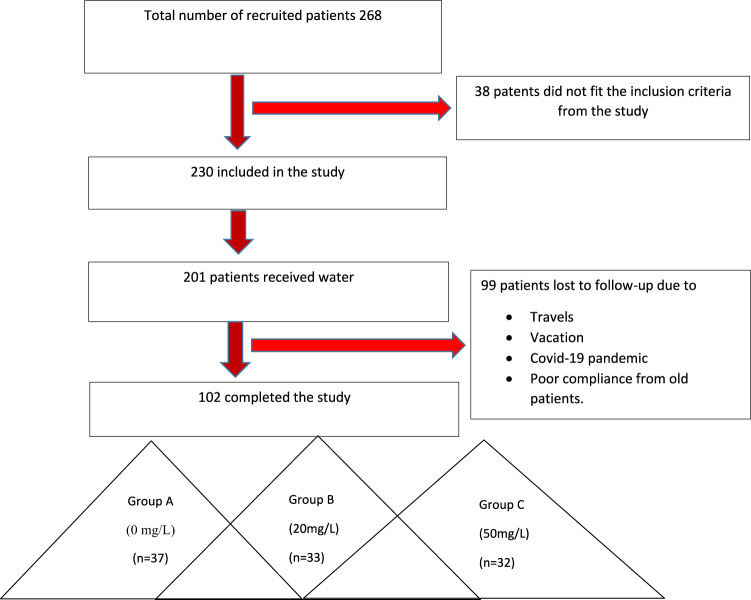
There is evidence that increasing the consumption of water containing magnesium can improve glucose metabolism and insulin resistance in patients with type 2 diabetes mellitus (T2DM). This trial was undertaken with the objective of evaluating the effect of adding different concentrations of magnesium chloride to the desalinated drinking water on the glycemic, metabolic, and insulin resistance parameters among patients with T2DM. A randomized cross-sectional controlled clinical trial was conducted to evaluate the effects of adding magnesium chloride supplement to desalinated drinking water consumed by patients with T2DM on the glycemic and metabolic parameters and indicators of insulin sensitivity. The total number of patients with T2DM who successfully completed the trial is 102. Patients were randomly allocated into three groups: the first group received bottled water without added magnesium (0 mg/L) (Group A, = 37); the second group received bottled water with a low level of magnesium (20 mg/L) (Group B, = 33); and the third group received drinking water with a high level of magnesium (50 mg/L) (Group C, = 32). The daily consumption of elemental magnesium for a period of 3 months resulted in significant improvement in HbA1C (8.0 vs 8.2%, = 0.04), insulin level (7.5 vs 9.9 μIU/mL, = 0.03), and homeostasis model assessment-estimated insulin resistance (HOMA.IR) (2.5 vs 2.9, = 0.002) in group C. However, there was no significant improvement in fasting blood glucose (FBS) level or lipid profile. The results of this study suggest that oral magnesium supplementation at the given dose of 50 mg/L daily added to drinking water could improve long-term glycemic control indicators and reduce insulin resistance in patients with T2DM.
有证据表明,增加含镁水的摄入量可改善2型糖尿病(T2DM)患者的葡萄糖代谢和胰岛素抵抗。本试验旨在评估向淡化饮用水中添加不同浓度的氯化镁对T2DM患者血糖、代谢和胰岛素抵抗参数的影响。进行了一项随机横断面对照临床试验,以评估向T2DM患者饮用的淡化饮用水中添加氯化镁补充剂对血糖和代谢参数以及胰岛素敏感性指标的影响。成功完成试验的T2DM患者总数为102例。患者被随机分为三组:第一组饮用未添加镁(0 mg/L)的瓶装水(A组,n = 37);第二组饮用低镁水平(20 mg/L)的瓶装水(B组,n = 33);第三组饮用高镁水平(50 mg/L)的饮用水(C组,n = 32)。为期3个月的每日元素镁摄入量使C组的糖化血红蛋白(HbA1C)(8.0%对8.2%,P = 0.04)、胰岛素水平(7.5对9.9 μIU/mL,P = 0.03)和稳态模型评估估计的胰岛素抵抗(HOMA-IR)(2.5对2.9,P = 0.002)有显著改善。然而,空腹血糖(FBS)水平或血脂谱没有显著改善。本研究结果表明,每天在饮用水中添加50 mg/L的口服镁补充剂可改善T2DM患者的长期血糖控制指标并降低胰岛素抵抗。