Department of Epidemiology, Boston University School of Public Health, Boston, Massachusetts.
Slone Epidemiology Center at Boston University, Boston, Massachusetts.
Cancer Epidemiol Biomarkers Prev. 2023 Jul 5;32(7):927-935. doi: 10.1158/1055-9965.EPI-22-0808.
Animal and experimental studies suggest circadian disruption increases colorectal cancer risk, but evidence in humans is limited. We examined night shift work, chronotype, and residential position within a time zone, proxies for circadian disruption, in relation to colorectal cancer risk.
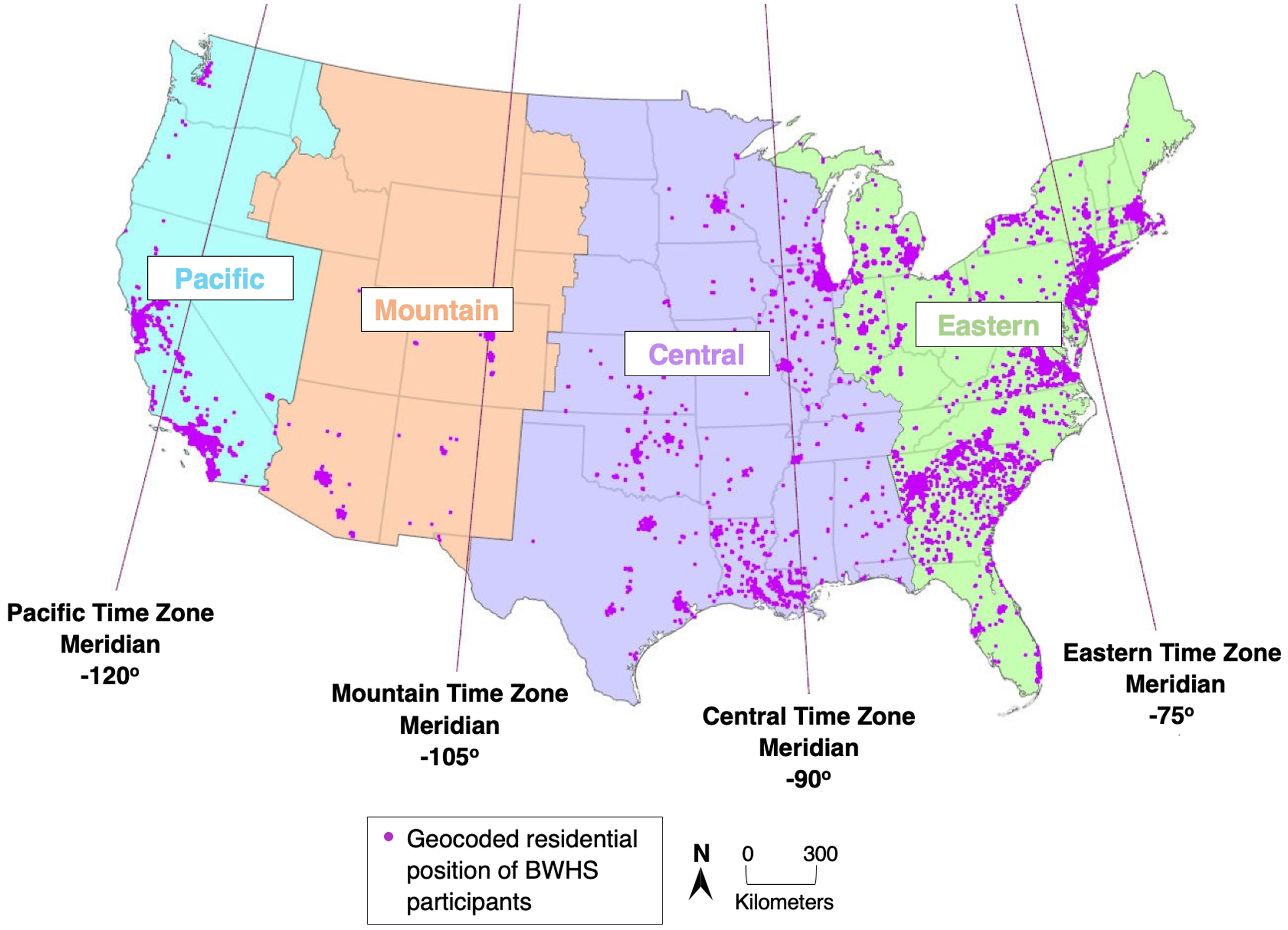
Participants in the Black Women's Health Study, a prospective cohort of 59,000 Black American women established in 1995, reported history of night shift work and chronotype on follow-up questionnaires. Residential position within a time zone was estimated using participant addresses at each questionnaire cycle. Number of colorectal cancer cases and follow-up duration varied by analysis depending on timing of exposure assessment, ranging from 204 over the 2005 to 2018 night shift work study period to 452 over the 1995 to 2018 residential position study period. Cox proportional hazards regression was used to estimate multivariable-adjusted HRs and 95% confidence intervals (CI).
Compared with never having worked a night shift, working a night shift for ≥10 years was associated with increased colorectal cancer risk (HR = 1.64; 95% CI, 1.01-2.66). However, shorter duration was not. The HR for evening versus morning chronotype was 0.96 (95% CI, 0.73-1.27). Westward position of residence within a time zone was not associated with colorectal cancer risk (HR per 5-degree longitude increase: 0.92; 95% CI, 0.82-1.03).
Our findings suggest a possible increased risk of colorectal cancer associated with long duration night shift work; however, results require confirmation in larger studies.
Circadian disruption from long-term night shift work may contribute to colorectal cancer development in Black women.
动物和实验研究表明,昼夜节律紊乱会增加结直肠癌的风险,但人类的证据有限。我们研究了夜班工作、昼夜节律类型和时区内的居住位置,这些都是昼夜节律紊乱的替代指标,与结直肠癌风险的关系。
黑人女性健康研究(Black Women's Health Study)是一项前瞻性队列研究,纳入了 1995 年建立的 59000 名美国黑人女性,参与者在随访问卷中报告了夜班工作和昼夜节律类型的历史。时区内的居住位置是根据每个问卷周期的参与者地址来估计的。根据暴露评估的时间,结直肠癌病例数和随访时间有所不同,从 2005 年至 2018 年夜班工作研究期间的 204 例到 1995 年至 2018 年居住位置研究期间的 452 例不等。使用 Cox 比例风险回归估计多变量调整后的 HR 和 95%置信区间(CI)。
与从未上过夜班相比,上夜班≥10 年与结直肠癌风险增加相关(HR=1.64;95%CI,1.01-2.66)。然而,较短的持续时间则没有。夜间型与早晨型昼夜节律类型相比,HR 为 0.96(95%CI,0.73-1.27)。时区内居住位置向西移动与结直肠癌风险无关(每增加 5 度经度,HR 为 0.92;95%CI,0.82-1.03)。
我们的研究结果表明,长期夜班工作可能与结直肠癌风险增加有关;然而,这些结果需要在更大的研究中得到证实。
长期夜班工作引起的昼夜节律紊乱可能导致黑人女性结直肠癌的发生。