Univ Lyon, CNRS, INSA Lyon, Université Claude Bernard Lyon 1, Ecole Centrale de Lyon, Ampère, UMR5005, 69134 Ecully, France.
ISME J. 2023 Feb;17(2):309-314. doi: 10.1038/s41396-022-01341-5. Epub 2022 Nov 21.
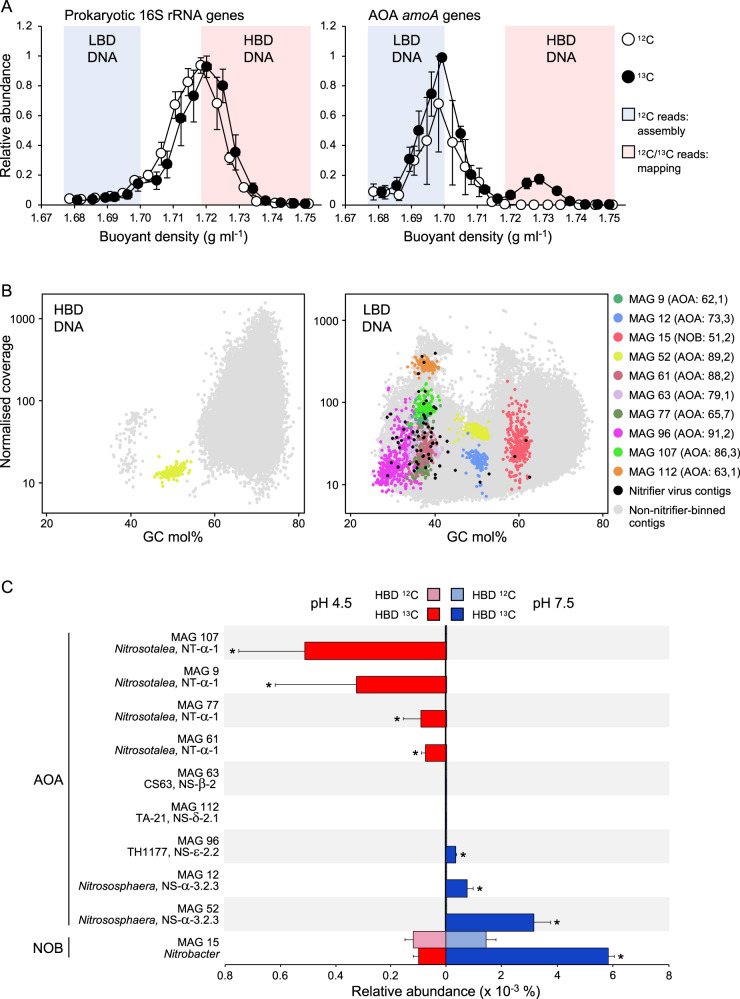
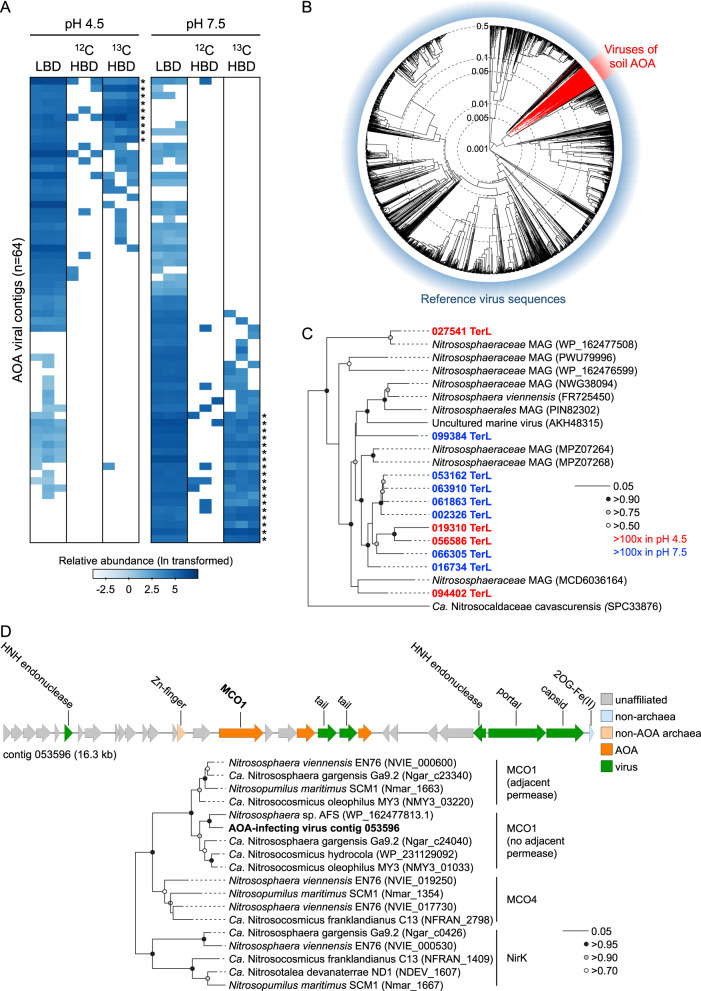
Ammonia-oxidising archaea (AOA) are a ubiquitous component of microbial communities and dominate the first stage of nitrification in some soils. While we are beginning to understand soil virus dynamics, we have no knowledge of the composition or activity of those infecting nitrifiers or their potential to influence processes. This study aimed to characterise viruses having infected autotrophic AOA in two nitrifying soils of contrasting pH by following transfer of assimilated CO-derived C from host to virus via DNA stable-isotope probing and metagenomic analysis. Incorporation of C into low GC mol% AOA and virus genomes increased DNA buoyant density in CsCl gradients but resulted in co-migration with dominant non-enriched high GC mol% genomes, reducing sequencing depth and contig assembly. We therefore developed a hybrid approach where AOA and virus genomes were assembled from low buoyant density DNA with subsequent mapping of C isotopically enriched high buoyant density DNA reads to identify activity of AOA. Metagenome-assembled genomes were different between the two soils and represented a broad diversity of active populations. Sixty-four AOA-infecting viral operational taxonomic units (vOTUs) were identified with no clear relatedness to previously characterised prokaryote viruses. These vOTUs were also distinct between soils, with 42% enriched in C derived from hosts. The majority were predicted as capable of lysogeny and auxiliary metabolic genes included an AOA-specific multicopper oxidase suggesting infection may augment copper uptake essential for central metabolic functioning. These findings indicate virus infection of AOA may be a frequent process during nitrification with potential to influence host physiology and activity.
氨氧化古菌 (AOA) 是微生物群落中普遍存在的组成部分,在一些土壤中主导硝化作用的第一阶段。虽然我们开始了解土壤病毒动态,但我们对感染硝化生物的病毒的组成或活性及其潜在影响过程一无所知。本研究旨在通过 DNA 稳定同位素探针和宏基因组分析,追踪从宿主到病毒的同化 CO 衍生 C 的转移,来描述两种 pH 不同的硝化土壤中感染自养 AOA 的病毒。C 掺入低 GC mol% AOA 和病毒基因组会增加 CsCl 梯度中 DNA 的浮力密度,但会与占主导地位的非富集高 GC mol%基因组共同迁移,从而降低测序深度和连续组装。因此,我们开发了一种混合方法,即从低浮力密度 DNA 组装 AOA 和病毒基因组,然后将 C 同位素富集的高浮力密度 DNA 读取映射到识别 AOA 活性。两种土壤之间的宏基因组组装基因组不同,代表了广泛的活性种群。鉴定出 64 种感染 AOA 的病毒分类操作单元 (vOTU),与先前表征的原核病毒没有明显的亲缘关系。这些 vOTU 也在土壤之间存在差异,其中 42% 来自宿主的 C 得到了富集。大多数预测为溶原性,辅助代谢基因包括一种 AOA 特异性多铜氧化酶,表明感染可能会增强硝化作用中对中央代谢功能至关重要的铜摄取。这些发现表明,AOA 的病毒感染可能是硝化作用过程中的一个常见过程,具有影响宿主生理学和活性的潜力。