Department of Brain Sciences, Weizmann Institute of Science, Rehovot 76100, Israel.
Department of Brain Sciences, Weizmann Institute of Science, Rehovot 76100, Israel.
Cell Rep. 2022 Nov 22;41(8):111695. doi: 10.1016/j.celrep.2022.111695.
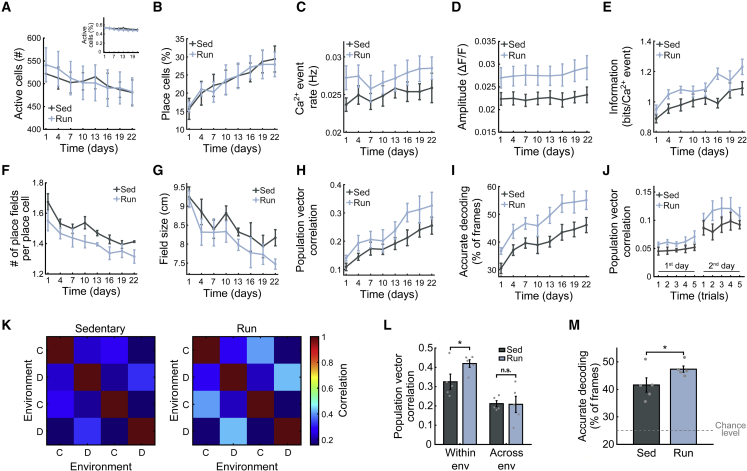
Physical exercise is known to augment brain functioning, improving memory and cognition. However, while some of the physiological effects of physical activity on the brain are known, little is known about its effects on the neural code. Using calcium imaging in freely behaving mice, we study how voluntary exercise affects the quality and long-term stability of hippocampal place codes. We find that running accelerates the emergence of a more informative spatial code in novel environments and increases code stability over days and weeks. Paradoxically, although runners demonstrated an overall more stable place code than their sedentary peers, their place code changed faster when controlling for code quality level. A model-based simulation shows that the combination of improved code quality and faster representational drift in runners, but neither of these effects alone, could account for our results. Thus, exercise may enhance hippocampal function via a more informative and dynamic place code.
体育锻炼已知可以增强大脑功能,改善记忆力和认知能力。然而,虽然人们已经了解了身体活动对大脑的一些生理影响,但对其对神经编码的影响却知之甚少。本研究利用自由活动的小鼠的钙成像技术,研究了自愿运动如何影响海马体位置编码的质量和长期稳定性。我们发现,跑步可以加速在新环境中形成更具信息量的空间编码,并在数天和数周内提高编码稳定性。矛盾的是,尽管跑步者的位置编码比久坐不动的同伴总体上更稳定,但在控制编码质量水平后,他们的位置编码变化更快。基于模型的模拟表明,跑步者的编码质量提高和表示漂移速度加快的结合,而不是这两种效果中的任何一种,都可以解释我们的结果。因此,运动可能通过更具信息量和动态的位置编码来增强海马体功能。