School of Public Health, Shanghai Jiao Tong University School of Medicine, Shanghai, China.
Kunshan Huaqiao People's Hospital, Kunshan, China.
Front Public Health. 2022 Nov 7;10:990620. doi: 10.3389/fpubh.2022.990620. eCollection 2022.
To introduce patient-centered approach in China and to relate it with Chinese patient satisfaction validating the Chinese version of Patient-Professional Interaction Questionnaire (PPIQ-C).
This cross-sectional survey was conducted through face-to-face interviews from June to September in 2019. Participants rated their patient-centered care experience the 16-item translated PPIQ, their experience of the received medical service, and their overall satisfaction.
Kunshan Huaqiao People's Hospital in Jiangsu, China.
A total of 230 participants (87 males and 143 females; 108 outpatients and 122 inpatients).
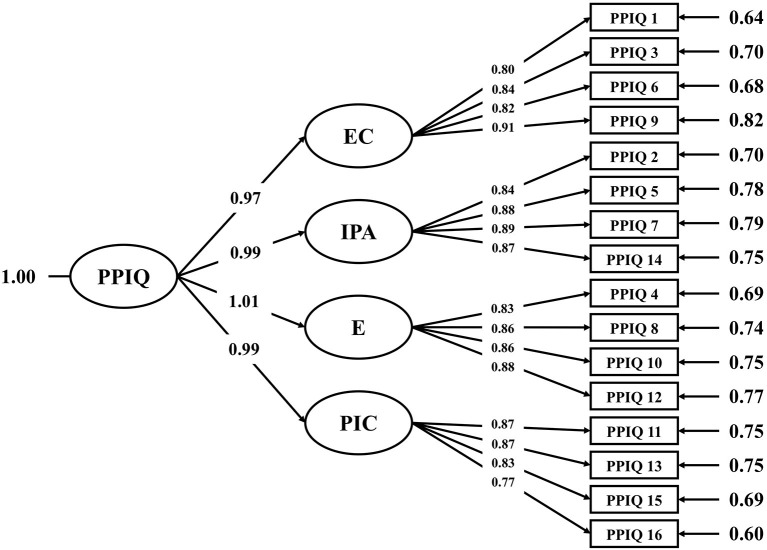
PPIQ-C exhibited acceptable psychometric properties. Data revealed a single factor model of the 16 PPIQ-C items [ = 12.394, = 0.823, CFI = 1.000, TLI = 1.019, RMSEA = 0.000, SRMR = 0.032] had a superior model fit over the original first-order with four correlated factors and the second-order structures. The overall reliability was excellent (McDonald's ω = 0.975). In terms of patient satisfaction, process, treatment quality, and communication significantly predicted patient satisfaction, while environment, staff attitude, and medical ethics did not [ = 0.427, = 24.887, < 0.001]. Most importantly, the total score of PPIQ-C predicted patient satisfaction above and beyond the above-mentioned medical service perspectives ( = 0.595, = 0.207, = 0.004). Finally, the constructive effect of PCC on patient satisfaction was stronger for departments of Pediatrics than Surgery.
The Chinese version of the PPIQ scale (PPIQ-C) exhibited acceptable psychometric properties. Yet the distinction among the four factors was not supported, suggesting potential difference(s) across cultures. Patient-centered care (PCC), reflected by the overall PPIQ-C score, predicted overall patient satisfaction above and beyond other medical service perspectives. Adopting PCC approach in appropriate situations will probably advance the development of performance evaluation systems in China, thus improving the overall health care and patient satisfaction.
介绍中国以患者为中心的方法,并将其与中国患者满意度相关联,同时验证患者-专业人员互动问卷(PPIQ-C)的中文版。
这是一项横断面调查,于 2019 年 6 月至 9 月通过面对面访谈进行。参与者对他们的以患者为中心的护理体验(经过翻译的 16 项 PPIQ)、他们对所接受医疗服务的体验以及他们的整体满意度进行了评分。
中国江苏昆山华侨医院。
共有 230 名参与者(男性 87 名,女性 143 名;门诊患者 108 名,住院患者 122 名)。
PPIQ-C 表现出可接受的心理测量特性。数据显示,16 项 PPIQ-C 项目的单因素模型[ = 12.394, = 0.823,CFI = 1.000,TLI = 1.019,RMSEA = 0.000,SRMR = 0.032]优于原始一阶四因素相关和二阶结构,模型拟合度更高。整体信度极佳(McDonald's ω = 0.975)。就患者满意度而言,过程、治疗质量和沟通显著预测了患者满意度,而环境、员工态度和医疗道德则没有( = 0.427, = 24.887, < 0.001)。最重要的是,PPIQ-C 的总分预测患者满意度高于上述医疗服务视角( = 0.595, = 0.207, = 0.004)。最后,以患者为中心的护理(PCC)对儿科部门患者满意度的构建效果强于外科部门。
患者-专业人员互动问卷(PPIQ)的中文版(PPIQ-C)具有可接受的心理测量特性。然而,四个因素之间的区别并不支持,这表明文化之间存在潜在差异。以患者为中心的护理(PCC),由整个 PPIQ-C 评分反映,在预测整体患者满意度方面优于其他医疗服务视角。在适当的情况下采用以患者为中心的方法可能会促进中国绩效评估体系的发展,从而提高整体医疗保健和患者满意度。