School of Biological Sciences & Engineering, Yachay Tech University, Urcuquí 100119, Ecuador.
Colegio de Ciencias e Ingenierías, Universidad San Francisco de Quito (USFQ), Departamento de Ingeniería Química, Quito 170901, Ecuador.
Molecules. 2022 Nov 18;27(22):7999. doi: 10.3390/molecules27227999.
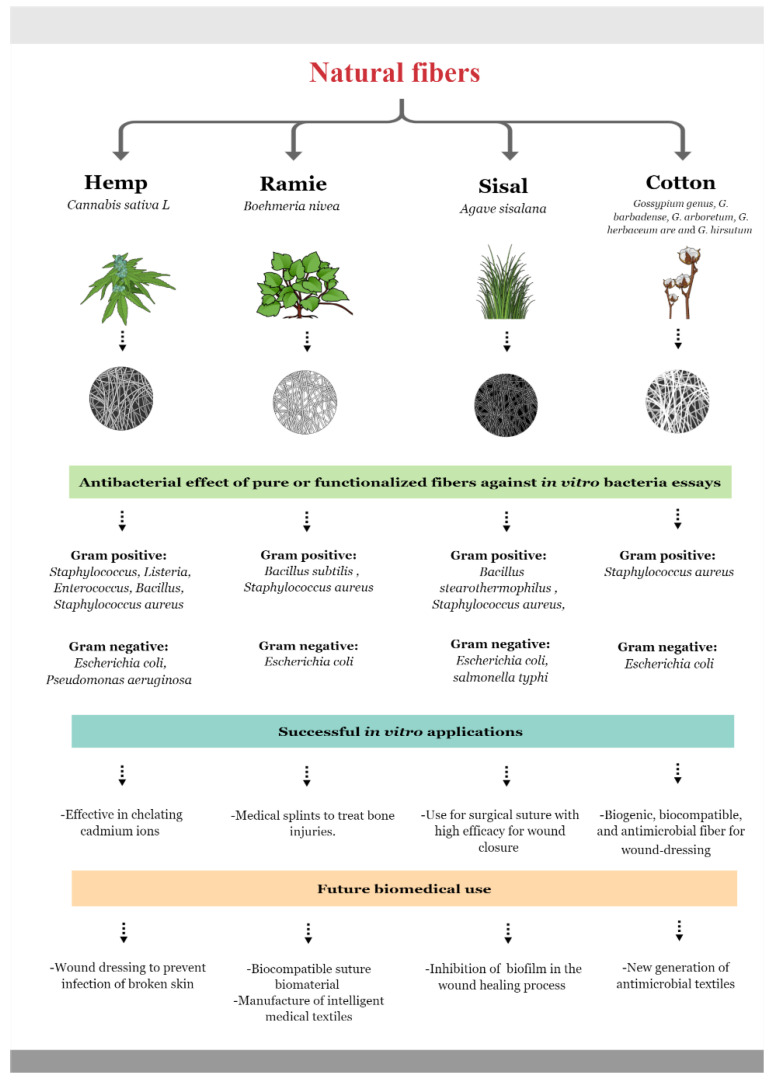
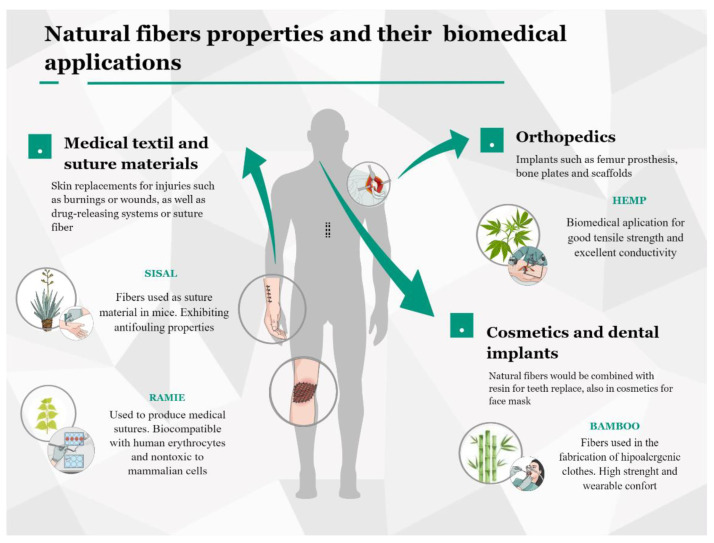
Healthcare-associated infections (HAI), or nosocomial infections, are a global health and economic problem in developed and developing countries, particularly for immunocompromised patients in their intensive care units (ICUs) and surgical site hospital areas. Recurrent pathogens in HAIs prevail over antibiotic-resistant bacteria, such as methicillin-resistant (MRSA) and . For this reason, natural antibacterial mechanisms are a viable alternative for HAI treatment. Natural fibers can inhibit bacterial growth, which can be considered a great advantage in these applications. Moreover, these fibers have been reported to be biocompatible and biodegradable, essential features for biomedical materials to avoid complications due to infections and significant immune responses. Consequently, tissue engineering, medical textiles, orthopedics, and dental implants, as well as cosmetics, are fields currently expanding the use of plant fibers. In this review, we will discuss the source of natural fibers with antimicrobial properties, antimicrobial mechanisms, and their biomedical applications.
医疗保健相关感染(HAI),或医院获得性感染,是发达国家和发展中国家的一个全球性健康和经济问题,特别是对于重症监护病房(ICU)和外科手术部位医院区域的免疫功能低下患者。HAI 中的反复出现的病原体超过了抗生素耐药菌,例如耐甲氧西林金黄色葡萄球菌(MRSA)和 。出于这个原因,天然抗菌机制是治疗 HAI 的可行替代方案。天然纤维可以抑制细菌生长,这在这些应用中是一个很大的优势。此外,这些纤维已被报道为生物相容和可生物降解的,这是生物医学材料的基本特征,可以避免因感染和重大免疫反应而引起的并发症。因此,组织工程、医疗纺织品、骨科和牙科植入物以及化妆品等领域目前正在扩大植物纤维的使用。在这篇综述中,我们将讨论具有抗菌性能的天然纤维的来源、抗菌机制及其在生物医学中的应用。