Department of International Health, Johns Hopkins Bloomberg School of Public Health, Baltimore, MD, USA.
Department of International Health, Johns Hopkins Bloomberg School of Public Health, Baltimore, MD, USA; International Vaccine Access Centre, Johns Hopkins Bloomberg School of Public Health, Baltimore, MD, USA.
Vaccine. 2023 Jan 4;41(1):211-218. doi: 10.1016/j.vaccine.2022.09.043. Epub 2022 Sep 20.
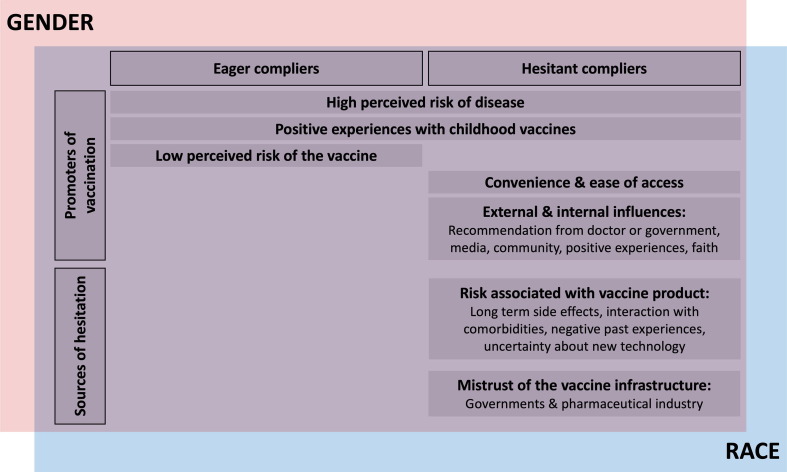
COVID-19 vaccines are essential public health tools for protecting older adults, who are at high risk of severe outcomes associated with COVID-19. Little is known, however, about how older adults approach the decision to receive a COVID-19 vaccine. We hypothesized that intersections between gender and race may provide unique insight into the decision-making process and the factors that lead to vaccine uptake among hesitant individuals. We performed in-depth interviews with 24 older adults who had been vaccinated against COVID-19 and used the framework approach with an intersectional lens to analyze data. Two typologies emerged: eager compliers did not question the need to vaccinate, whereas hesitant compliers were skeptical of the vaccine and underwent a thorough decision-making process prior to vaccination. For eager compliers, the vaccine offered protection from a disease that posed a serious threat, and few risks were perceived. In contrast, hesitant compliers perceived risks associated with the vaccine product or mistrusted the infrastructure that led to rapid vaccine development. Hesitancy was greater among Black participants, and only Black participants reported mistrust in vaccine infrastructure. At the intersection of gender and race, a 'White male effect' was observed, whereby White men perceived the fewest risks associated with the vaccine, and Black women were the most fearful of serious side effects. Nearly all hesitant compliers ultimately got vaccinated due to the threat of COVID-19. Convenient access through vaccine clinics in senior's buildings was pivotal for hesitant compliers and external and internal influences had differential impacts by race and gender. Emphasizing the risk of COVID-19, convenient and accessible opportunities for vaccination, and messages that are targeted to specific groups are likely to increase vaccine uptake among older adults.
COVID-19 疫苗是保护老年人的重要公共卫生工具,老年人因 COVID-19 而出现严重后果的风险很高。然而,对于老年人如何看待接种 COVID-19 疫苗的决定,人们知之甚少。我们假设,性别和种族的交叉点可能为犹豫不决的个体的决策过程和导致疫苗接种的因素提供独特的见解。我们对 24 名已接种 COVID-19 疫苗的老年人进行了深入访谈,并使用框架方法和交叉视角分析数据。出现了两种类型:热切顺从者不质疑接种疫苗的必要性,而犹豫不决的顺从者对疫苗持怀疑态度,并在接种疫苗前进行了彻底的决策过程。对于热切顺从者,疫苗提供了免受严重威胁疾病的保护,几乎没有感知到风险。相比之下,犹豫不决的顺从者认为疫苗产品存在风险,或者不信任导致快速疫苗开发的基础设施。黑人参与者的犹豫情绪更为强烈,只有黑人参与者报告对疫苗基础设施的不信任。在性别和种族的交叉点上,观察到了“白人男性效应”,即白人男性认为疫苗的风险最小,而黑人女性对严重副作用的恐惧最大。几乎所有犹豫不决的顺从者最终都因 COVID-19 的威胁而接种了疫苗。在老年人建筑中的疫苗诊所方便接种对犹豫不决的顺从者至关重要,外部和内部影响对种族和性别有不同的影响。强调 COVID-19 的风险、方便和可及的疫苗接种机会,以及针对特定群体的信息,可能会增加老年人的疫苗接种率。