Division of Hospital Medicine, Johns Hopkins University School of Medicine, Baltimore, Maryland.
Integrated Research Center for Fetal Medicine, Department of Gynecology and Obstetrics, Johns Hopkins University School of Medicine, Baltimore, Maryland.
JAMA Netw Open. 2022 Nov 1;5(11):e2244141. doi: 10.1001/jamanetworkopen.2022.44141.
Pregnant people are at increased risk of poor outcomes due to infection with SARS-CoV-2, and there are limited therapeutic options available.
To evaluate the clinical outcomes associated with nirmatrelvir and ritonavir used to treat SARS-CoV-2 infection in pregnant patients.
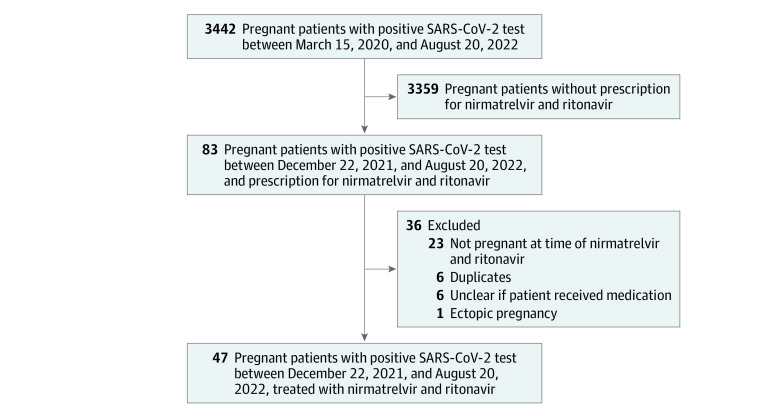
DESIGN, SETTING, AND PARTICIPANTS: This case series included pregnant patients who were diagnosed with SARS-CoV-2 infection, received nirmatrelvir and ritonavir, and delivered their offspring within the Johns Hopkins Health System between December 22, 2021, and August 20, 2022.
Treatment with nirmatrelvir and ritonavir for SARS-CoV-2 infection during pregnancy.
Clinical characteristics and outcomes were ascertained through manual record review.
Forty-seven pregnant patients (median [range] age, 34 [22-43] years) were included in the study, and the median (range) gestational age of their offspring was 28.4 (4.3-39.6) weeks. Medication was initiated at a median (range) of 1 (0-5) day after symptom onset, and only 2 patients [4.3%] did not complete the course of therapy because of adverse effects. Thirty patients (63.8%) treated with nirmatrelvir and ritonavir had a comorbidity in addition to pregnancy that could be a risk factor for developing severe COVID-19. Twenty-five patients [53.2%] delivered after treatment with nirmatrelvir and ritonavir. Twelve of these patients [48.0%] underwent cesarean delivery, 9 [75.0%] of which were scheduled. Two of 47 patients [4.3%] were hospitalized for conditions related to preexisting comorbidities.
In this case series, pregnant patients who were treated with nirmatrelvir and ritonavir tolerated treatment well, although there was an unexpectedly high rate of cesarean deliveries. The lack of an increase in serious adverse effects affecting pregnant patients or offspring suggests that clinicians can use this drug combination to treat pregnant patients with SARS-CoV-2 infection.
由于感染 SARS-CoV-2,孕妇的不良结局风险增加,而且可供选择的治疗方法有限。
评估尼马曲韦和利托那韦治疗感染 SARS-CoV-2 的孕妇的临床结局。
设计、地点和参与者:本病例系列纳入了 2021 年 12 月 22 日至 2022 年 8 月 20 日期间在约翰霍普金斯卫生系统被诊断为 SARS-CoV-2 感染、接受尼马曲韦和利托那韦治疗并分娩的孕妇。
怀孕期间使用尼马曲韦和利托那韦治疗 SARS-CoV-2 感染。
通过手动记录审查确定临床特征和结局。
本研究纳入 47 例孕妇(中位[范围]年龄,34[22-43]岁),其子女的中位(范围)胎龄为 28.4(4.3-39.6)周。药物治疗开始时的中位(范围)时间为症状出现后 1 天(0-5 天),只有 2 例(4.3%)患者因不良反应而未完成疗程。30 例(63.8%)除妊娠外还合并一种可能导致 COVID-19 重症的合并症。25 例(53.2%)患者接受尼马曲韦和利托那韦治疗后分娩。其中 12 例(48.0%)患者行剖宫产,9 例(75.0%)为计划性剖宫产。47 例患者中有 2 例(4.3%)因与既往合并症相关的情况住院。
在本病例系列中,接受尼马曲韦和利托那韦治疗的孕妇耐受治疗情况良好,尽管剖宫产率意外较高。孕妇或其子女未出现严重不良事件增加的情况,提示临床医生可以使用这种药物组合治疗感染 SARS-CoV-2 的孕妇。