
往昔的回响:乌干达北部曾被绑架青少年中创伤后应激障碍的患病率及相关因素:WAYS研究的结果
Echoes of the past: prevalence and correlates of PTSD among formerly abducted youths in northern Uganda: findings from the WAYS study.
作者信息
Amone-P'Olak Kennedy, Omech Bernard, Kakinda Adrian Ivan, Kibedi Henry
机构信息
Psychology, Kyambogo University, Kampala, Uganda.
Department of Public Health, Lira University, Lira, Uganda.
出版信息
Gen Psychiatr. 2022 Nov 10;35(5):e100840. doi: 10.1136/gpsych-2022-100840. eCollection 2022.
BACKGROUND
Post-traumatic stress disorder (PTSD) has considerable and persistent effects on survivors of war, particularly in postconflict areas. Yet, evidence on what keeps survivors on the path of PTSD remains scarce.
AIMS
The current study aimed to assess the prevalence and correlates of PTSD symptoms among the war-affected population in northern Uganda.
METHODS
Data from 476 war-affected youths (aged 20-27 years) who had participated in a longitudinal cohort study were analysed to describe the enduring associations of background and postwar environmental risk factors with PTSD symptoms. The Impact of Event Scale-Revised was used to evaluate symptoms of PTSD. Descriptive statistics were used to compute background and postwar environmental correlates. Binary logistic regression analyses were fitted to assess the magnitude of the effects of the correlates on PTSD symptoms.
RESULTS
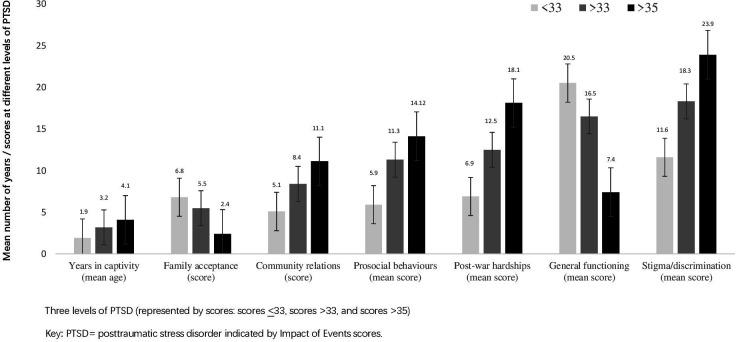
Background and postwar environmental factors (eg, sexual abuse and injury in captivity) were significantly associated with PTSD symptoms. Postwar environmental factors associated with PTSD symptoms included postwar hardships, stigma/discrimination, chronic illness, community relations, family acceptance and general functioning, among others. The odds ratios (ORs) for post-war hardships were 2.41 (95% confidence interval (CI): 1.63 to 3.56) and 2.90 (95% CI: 2.03 to 4.14) for high and severe PTSD, respectively. For stigma/discrimination, compared with higher scores, the ORs were 3.38 (95% CI: 2.22 to 5.17) and 4.12 (95% CI: 2.69 to 6.30) for high and severe PTSD symptoms, respectively.
CONCLUSIONS
Background and postwar environmental stressors exacerbate the severity of PTSD symptoms in survivors of war and should form the basis for interventions to alleviate the toxic effects of war on survivors.
背景
创伤后应激障碍(PTSD)对战乱幸存者有相当大且持续的影响,尤其是在冲突后地区。然而,关于哪些因素使幸存者持续患有创伤后应激障碍的证据仍然很少。
目的
本研究旨在评估乌干达北部受战争影响人群中创伤后应激障碍症状的患病率及其相关因素。
方法
对476名参与纵向队列研究的受战争影响青年(年龄在20 - 27岁之间)的数据进行分析,以描述背景因素和战后环境风险因素与创伤后应激障碍症状之间的持久关联。采用事件影响量表修订版来评估创伤后应激障碍症状。使用描述性统计来计算背景因素和战后环境相关因素。采用二元逻辑回归分析来评估这些相关因素对创伤后应激障碍症状影响的大小。
结果
背景因素和战后环境因素(如性虐待和被囚禁时受伤)与创伤后应激障碍症状显著相关。与创伤后应激障碍症状相关的战后环境因素包括战后艰难困苦、耻辱感/歧视、慢性病、社区关系、家庭接纳程度和总体功能等。战后艰难困苦对于高度和重度创伤后应激障碍的优势比(OR)分别为2.41(95%置信区间(CI):1.63至3.56)和2.90(95%CI:2.03至4.14)。对于耻辱感/歧视,与得分较高者相比,高度和重度创伤后应激障碍症状的OR分别为3.38(95%CI:2.22至5.17)和4.12(95%CI:2.69至6.30)。
结论
背景因素和战后环境应激源会加剧战乱幸存者创伤后应激障碍症状的严重程度,应成为减轻战争对幸存者有害影响的干预措施的基础。

 Zotero 插件