Division of Cancer Control and Population Sciences, National Cancer Institute, Rockville, MD, USA.
J Gen Intern Med. 2023 Apr;38(5):1200-1206. doi: 10.1007/s11606-022-07801-0. Epub 2022 Nov 30.
People experiencing financial burden are underrepresented in clinical trials.
Describe the prevalence of cost-related considerations influential to trial participation and their associations with person-level characteristics.
This cross-sectional study used and assessed how three cost-related considerations would influence the decision to participate in a hypothetical clinical trial.
A total of 3682 US adult respondents to the Health Information National Trends Survey MAIN MEASURES: Survey-weighted multivariable logistic regression estimated associations between respondent characteristics and odds of reporting cost-related considerations as very influential to participation.
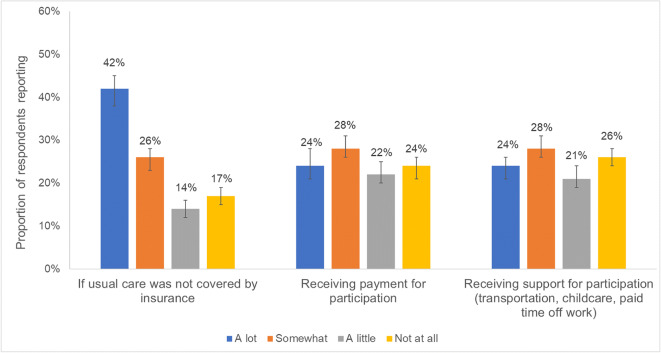
Among 3682 respondents, median age was 48 (IQR 33-61). Most were non-Hispanic White (60%), living comfortably or getting by on their income (74%), with ≥ 1 medical condition (61%). Over half (55%) of respondents reported at least one cost-related consideration as very influential to trial participation, including if usual care was not covered by insurance (reported by 42%), payment for participation (24%), or support for participation (24%). Respondents who were younger (18-34 vs. ≥ 75, adjusted odds ratio [aOR] 4.3, 95% CI 2.3-8.1), more educated (high school vs. <high school, aOR 2.1, 95% CI 1.1-4.1), or with lower perceived income (having difficulty vs. living comfortably, aOR 2.1, 95% CI 1.1-3.8) had higher odds of reporting any cost-related consideration as very influential to trial participation. Non-Hispanic Black vs. non-Hispanic White respondents had 29% lower odds (95% CI 0.5-0.9) of reporting any cost-related consideration as very influential to trial participation.
Cost-related considerations would influence many individuals' decisions to participate in a clinical trial, though prevalence of these concerns differed by respondent characteristics. Reducing financial barriers to trial participation may promote equitable trial access and greater trial enrollment diversity.
在临床试验中,经济负担过重的人群代表性不足。
描述影响参与临床试验的相关费用因素的普遍程度及其与个体特征的关联。
本横断面研究使用并评估了三种与费用相关的考虑因素将如何影响参与假设性临床试验的决策。
共纳入 3682 名接受健康信息国家趋势调查的美国成年受访者。
采用调查加权多变量逻辑回归估计受访者特征与报告费用相关考虑因素对参与非常有影响的可能性之间的关联。
在 3682 名受访者中,中位年龄为 48 岁(IQR 33-61)。大多数受访者是非西班牙裔白人(60%),舒适或勉强维持生计(74%),并患有≥1 种疾病(61%)。超过一半(55%)的受访者报告至少有一种费用相关考虑因素对参与试验非常有影响,包括如果常规护理不受保险覆盖(42%)、参与费用(24%)或参与支持(24%)。与年龄较大(18-34 岁与≥75 岁,调整后的优势比[aOR] 4.3,95%CI 2.3-8.1)、受教育程度较高(高中与<高中,aOR 2.1,95%CI 1.1-4.1)或收入感知较低(有困难与舒适,aOR 2.1,95%CI 1.1-3.8)的受访者相比,报告任何费用相关考虑因素对参与试验非常有影响的可能性更高。与非西班牙裔黑人相比,非西班牙裔白人报告任何费用相关考虑因素对参与试验非常有影响的可能性低 29%(95%CI 0.5-0.9)。
与费用相关的考虑因素可能会影响许多人参与临床试验的决策,但这些问题的发生率因受访者特征而异。降低参与试验的经济障碍可能会促进公平的试验准入,并提高试验参与多样性。