Kim Ui-Jin, Choi Won-Jun, Kang Seong-Kyu, Lee Wanhyung, Ham Seunghon, Lee Junhyeong, Lee Yongho, Han Eunseun, Lee Sanghyuk, Kim Yongkyu, Kim Inah
Department of Medicine, Graduate School of Gachon University, Incheon, Korea.
Department of Occupational and Environmental Medicine, Gachon University Gil Medical Center, Incheon, Korea.
Ann Occup Environ Med. 2022 Oct 25;34:e30. doi: 10.35371/aoem.2022.34.e30. eCollection 2022.
Although working hours have decreased in Korea, they are still high compared to that of other countries. In Korea, cardiovascular and cerebrovascular diseases (CCVDs) related to overwork in Korea continually occur, and the social burden from overwork is estimated to be high. This study investigated the amendment of regulations affecting the approval rate of occupational CCVDs.
The change in approval rate of occupational CCVDs and related regulations were investigated using the Act and public notice on the standards for recognition of occupational CCVDs and the yearbooks of the Ministry of Employment and Labor. The CCVD mortality was estimated using data on the number of deaths according to the cause of death, the number of employed people, and resident registration population aged 15-64 years. The cumulative mortality of CCVDs was estimated using the Kaplan-Meier method.
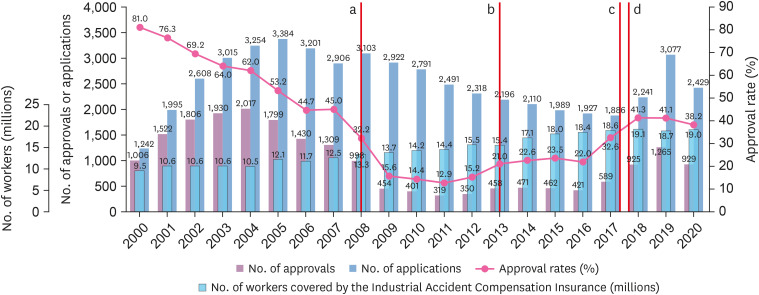
Since the establishment of the standards for recognition in Korea in 1982, the scope of occupational diseases has been expanded to include intracerebral hemorrhage, subarachnoid hemorrhage, cerebral infarction, myocardial infarction, and aortic dissection. In 2013, the concept of working hours was introduced in chronic overwork. The approval rate of occupational CCVDs was 44.7% in 2006, which decreased to 12.9% in 2011. After the improvement of related regulations, the approval rate increased to 41.3% in 2018. From 2000 to 2017, the CCVD mortality of both the unemployed and employed tended to decrease, and their cumulative CCVD mortalities were 549.3 and 319.7 per 100,000 people, respectively.
CCVDs are recognized as occupational diseases in Korea. The amendments to the standards for recognition, the introduction of the Occupational Disease Adjudication Committee, the principle of presumption, and the reduction of working hours have changed the approval rate of occupational CCVDs. A strategic approach is needed to further reduce the incidence of CCVDs.
尽管韩国的工作时长有所减少,但与其他国家相比仍处于高位。在韩国,因过度劳累引发的心血管和脑血管疾病(CCVDs)持续发生,过度劳累带来的社会负担估计很高。本研究调查了影响职业性CCVDs认定率的法规修订情况。
利用《职业性CCVDs认定标准法》及公告以及就业和劳动部年鉴,调查职业性CCVDs认定率和相关法规的变化。根据死因死亡人数、就业人数以及15 - 64岁居民登记人口数据估算CCVD死亡率。采用Kaplan - Meier方法估算CCVDs的累积死亡率。
自1982年韩国制定认定标准以来,职业病范围已扩大至包括脑出血、蛛网膜下腔出血、脑梗死、心肌梗死和主动脉夹层。2013年,慢性过度劳累中引入了工作时长概念。2006年职业性CCVDs认定率为44.7%,2011年降至12.9%。相关法规改进后,2018年认定率增至41.3%。2000年至2017年,失业者和就业者的CCVD死亡率均呈下降趋势,其CCVD累积死亡率分别为每10万人549.3例和319.7例。
在韩国,CCVDs被认定为职业病。认定标准的修订、职业病判定委员会的引入、推定原则以及工作时长的减少改变了职业性CCVDs的认定率。需要采取战略方法进一步降低CCVDs的发病率。