Department of Biology, University of Rome "Tor Vergata", Via Della Ricerca Scientifica 1, 00133, Rome, Italy.
PhD program in Cellular and Molecular Biology, Department of Biology, University of Rome "Tor Vergata", Via della Ricerca Scientifica 1, 00133, Rome, Italy.
Cell Oncol (Dordr). 2023 Feb;46(1):93-115. doi: 10.1007/s13402-022-00738-w. Epub 2022 Dec 1.
The main mechanism underlying cancer dissemination is the epithelial to mesenchymal transition (EMT). This process is orchestrated by cytokines like TGFβ, involving "non-canonical" AKT- or STAT3-driven pathways. Recently, the alteration of copper homeostasis seems involved in the onset and progression of cancer.
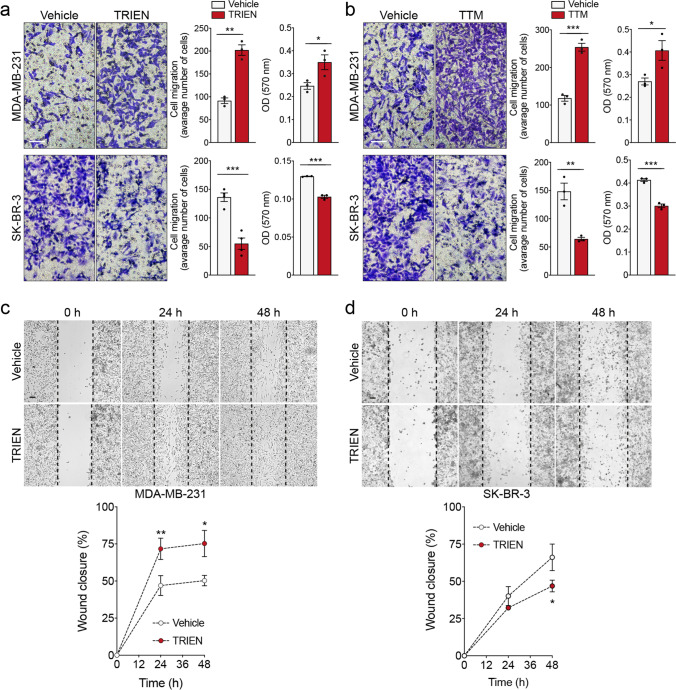
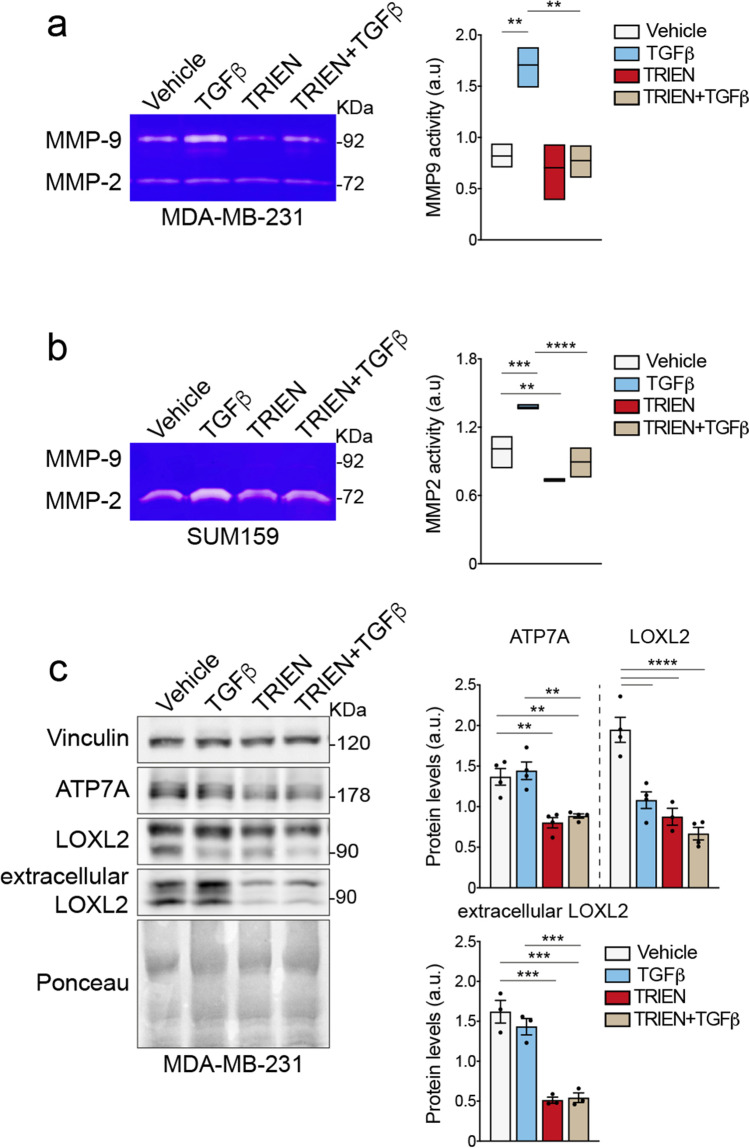
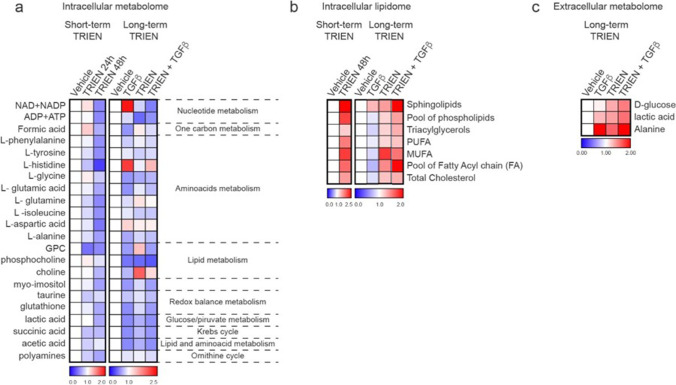
We expose different breast cancer cell lines, including two triple negative (TNBC) ones, an HER2 enriched and one cell line representative of the Luminal A molecular subtype, to short- or long-term copper-chelation by triethylenetetramine (TRIEN). We analyse changes in the expression of EMT markers (E-cadherin, fibronectin, vimentin and αSMA), in the levels and activity of extracellular matrix components (LOXL2, fibronectin and MMP2/9) and of copper homeostasis markers by Western blot analyses, immunofluorescence, enzyme activity assays and RT-qPCR. Boyden Chamber and wound healing assays revealed the impact of copper chelation on cell migration. Additionally, we explored whether perturbation of copper homeostasis affects EMT prompted by TGFβ. Metabolomic and lipidomic analyses were applied to search the effects of copper chelation on the metabolism of breast cancer cells. Finally, bioinformatics analysis of data on breast cancer patients obtained from different databases was employed to correlate changes in kinases and copper markers with patients' survival.
Remarkably, only HER2 negative breast cancer cells differently responded to short- or long-term exposure to TRIEN, initially becoming more aggressive but, upon prolonged exposure, retrieving epithelial features, reducing their invasiveness. This phenomenon may be related to the different impact of the short and prolonged activation of the AKT kinase and to the repression of STAT3 signalling. Bioinformatics analyses confirmed the positive correlation of breast cancer patients' survival with AKT activation and up-regulation of CCS. Eventually, metabolomics studies demonstrate a prevalence of glycolysis over mitochondrial energetic metabolism and of lipidome changes in TNBC cells upon TRIEN treatment.
We provide evidence of a pivotal role of copper in AKT-driven EMT activation, acting independently of HER2 in TNBC cells and via a profound change in their metabolism. Our results support the use of copper-chelators as an adjuvant therapeutic strategy for TNBC.
癌症转移的主要机制是上皮间质转化(EMT)。这个过程由 TGFβ 等细胞因子协调,涉及“非经典”的 AKT 或 STAT3 驱动途径。最近,铜稳态的改变似乎与癌症的发生和发展有关。
我们使不同的乳腺癌细胞系(包括两种三阴性乳腺癌(TNBC)、一种 HER2 富集型和一种代表 Luminal A 分子亚型的细胞系)接受三乙烯四胺(TRIEN)的短期或长期螯合铜处理。我们通过 Western blot 分析、免疫荧光、酶活性测定和 RT-qPCR 分析 EMT 标志物(E-钙粘蛋白、纤连蛋白、波形蛋白和αSMA)、细胞外基质成分(LOXL2、纤连蛋白和 MMP2/9)和铜稳态标志物的表达变化。Boyden 室和划痕愈合试验揭示了铜螯合作用对细胞迁移的影响。此外,我们还探讨了铜稳态的扰动是否会影响 TGFβ 诱导的 EMT。代谢组学和脂质组学分析被应用于寻找铜螯合作用对乳腺癌细胞代谢的影响。最后,我们利用从不同数据库获得的乳腺癌患者的数据进行生物信息学分析,以确定激酶和铜标志物的变化与患者生存的相关性。
值得注意的是,只有 HER2 阴性的乳腺癌细胞对 TRIEN 的短期或长期暴露有不同的反应,最初变得更具侵袭性,但长期暴露后,它们恢复了上皮特征,降低了侵袭性。这一现象可能与 AKT 激酶的短期和长期激活的不同影响以及 STAT3 信号的抑制有关。生物信息学分析证实了乳腺癌患者的生存与 AKT 激活和 CCS 的上调呈正相关。最终,代谢组学研究表明,在 TRIEN 处理后,TNBC 细胞中糖酵解优先于线粒体能量代谢,脂质组也发生变化。
我们提供了铜在 AKT 驱动的 EMT 激活中起关键作用的证据,在 TNBC 细胞中,它独立于 HER2 发挥作用,并通过其代谢的深刻变化来发挥作用。我们的研究结果支持使用铜螯合剂作为 TNBC 的辅助治疗策略。