Department of Life Sciences, Imperial College London, London, United Kingdom.
PLoS One. 2022 Dec 1;17(12):e0278484. doi: 10.1371/journal.pone.0278484. eCollection 2022.
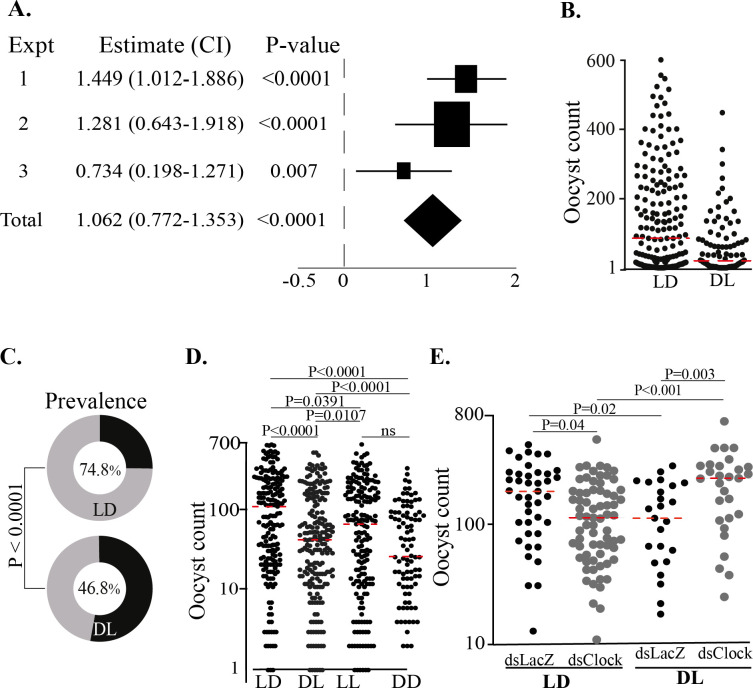
Key behaviours, physiologies and gene expressions in Anopheles mosquitoes impact the transmission of Plasmodium. Such mosquito factors are rhythmic to closely follow diel rhythms. Here, we set to explore the impact of the mosquito circadian rhythm on the tripartite interaction between the vector, the parasite and the midgut microbiota, and investigate how this may affect the parasite infection outcomes. We assess Plasmodium falciparum infection prevalence and intensity, as a proxy for gametocyte infectivity, in Anopheles gambiae mosquitoes that received a gametocyte-containing bloodfeed and measure the abundance of the midgut microbiota at different times of the mosquito rearing light-dark cycle. Gametocyte infectivity is also compared in mosquitoes reared and maintained under a reversed light-dark regime. The effect of the circadian clock on the infection outcome is also investigated through silencing of the CLOCK gene that is central in the regulation of animal circadian rhythms. The results reveal that the A. gambiae circadian cycle plays a key role in the intensity of infection of P. falciparum gametocytes. We show that parasite gametocytes are more infectious during the night-time, where standard membrane feeding assays (SMFAs) at different time points in the mosquito natural circadian rhythm demonstrate that gametocytes are more infectious when ingested at midnight than midday. When mosquitoes were cultured under a reversed light/dark regime, disrupting their natural physiological homeostasis, and infected with P. falciparum at evening hours, the infection intensity and prevalence were significantly decreased. Similar results were obtained in mosquitoes reared under the standard light/dark regime upon silencing of CLOCK, a key regulator of the circadian rhythm, highlighting the importance of the circadian rhythm for the mosquito vectorial capacity. At that time, the mosquito midgut microbiota load is significantly reduced, while the expression of lysozyme C-1 (LYSC-1) is elevated, which is involved in both the immune response and microbiota digestion. We conclude that the tripartite interactions between the mosquito vector, the malaria parasite and the mosquito gut microbiota are finely tuned to support and maintain malaria transmission. Our data add to the knowledge framework required for designing appropriate and biologically relevant SMFA protocols.
关键行为、生理学和基因表达在疟蚊中影响疟原虫的传播。这些蚊子因素是有节奏的,以紧密跟随昼夜节律。在这里,我们旨在探索蚊子生物钟对媒介、寄生虫和肠道微生物群之间的三方相互作用的影响,并研究这可能如何影响寄生虫感染结果。我们评估感染疟原虫的疟蚊的感染率和强度,作为配子体感染力的替代指标,这些蚊子接受了含有配子体的血液喂食,并在蚊子饲养的明暗循环的不同时间测量肠道微生物群的丰度。还比较了在相反的明暗制度下饲养和维持的蚊子中的配子体感染力。通过沉默中央生物钟基因(CLOCK)来研究生物钟对感染结果的影响,该基因在动物生物钟调节中起核心作用。结果表明,冈比亚按蚊的生物钟周期在疟原虫配子体感染强度中起着关键作用。我们表明,寄生虫配子体在夜间更具感染力,在蚊子自然生物钟的不同时间点进行标准膜喂食测定(SMFA)表明,配子体在午夜时比中午时更具感染力。当蚊子在颠倒的明暗制度下培养时,破坏了它们的自然生理平衡,并在傍晚感染疟原虫时,感染强度和流行率显著降低。在标准明暗制度下饲养的蚊子中沉默 CLOCK 时也获得了类似的结果,CLOCK 是生物钟的关键调节剂,这突出了生物钟对蚊子传播能力的重要性。此时,蚊子肠道微生物群的负荷显著降低,而溶菌酶 C-1(LYSC-1)的表达升高,这与免疫反应和微生物群消化都有关。我们得出结论,蚊子媒介、疟原虫寄生虫和蚊子肠道微生物群之间的三方相互作用是精细调节的,以支持和维持疟疾传播。我们的数据增加了设计适当和具有生物学相关性的 SMFA 方案所需的知识框架。