Division of Medical Oncology, Department of Internal Medicine, Faculty of Medicine, Srinakharinwirot University, Nakhon Nayok, Thailand.
Division of Medical Oncology, Department of Internal Medicine, Faculty of Medicine, Chulalongkorn University, Bangkok, Thailand.
JCO Glob Oncol. 2022 Nov;8:e2200205. doi: 10.1200/GO.22.00205.
Atezolizumab plus bevacizumab treatment is a first-line therapy for unresectable hepatocellular carcinoma (HCC) worldwide. The efficacy, safety, and patient-reported outcomes (PROs) of HCC in Thailand have not yet been reported. This study aimed to evaluate the efficacy, safety, and PROs of atezolizumab plus bevacizumab.
From September 2020 to August 2021, 30 patients with unresectable HCC who met the inclusion criteria of atezolizumab plus bevacizumab as first-line treatment were enrolled. Analysis was assessed for progression-free survival, overall survival, adverse events (AEs), and quality of life (QoL).
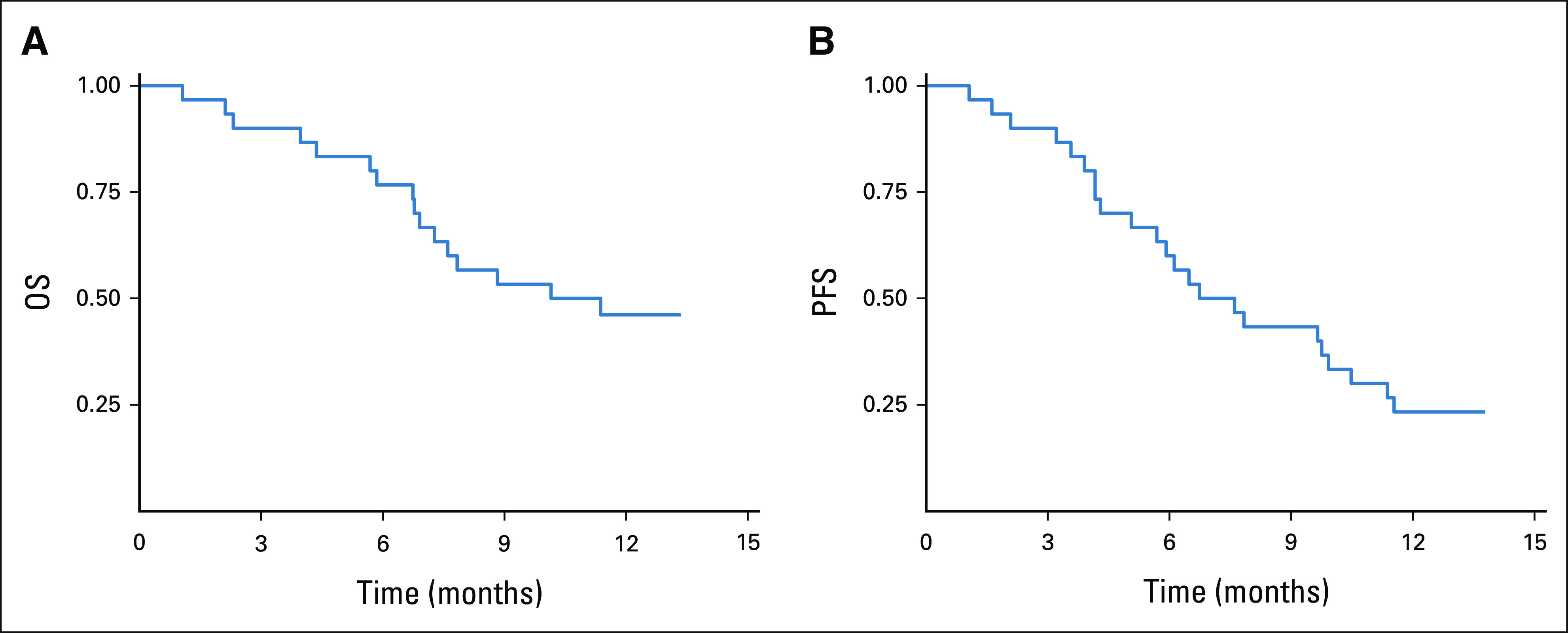
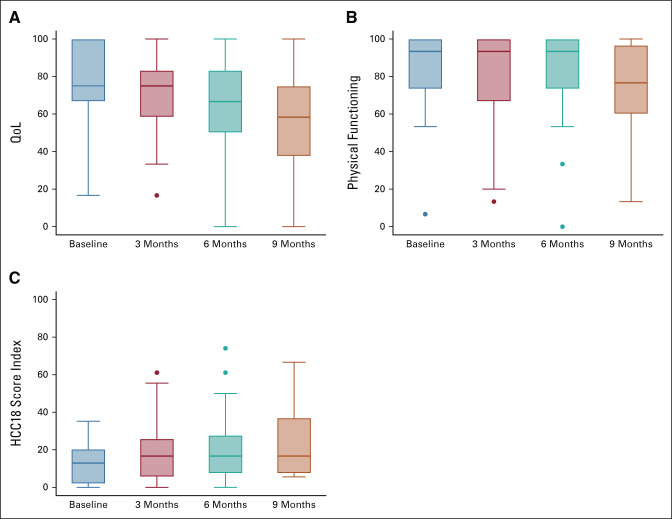
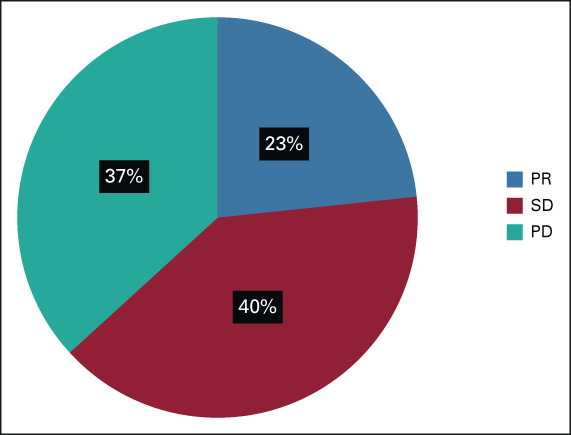
The median progression-free survival and overall survival periods were 6.7 and 10.2 months, respectively. The disease control rate was 63.3%. The frequent AEs were proteinuria, hypertension, and hepatitis. Serious AEs included gastrointestinal bleeding, but none of the patients died from serious AEs. The discontinuation rate was 23.3%, and the median number of treatment cycles was 10.5 cycles. In total, 23.3% of the patients continued treatment after 1 year of therapy. The global health status/QoL and physical function scores showed less deterioration at baseline than at 3 and 6 months (median scores = 76.7, 71.6, and 64.1 in QoL and 84.7, 79.6, and 79.0 in physical function, respectively). The HCC18 symptom score index data showed a slow progression of symptom scores from baseline to 3 and 6 months (12.7, 19.6, and 22.3, respectively).
This study demonstrates that atezolizumab plus bevacizumab is effective and has a safety profile comparable with that of previous studies as first-line therapy for unresectable HCC in a real-world setting and in Thai populations. Data on PROs also demonstrate benefits in terms of patients' QoL and symptoms.
阿替利珠单抗联合贝伐珠单抗治疗是全球不可切除肝细胞癌(HCC)的一线治疗方法。尚未报道泰国 HCC 的疗效、安全性和患者报告的结局(PROs)。本研究旨在评估阿替利珠单抗联合贝伐珠单抗的疗效、安全性和 PROs。
从 2020 年 9 月至 2021 年 8 月,共纳入 30 名符合阿替利珠单抗联合贝伐珠单抗一线治疗条件的不可切除 HCC 患者。对无进展生存期、总生存期、不良事件(AEs)和生活质量(QoL)进行分析评估。
中位无进展生存期和总生存期分别为 6.7 个月和 10.2 个月。疾病控制率为 63.3%。常见的 AEs 包括蛋白尿、高血压和肝炎。严重的 AEs 包括胃肠道出血,但无患者因严重 AEs 死亡。停药率为 23.3%,中位治疗周期数为 10.5 个周期。总共有 23.3%的患者在治疗 1 年后继续治疗。全球健康状况/QoL 和身体功能评分在基线时比 3 个月和 6 个月时下降(QoL 的中位数评分分别为 76.7、71.6 和 64.1,身体功能分别为 84.7、79.6 和 79.0)。HCC18 症状评分指数数据显示,症状评分从基线到 3 个月和 6 个月的进展缓慢(分别为 12.7、19.6 和 22.3)。
本研究表明,阿替利珠单抗联合贝伐珠单抗作为不可切除 HCC 的一线治疗在真实世界环境和泰国人群中是有效且具有与既往研究相当的安全性特征。PROs 数据也表明在患者的 QoL 和症状方面具有获益。