Division of Social and Behavioural Health Sciences, Dalla Lana School of Public Health, University of Toronto, 155 College Street, 6th Floor, Toronto, Ontario M5T 3M7, Canada.
Department of Health Research Methods, Evidence, and Impact, Faculty of Health Sciences, McMaster University, 1280 Main Street West, Hamilton, Ontario L8S 4K1, Canada.
Health Policy. 2023 Jan;127:19-28. doi: 10.1016/j.healthpol.2022.11.011. Epub 2022 Nov 23.
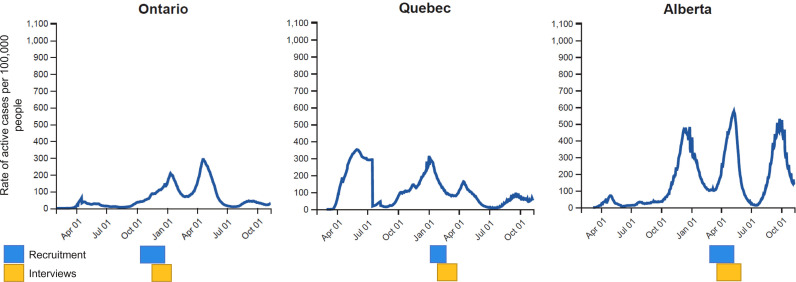
The extent to which power, resources, and responsibilities for public health are centralized or decentralized within a jurisdiction and how public health functions are integrated or coordinated with health care services may shape pandemic responses. However, little is known about the impacts of centralization and integration on public health system responses to the COVID-19 pandemic. We examine how public health leaders perceive centralization and integration facilitated and impeded effective COVID-19 responses in three Canadian provinces. We conducted a comparative case study involving semi-structured interviews with 58 public health system leaders in three Canadian provinces with varying degrees of centralization and integration. Greater public health system centralization and integration was seen by public health leaders to facilitate more rapidly initiated and well-coordinated provincial COVID-19 responses. Decentralization may have enabled locally tailored responses in the context of limited provincial leadership. Opacity in provincial decision-making processes, jurisdictional ambiguity impacting Indigenous communities, and ineffectual public health investments were impediments across jurisdictions and thus appear to be less impacted by centralization and integration. Our study generates novel insights about potential structural facilitators and impediments of effective COVID-19 pandemic responses during the second year of the pandemic. Findings highlight key areas for future research to inform system design that support leaders to manage large-scale public health emergencies.
在管辖权范围内,公共卫生的权力、资源和责任集中或分散的程度,以及公共卫生职能与医疗服务整合或协调的程度,可能会影响大流行病的应对。然而,对于集中化和整合对公共卫生系统应对 COVID-19 大流行的影响知之甚少。我们研究了公共卫生领导人如何看待加拿大三个省份的集中化和整合促进和阻碍有效 COVID-19 应对的情况。我们进行了一项比较案例研究,涉及对加拿大三个省份的 58 名公共卫生系统领导人进行半结构化访谈,这些省份的集中化和整合程度不同。公共卫生领导人认为,公共卫生系统的更大集中化和整合有助于更迅速地启动和更好地协调省级 COVID-19 应对。在省级领导有限的情况下,权力下放可能使地方能够做出有针对性的反应。在省级决策过程中缺乏透明度、影响土著社区的管辖权模糊以及公共卫生投资无效,这些都是各辖区的障碍,因此似乎较少受到集中化和整合的影响。我们的研究为大流行病第二年有效应对 COVID-19 大流行的潜在结构促进因素和障碍提供了新的见解。研究结果强调了未来研究的关键领域,为支持领导人管理大规模公共卫生紧急情况的系统设计提供信息。