Department of Oral Medicine, The Faculty of Dental Medicine, Damascus University, Damascus, Syria.
Department of Oral Medicine and Pathology, The Faculty of Dental Medicine, Al-Sham Private University, Damascus, Syria.
J Oral Pathol Med. 2023 Jan;52(1):29-36. doi: 10.1111/jop.13392. Epub 2022 Dec 13.
Cell-free DNA (cfDNA) and cell-free mitochondrial DNA (cf-mtDNA) have been postulated as potential diagnostic and prognostic biomarkers for different human malignancies. Early detection of head and neck malignancies is fundamental for optimal patient management. This study, therefore, aimed to assess the utility of saliva-based liquid biopsy as a noninvasive source of cfDNA and cf-mtDNA for detecting head and neck cancer (HNSCC).
One hundred thirty-three patients diagnosed with either oral leukoplakia (OLK) or HNSCC were compared with 137 healthy volunteers. An unstimulated whole saliva sample was collected from each participant. The absolute copy numbers of salivary cf-mtDNA and cfDNA were quantified using Multiplex Quantitative PCR. Two diagnostic indices based on the investigated molecules were assessed for their ability to differentiate between different diagnostic categories.
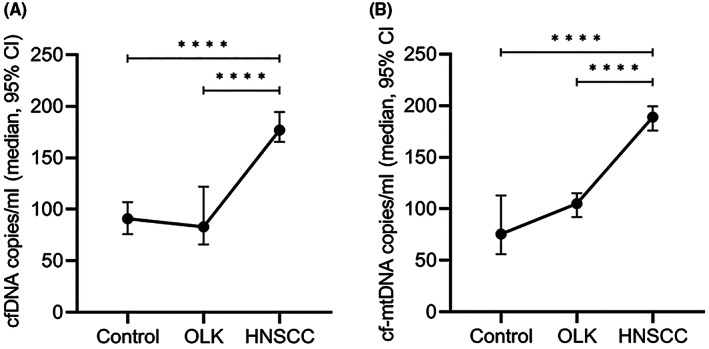
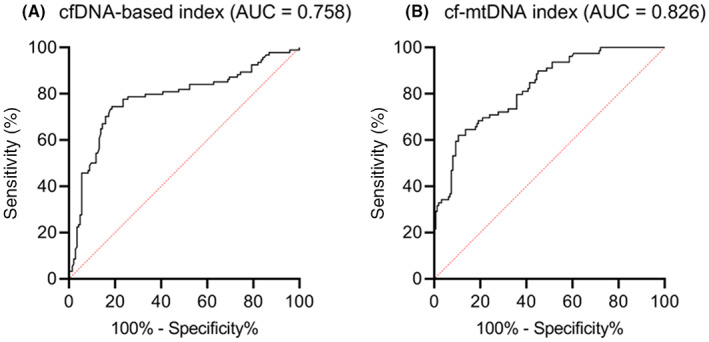
The median scores of cfDNA and cf-mtDNA were statistically significantly higher among HNSCC patients (p < 0.05), revealing area under the curve values of 0.758 and 0.826, respectively. The associated accuracy for this test in discriminating HNSCC from other diagnostic categories was 77.37% for the cfDNA-based index and 80.5% for the cf-mtDNA-based index. The median score of cfDNA was statistically significantly higher for patients with severe epithelial dysplasia (OED) compared to those with epithelial keratosis with no OED and mild OED. However, there was no significant difference between controls and OLK individuals.
cfDNA and cf-mtDNA showed potential for use as precision medicine tools to detect HNSCC. Further multi-centre prospective studies are warranted to assess the prognostic utility of these molecules.
游离 DNA(cfDNA)和游离线粒体 DNA(cf-mtDNA)被认为是不同人类恶性肿瘤的潜在诊断和预后生物标志物。对头颈部恶性肿瘤的早期检测对于优化患者管理至关重要。因此,本研究旨在评估基于唾液的液体活检作为 cfDNA 和 cf-mtDNA 的非侵入性来源用于检测头颈部癌症(HNSCC)的效用。
将 133 例诊断为口腔白斑(OLK)或 HNSCC 的患者与 137 例健康志愿者进行比较。每位参与者采集一份未刺激的全唾液样本。使用多重定量 PCR 定量唾液 cf-mtDNA 和 cfDNA 的绝对拷贝数。评估基于所研究分子的两个诊断指数,以评估其区分不同诊断类别的能力。
HNSCC 患者的 cfDNA 和 cf-mtDNA 中位数得分统计学上显着高于其他患者(p<0.05),分别显示曲线下面积值为 0.758 和 0.826。该测试区分 HNSCC 与其他诊断类别的准确性,cfDNA 为 77.37%,cf-mtDNA 为 80.5%。cfDNA 的中位数得分在患有严重上皮异型增生(OED)的患者中统计学上显着高于无 OED 和轻度 OED 的角化上皮患者。然而,对照组和 OLK 个体之间没有显着差异。
cfDNA 和 cf-mtDNA 显示出作为检测 HNSCC 的精准医学工具的潜力。需要进一步的多中心前瞻性研究来评估这些分子的预后效用。