Hernandez Mario Funes, Rodriguez Fatima
Department of Medicine, Division of Nephrology, Stanford University School of Medicine, Stanford, CA USA.
Department of Medicine, Division of Cardiovascular Medicine, Stanford University School of Medicine, 453 Quarry Road, Room 332B, Stanford, CA 94305 USA.
Curr Cardiovasc Risk Rep. 2023;17(1):1-20. doi: 10.1007/s12170-022-00711-0. Epub 2022 Nov 28.
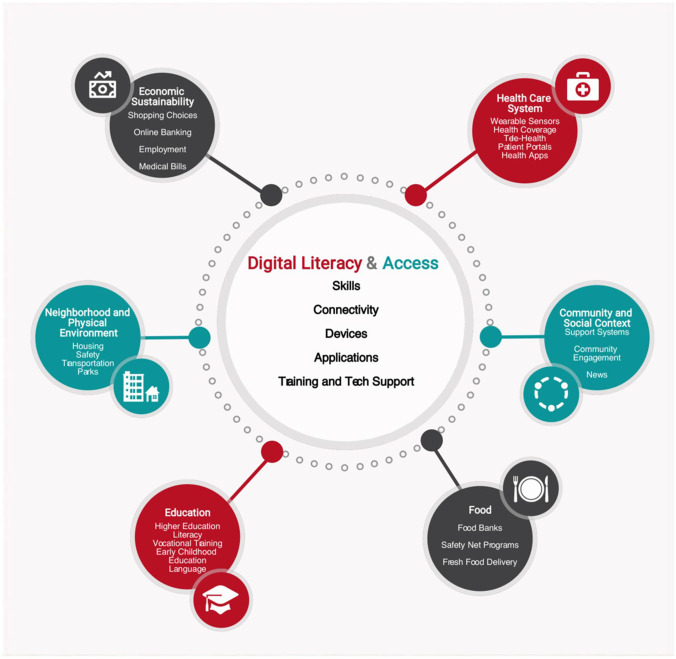
In this review, we define health equity, disparities, and social determinants of health; the different components of digital health; the barriers to digital health equity; and cardiovascular digital health trials and possible solutions to improve health equity through digital health.
Digital health interventions show incredible potential to improve cardiovascular diseases by obtaining longitudinal, continuous, and actionable patient data; increasing access to care; and by decreasing delivery barriers and cost. However, certain populations have experienced decreased access to digital health innovations and decreased representation in cardiovascular digital health trials.
Special efforts will need to be made to expand access to the different elements of digital health, ensuring that the digital divide does not exacerbate health disparities. As the expansion of digital health technologies continues, it is vital to increase representation of minoritized groups in all stages of the process: product development (needs findings and screening, concept generation, product creation, and testing), clinical research (pilot studies, feasibility studies, and randomized control trials), and finally health services deployment.
在本综述中,我们定义了健康公平、差异以及健康的社会决定因素;数字健康的不同组成部分;数字健康公平的障碍;以及心血管数字健康试验和通过数字健康改善健康公平的可能解决方案。
数字健康干预措施通过获取纵向、连续且可采取行动的患者数据、增加医疗服务可及性、降低服务提供障碍和成本,在改善心血管疾病方面显示出巨大潜力。然而,某些人群获得数字健康创新的机会减少,且在心血管数字健康试验中的代表性降低。
需要做出特别努力来扩大对数字健康不同要素的获取,确保数字鸿沟不会加剧健康差异。随着数字健康技术的不断扩展,在整个过程的所有阶段增加少数群体的代表性至关重要:产品开发(需求发现与筛选、概念生成、产品创建和测试)、临床研究(试点研究、可行性研究和随机对照试验),以及最终的健康服务部署。