Crawford Allison, Serhal Eva
Virtual Mental Health and Outreach, Centre for Addiction and Mental Health, Toronto, ON, Canada.
Department of Psychiatry, University of Toronto, Toronto, ON, Canada.
J Med Internet Res. 2020 Jun 2;22(6):e19361. doi: 10.2196/19361.
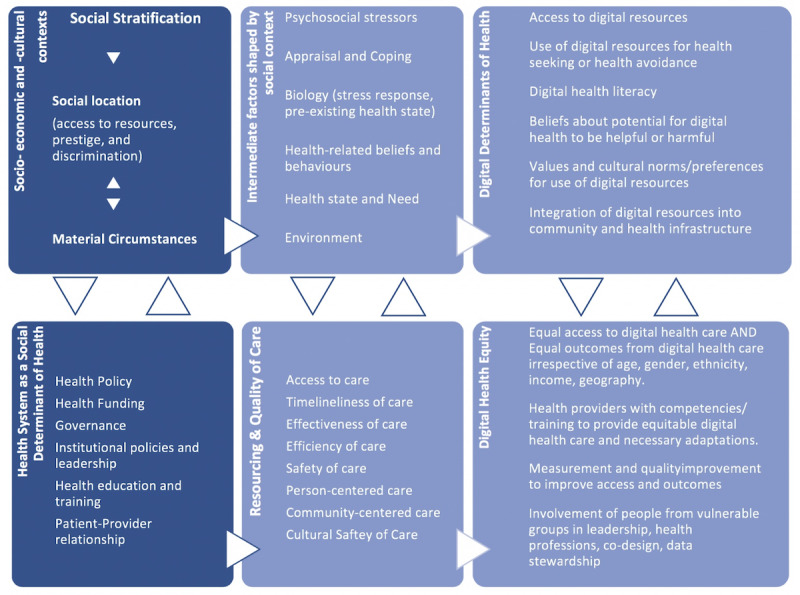
Digital health innovations have been rapidly implemented and scaled to provide solutions to health delivery challenges posed by the coronavirus disease (COVID-19) pandemic. This has provided people with ongoing access to vital health services while minimizing their potential exposure to infection and allowing them to maintain social distancing. However, these solutions may have unintended consequences for health equity. Poverty, lack of access to digital health, poor engagement with digital health for some communities, and barriers to digital health literacy are some factors that can contribute to poor health outcomes. We present the Digital Health Equity Framework, which can be used to consider health equity factors. Along with person-centered care, digital health equity should be incorporated into health provider training and should be championed at the individual, institutional, and social levels. Important future directions will be to develop measurement-based approaches to digital health equity and to use these findings to further validate and refine this model.
数字健康创新已迅速得到实施和推广,以应对冠状病毒病(COVID-19)大流行给医疗服务带来的挑战。这使人们能够持续获得重要的医疗服务,同时将他们潜在的感染风险降至最低,并使他们能够保持社交距离。然而,这些解决方案可能会对健康公平产生意想不到的后果。贫困、无法获得数字健康服务、一些社区对数字健康的参与度低以及数字健康素养障碍等因素,都可能导致不良的健康结果。我们提出了数字健康公平框架,可用于考量健康公平因素。除了以患者为中心的护理外,数字健康公平还应纳入医疗服务提供者的培训中,并应在个人、机构和社会层面加以倡导。未来的重要方向将是开发基于测量的数字健康公平方法,并利用这些研究结果进一步验证和完善该模型。