Sánchez-Fernández Magdalena, Borda-Mas Mercedes
Department of Personality, Assessment and Psychological Treatment, University of Seville (Universidad de Sevilla), C. Camilo José Cela, S/N, 41018 Seville, Spain.
Educ Inf Technol (Dordr). 2023;28(6):7111-7204. doi: 10.1007/s10639-022-11437-2. Epub 2022 Nov 29.
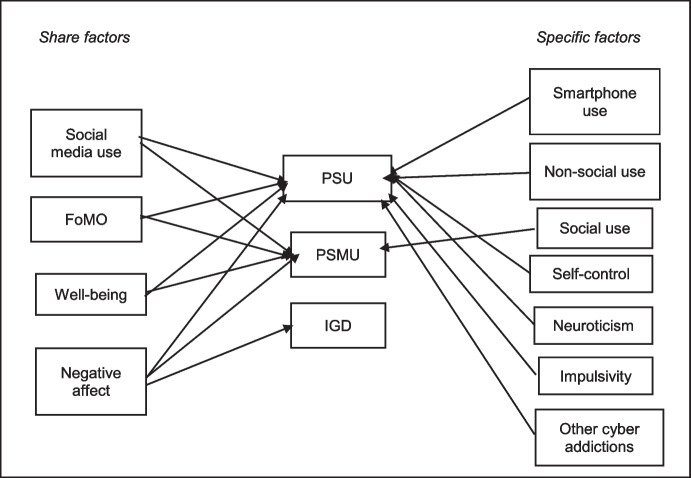
University students are a high-risk population with problematic online behaviours that include generalized problematic Internet/smartphone use and specific problematic Internet uses (for example, social media or gaming). The study of their predictive factors is needed in order to develop preventative strategies. This systematic review aims to understand the current state of play by examining the terminology, assessment instruments, prevalence, and predictive factors associated with problematic smartphone use and specific problematic Internet uses in university students. A literature review was conducted according to the PRISMA guidelines using four major databases. A total of 117 studies were included, divided into four groups according to the domain of problem behaviour: problematic smartphone use ( = 67), problematic social media use ( = 39), Internet gaming disorder ( = 9), and problematic online pornography use ( = 2). Variability was found in terminology, assessment tools, and prevalence rates in the four groups. Ten predictors of problematic smartphone use, five predictors of problematic social media use, and one predictor of problematic online gaming were identified. Negative affectivity is found to be a common predictor for all three groups, while social media use, psychological well-being, and Fear of Missing Out are common to problematic smartphone and social media use. Our findings reaffirm the need to reach consistent diagnostic criteria in cyber addictions and allow us to make progress in the investigation of their predictive factors, thus allowing formulation of preventive strategies.
大学生是存在网络行为问题的高风险人群,这些问题包括普遍存在的网络/智能手机使用问题以及特定的网络使用问题(例如,社交媒体或游戏)。为了制定预防策略,需要对其预测因素进行研究。本系统综述旨在通过研究与大学生问题智能手机使用和特定网络使用问题相关的术语、评估工具、患病率和预测因素,来了解当前的研究现状。根据PRISMA指南,使用四个主要数据库进行了文献综述。共纳入117项研究,根据问题行为领域分为四组:问题智能手机使用(n = 67)、问题社交媒体使用(n = 39)、网络游戏障碍(n = 9)和问题网络色情使用(n = 2)。四组在术语、评估工具和患病率方面存在差异。确定了问题智能手机使用的10个预测因素、问题社交媒体使用的5个预测因素和问题网络游戏的1个预测因素。消极情感被发现是所有三组的共同预测因素,而社交媒体使用、心理健康和错失恐惧是问题智能手机和社交媒体使用的共同因素。我们的研究结果再次强调了在网络成瘾方面达成一致诊断标准的必要性,并使我们能够在其预测因素的研究上取得进展,从而制定预防策略。