General Paediatrics, Department of Infectious Disease and Internal Medicine, Robert Debré Mother-Child University Hospital, AP-HP, Paris, France.
Reference Centre for Rheumatic, AutoImmune and Systemic Diseases in Children (RAISE), Paris, France.
J Clin Immunol. 2023 Apr;43(3):615-624. doi: 10.1007/s10875-022-01407-1. Epub 2022 Dec 5.
Juvenile systemic lupus erythematosus (j-SLE) is a rare chronic autoimmune disease affecting multiple organs. Ranging from minor features, such as headache or mild cognitive impairment, to serious and life-threatening presentations, j-neuropsychiatric SLE (j-NPSLE) is a therapeutic challenge. Thus, the diagnosis of NPSLE remains difficult, especially in pediatrics, with no specific biomarker of the disease yet validated.
To identify central nervous system (CNS) disease biomarkers of j-NPSLE.
A 5-year retrospective tertiary reference monocentric j-SLE study. A combination of standardized diagnostic criteria and multidisciplinary pediatric clinical expertise was combined to attribute NP involvement in the context of j-SLE. Neopterin and interferon-alpha (IFN-α) protein levels in cerebrospinal fluid (CSF) were assessed, together with routine biological and radiological investigations.
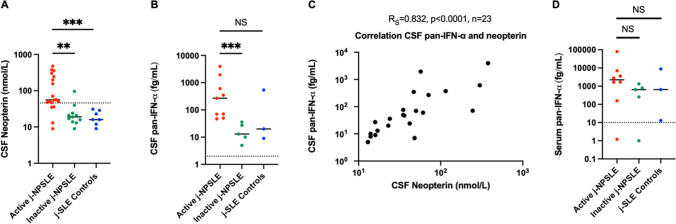
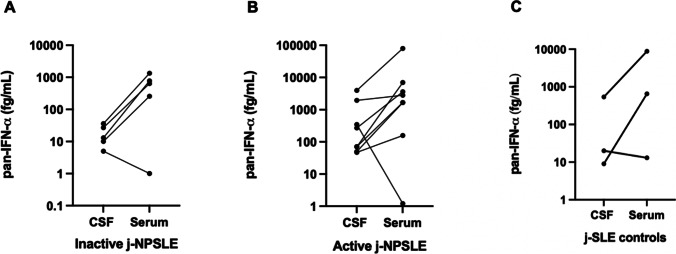
Among 51 patients with j-SLE included, 39% presented with j-NPSLE. J-NPSLE was diagnosed at onset of j-SLE in 65% of patients. No specific routine biological or radiological marker of j-NPSLE was identified. However, CSF neopterin levels were significantly higher in active j-NPSLE with CNS involvement than in j-SLE alone (p = 0.0008). Neopterin and IFN-α protein levels in CSF were significantly higher at diagnosis of j-NPSLE with CNS involvement than after resolution of NP features (respectively p = 0.0015 and p = 0.0010) upon immunosuppressive treatment in all patients tested (n = 10). Both biomarkers correlated strongly with each other (R = 0.832, p < 0.0001, n = 23 paired samples).
CSF IFN-α and neopterin constitute promising biomarkers useful in the diagnosis and monitoring of activity in j-NPSLE.
幼年系统性红斑狼疮(j-SLE)是一种罕见的慢性自身免疫性疾病,可影响多个器官。从轻微的表现,如头痛或轻度认知障碍,到严重和危及生命的表现,j-神经精神性 SLE(j-NPSLE)是一个治疗挑战。因此,NPSLE 的诊断仍然很困难,尤其是在儿科,目前还没有验证过该疾病的特异性生物标志物。
确定 j-NPSLE 的中枢神经系统(CNS)疾病生物标志物。
这是一项为期 5 年的回顾性三级参考单中心 j-SLE 研究。将标准化诊断标准和多学科儿科临床专业知识相结合,以确定在 j-SLE 背景下 NP 受累。评估了脑脊液(CSF)中的新蝶呤和干扰素-α(IFN-α)蛋白水平,以及常规的生物学和影像学检查。
在纳入的 51 例 j-SLE 患者中,39%出现 j-NPSLE。65%的 j-NPSLE 患者在 j-SLE 发病时即被诊断为 j-NPSLE。未发现 j-NPSLE 的特定常规生物学或影像学标志物。然而,与单纯 j-SLE 相比,有 CNS 受累的活动期 j-NPSLE 的 CSF 新蝶呤水平明显升高(p=0.0008)。在所有接受检查的患者(n=10)中,与 NP 特征缓解后相比,有 CNS 受累的 j-NPSLE 诊断时 CSF 中的新蝶呤和 IFN-α蛋白水平显著升高(分别为 p=0.0015 和 p=0.0010),并在接受免疫抑制治疗后。这两种生物标志物之间具有很强的相关性(R=0.832,p<0.0001,n=23 对样本)。
CSF IFN-α和新蝶呤是 j-NPSLE 诊断和监测活动的有前途的生物标志物。