Berlin School of Mind and Brain, Humboldt-Universität zu Berlin, Berlin, Germany.
Klinik für Psychiatrie and Psychotherapie, Charité, Universitätsmedizin Berlin, Berlin, Germany.
J Neurol. 2023 Mar;270(3):1637-1646. doi: 10.1007/s00415-022-11481-5. Epub 2022 Dec 6.
White matter hyperintensities (WMH) are the result of cerebral small vessel disease and may increase the risk of cognitive impairment (CI), recurrent stroke, and depression. We aimed to explore the association between selected cerebrovascular risk factors (CVRF) and WMH load as well as the effect of increased WMH burden on recurrent vascular events, CI, and depression in first-ever ischemic stroke patients.
431 from the PROSpective Cohort with Incident Stroke (PROSCIS) were included; Age-Related White Matter Changes (ARWMC) score was used to assess WMH burden on FLAIR. The presence of CVRF (defined via blood pressure, body-mass-index, and serological markers of kidney dysfunction, diabetes mellitus, and hyperlipoproteinemia) was categorized into normal, borderline, and pathological profiles based on commonly used clinical definitions. The primary outcomes included recurrent vascular events (combined endpoint of recurrent stroke, myocardial infarction and/or death), CI 3 years post-stroke, and depression 1-year post-stroke.
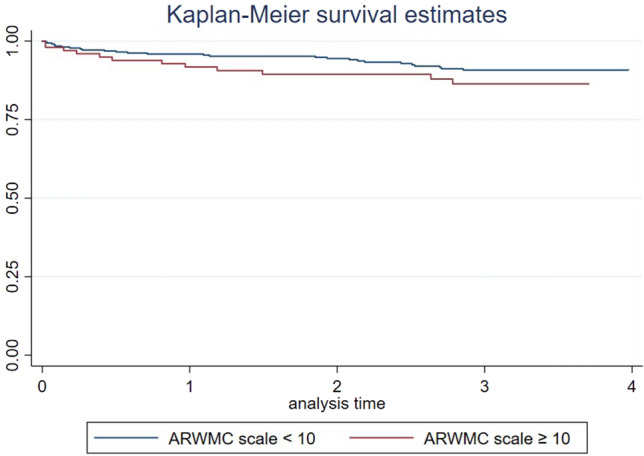
There was no clear association between CVRF profiles and WMH burden. High WMH lesion load (ARWMC score ≥ 10) was found to be associated with CI (adjusted OR 1.05 [95% CI 1.00-1.11]; p < 0.02) in a mixed-model analysis. Kaplan-Meier survival analysis showed a visible increase in the risk of recurrent vascular events following stroke; however, after adjustment, the risk was non-significant (HR 1.5 [95% CI 0.76-3]; p = 0.18). WMH burden was not associated with depression 1-year post stroke (adjusted OR 0.72 [95% CI 0.31-1.64]; p = 0.44).
Higher WMH burden was associated with a significant decline in cognition 3 years post-stroke in this cohort of first-ever stroke patients.
脑白质高信号(WMH)是小血管疾病的结果,可能增加认知障碍(CI)、复发性中风和抑郁的风险。我们旨在探讨选定的脑血管危险因素(CVRF)与 WMH 负荷之间的关系,以及增加的 WMH 负担对首发缺血性卒中患者复发性血管事件、CI 和抑郁的影响。
纳入了来自 PROSpective Cohort with Incident Stroke(PROSCIS)的 431 名患者;使用年龄相关性脑白质改变(ARWMC)评分评估 FLAIR 上的 WMH 负荷。CVRF(通过血压、体重指数以及肾功能、糖尿病和高脂蛋白血症的血清标志物定义)的存在分为正常、边缘和病理谱,基于常用的临床定义。主要结局包括复发性血管事件(复发性中风、心肌梗死和/或死亡的联合终点)、卒中后 3 年的 CI 和卒中后 1 年的抑郁。
CVRF 谱与 WMH 负荷之间没有明确的关联。在混合模型分析中,高 WMH 病变负荷(ARWMC 评分≥10)与 CI 相关(调整后的 OR 1.05[95%CI 1.00-1.11];p<0.02)。Kaplan-Meier 生存分析显示,卒中后复发性血管事件的风险明显增加;然而,调整后风险无统计学意义(HR 1.5[95%CI 0.76-3];p=0.18)。WMH 负荷与卒中后 1 年的抑郁无关(调整后的 OR 0.72[95%CI 0.31-1.64];p=0.44)。
在该队列首发卒中患者中,较高的 WMH 负荷与卒中后 3 年认知功能显著下降相关。