Division of Biometrics IX, Center for Drug Evaluation and Research, U.S. Food and Drug Administration, Silver Spring, MD, USA.
Division of Hematologic Malignancies II, Center for Drug Evaluation and Research, U.S. Food and Drug Administration, Silver Spring, MD, USA.
Blood Cancer J. 2021 Aug 31;11(8):148. doi: 10.1038/s41408-021-00543-y.
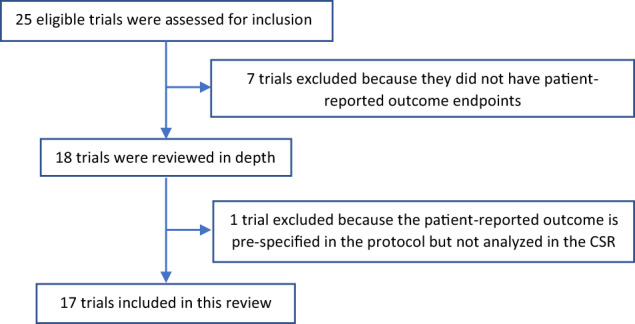
Over the past 13 years, there have been advances in characterizing the patient experience in oncology trials, primarily using patient-reported outcomes (PROs). This review aims to provide details on the PRO measures and analyses used in multiple myeloma (MM) registrational trials. We identified registrational trials supporting MM indications from 2007 to 2020 from FDA databases. Trial protocols, statistical analysis plans, and clinical study reports were reviewed for PRO measures used, collection methods, statistical analyses, baseline and instrument completion definitions, and thresholds for clinical meaningfulness. Twenty-five trials supporting 20 MM indications were identified; 17 (68%) contained submitted PRO data. Of the 17 trials, 14 were randomized controlled trials and the remainder were single-arm trials. All but one trial were open label trials. Seven trials collected data electronically and five in paper format. The majority of trials evaluated at least two PRO measures (82%) with two trials (12%) utilizing four measures. Nine unique PRO measures were used, most commonly the EORTC QLQ-30 (87%), EQ-5D (65%), and QLQ-MY20 (47%). All 17 (100%) trials provided descriptive summaries, 10 (59%) carried out longitudinal mixed model analysis, 9 (53%) conducted responder analysis, and 2 (12%) did a basic inferential test. We noted substantial heterogeneity in terms of PRO collection methods, measures, definitions, and analyses, which may hinder the ability to effectively capture and interpret patient experience in future MM clinical trials. Further research is needed to determine the most appropriate approaches for statistical and analytical methodologies for PRO data in MM trials.
在过去的 13 年中,人们在描述肿瘤学试验中的患者体验方面取得了进展,主要使用患者报告的结果(PROs)。本综述旨在详细介绍多发性骨髓瘤(MM)注册试验中使用的 PRO 措施和分析。我们从 FDA 数据库中确定了支持 MM 适应证的注册试验,这些试验来自 2007 年至 2020 年。我们查阅了试验方案、统计分析计划和临床研究报告,以了解所使用的 PRO 措施、收集方法、统计分析、基线和仪器完成定义以及临床意义的阈值。确定了支持 20 种 MM 适应证的 25 项试验;其中 17 项(68%)包含提交的 PRO 数据。在这 17 项试验中,14 项为随机对照试验,其余为单臂试验。除一项外,所有试验均为开放标签试验。有 7 项试验以电子方式收集数据,5 项以纸质格式收集数据。大多数试验评估了至少两种 PRO 措施(82%),其中两项试验(12%)使用了四种措施。使用了 9 种独特的 PRO 措施,最常用的是 EORTC QLQ-30(87%)、EQ-5D(65%)和 QLQ-MY20(47%)。所有 17 项(100%)试验均提供了描述性总结,10 项(59%)进行了纵向混合模型分析,9 项(53%)进行了应答者分析,2 项(12%)进行了基本推断测试。我们注意到在 PRO 收集方法、措施、定义和分析方面存在很大的异质性,这可能会阻碍在未来的 MM 临床试验中有效捕捉和解释患者体验的能力。需要进一步研究以确定 MM 试验中 PRO 数据的最合适统计和分析方法。