Institute for Educational and Health-Care Research in the Health Sector (InBVG), University of Applied Science Bielefeld, 33615 Bielefeld, Germany.
Int J Environ Res Public Health. 2022 Nov 30;19(23):16052. doi: 10.3390/ijerph192316052.
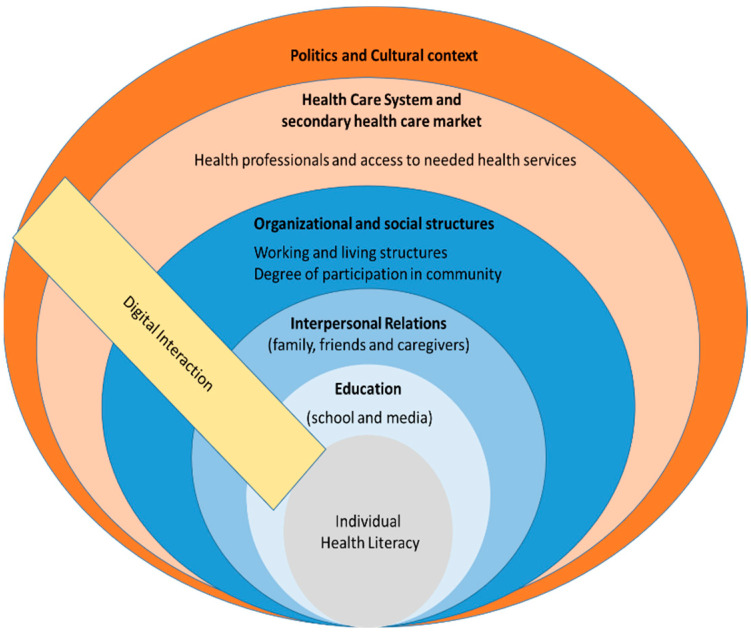
Health literacy is primarily understood as an individual construct. People with intellectual disabilities still seem to be a "hidden" population in health literacy research. A target-orientated health literacy approach for this population is needed for developing precise and effective interventions that consider social context dimensions. Therefore, the following research question was answered: Which dimensions influence the health literacy of people with intellectual disabilities? A secondary data analysis containing 38 guided interviews with people with mild to moderate intellectual disabilities was conducted. The analysis followed the content analysis by Schreier (2012). Six main dimensions were inductively outlined, which are "interpersonal relationship", "organizations and communities", "healthcare system", "education", "digital interaction spaces", "politics", and "cultural contexts". All these dimensions influence people with intellectual disabilities on an individual level regarding their level of health literacy. The importance of these single dimensions becomes clear, although for now, the link between all these dimensions is not yet considered. In future research, the focus should be on how to develop interventions considering social context dimensions. Furthermore, analyzing the connection between those dimensions seems promising.
健康素养主要被理解为一种个体建构。智障人士似乎仍然是健康素养研究中的一个“隐藏”群体。需要针对这一人群采用目标导向的健康素养方法,以便制定考虑社会背景维度的精确和有效的干预措施。因此,回答了以下研究问题:哪些维度影响智障人士的健康素养?对 38 名轻度至中度智障人士进行了 38 次指导性访谈的二次数据分析。分析遵循了 Schreier(2012 年)的内容分析。归纳出六个主要维度,分别是“人际关系”、“组织和社区”、“医疗保健系统”、“教育”、“数字互动空间”、“政治”和“文化背景”。所有这些维度都在个人层面上影响智障人士的健康素养水平。尽管目前还没有考虑到所有这些维度之间的联系,但这些单一维度的重要性变得显而易见。在未来的研究中,重点应该放在如何制定考虑社会背景维度的干预措施上。此外,分析这些维度之间的联系似乎很有前景。