Vollmer Andreas, Vollmer Michael, Lang Gernot, Straub Anton, Shavlokhova Veronika, Kübler Alexander, Gubik Sebastian, Brands Roman, Hartmann Stefan, Saravi Babak
Department of Oral and Maxillofacial Plastic Surgery, University Hospital of Würzburg, 97070 Würzburg, Germany.
Department of Oral and Maxillofacial Surgery, Tuebingen University Hospital, Osianderstrasse 2-8, 72076 Tuebingen, Germany.
J Clin Med. 2022 Dec 4;11(23):7210. doi: 10.3390/jcm11237210.
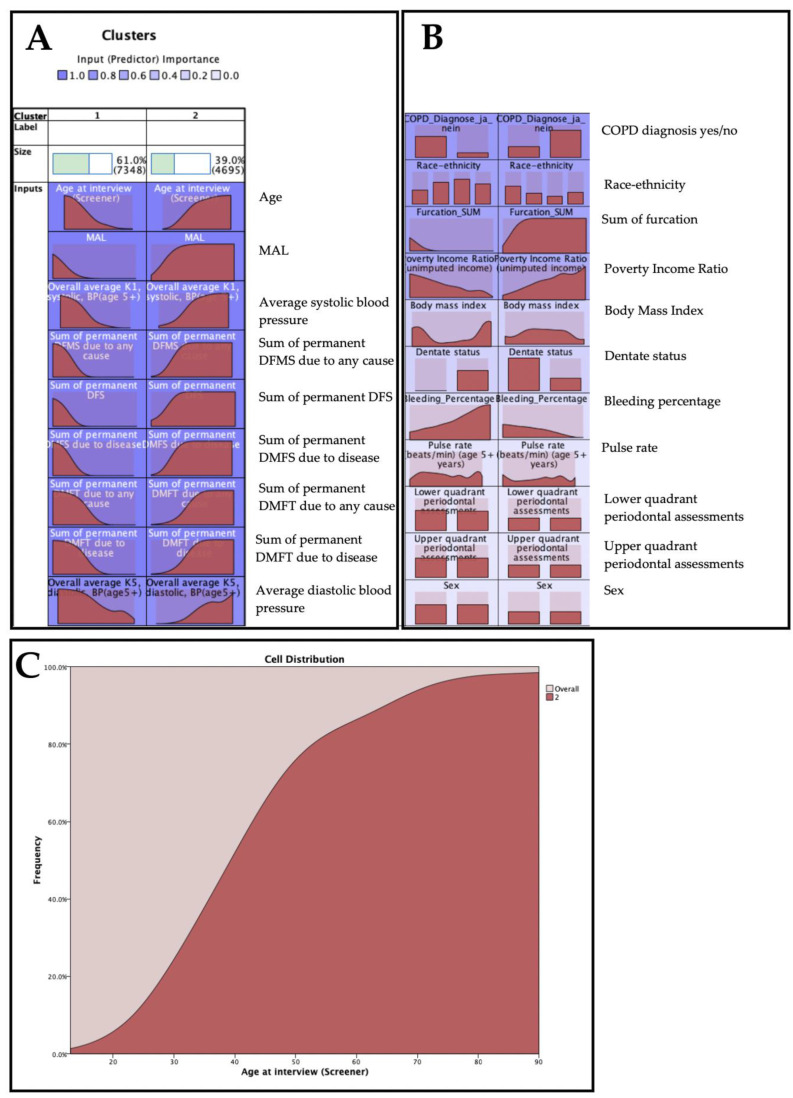
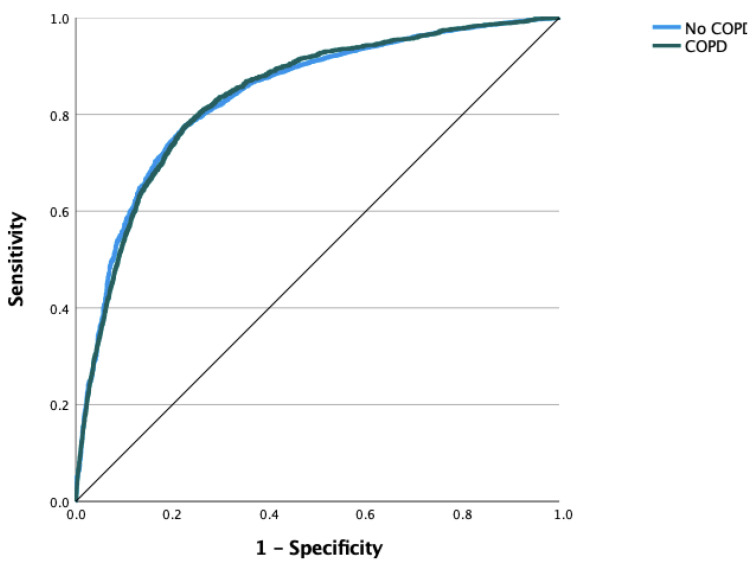
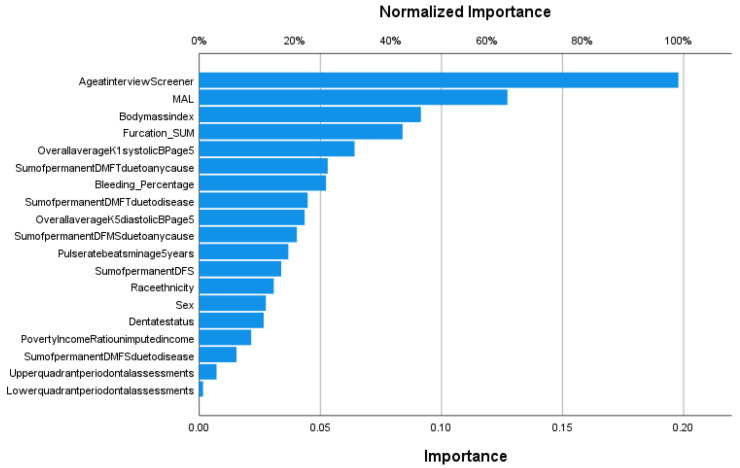
A number of cross-sectional epidemiological studies suggest that poor oral health is associated with respiratory diseases. However, the number of cases within the studies was limited, and the studies had different measurement conditions. By analyzing data from the National Health and Nutrition Examination Survey III (NHANES III), this study aimed to investigate possible associations between chronic obstructive pulmonary disease (COPD) and periodontitis in the general population. COPD was diagnosed in cases where FEV (1)/FVC ratio was below 70% (non-COPD versus COPD; binary classification task). We used unsupervised learning utilizing k-means clustering to identify clusters in the data. COPD classes were predicted with logistic regression, a random forest classifier, a stochastic gradient descent (SGD) classifier, k-nearest neighbors, a decision tree classifier, Gaussian naive Bayes (GaussianNB), support vector machines (SVM), a custom-made convolutional neural network (CNN), a multilayer perceptron artificial neural network (MLP), and a radial basis function neural network (RBNN) in Python. We calculated the accuracy of the prediction and the area under the curve (AUC). The most important predictors were determined using feature importance analysis. Results: Overall, 15,868 participants and 19 feature variables were included. Based on k-means clustering, the data were separated into two clusters that identified two risk characteristic groups of patients. The algorithms reached AUCs between 0.608 (DTC) and 0.953% (CNN) for the classification of COPD classes. Feature importance analysis of deep learning algorithms indicated that age and mean attachment loss were the most important features in predicting COPD. Conclusions: Data analysis of a large population showed that machine learning and deep learning algorithms could predict COPD cases based on demographics and oral health feature variables. This study indicates that periodontitis might be an important predictor of COPD. Further prospective studies examining the association between periodontitis and COPD are warranted to validate the present results.
多项横断面流行病学研究表明,口腔健康状况不佳与呼吸道疾病有关。然而,这些研究中的病例数量有限,且研究的测量条件各不相同。通过分析美国国家健康与营养检查调查三期(NHANES III)的数据,本研究旨在调查普通人群中慢性阻塞性肺疾病(COPD)与牙周炎之间可能存在的关联。当第一秒用力呼气容积(FEV₁)/用力肺活量(FVC)比值低于70%时诊断为COPD(非COPD与COPD;二元分类任务)。我们使用k均值聚类的无监督学习方法来识别数据中的聚类。使用逻辑回归、随机森林分类器、随机梯度下降(SGD)分类器、k近邻、决策树分类器、高斯朴素贝叶斯(GaussianNB)、支持向量机(SVM)、定制的卷积神经网络(CNN)、多层感知器人工神经网络(MLP)和径向基函数神经网络(RBNN)在Python中预测COPD类别。我们计算了预测的准确性和曲线下面积(AUC)。使用特征重要性分析确定最重要的预测因素。结果:总体而言,纳入了15868名参与者和19个特征变量。基于k均值聚类,数据被分为两个聚类,确定了两组具有不同风险特征的患者。这些算法对COPD类别的分类AUC在0.608(决策树分类器)和0.953%(卷积神经网络)之间。深度学习算法的特征重要性分析表明,年龄和平均附着丧失是预测COPD的最重要特征。结论:对大量人群的数据分析表明,机器学习和深度学习算法可以根据人口统计学和口腔健康特征变量预测COPD病例。本研究表明牙周炎可能是COPD的一个重要预测因素。有必要进行进一步的前瞻性研究来检验牙周炎与COPD之间的关联,以验证目前的结果。