Department of Orthopaedic Surgery, Stanford University, Stanford, CA 94305, USA.
Division of Physical Medicine and Rehabilitation, Stanford University, Stanford, CA 94305, USA.
Sensors (Basel). 2022 Nov 29;22(23):9301. doi: 10.3390/s22239301.
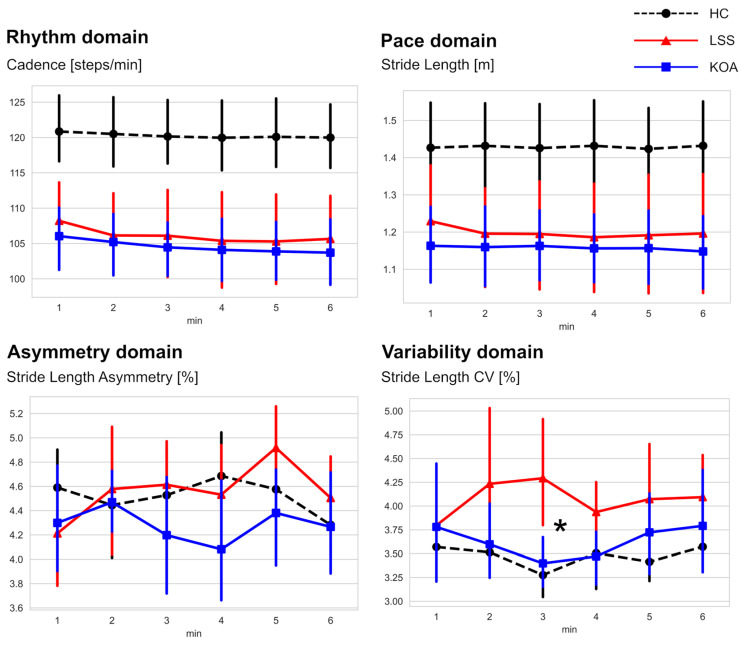
Mobility impairments are a common symptom of age-related degenerative diseases. Gait features can discriminate those with mobility disorders from healthy individuals, yet phenotyping specific pathologies remains challenging. This study aims to identify if gait parameters derived from two foot-mounted inertial measurement units (IMU) during the 6 min walk test (6MWT) can phenotype mobility impairment from different pathologies (Lumbar spinal stenosis (LSS)-neurogenic diseases, and knee osteoarthritis (KOA)-structural joint disease). Bilateral foot-mounted IMU data during the 6MWT were collected from patients with LSS and KOA and matched healthy controls (N = 30, 10 for each group). Eleven gait parameters representing four domains (pace, rhythm, asymmetry, variability) were derived for each minute of the 6MWT. In the entire 6MWT, gait parameters in all four domains distinguished between controls and both disease groups; however, the disease groups demonstrated no statistical differences, with a trend toward higher stride length variability in the LSS group ( = 0.057). Additional minute-by-minute comparisons identified stride length variability as a statistically significant marker between disease groups during the middle portion of 6WMT (3rd min: ≤ 0.05; 4th min: 0.06). These findings demonstrate that gait variability measures are a potential biomarker to phenotype mobility impairment from different pathologies. Increased gait variability indicates loss of gait rhythmicity, a common feature in neurologic impairment of locomotor control, thus reflecting the underlying mechanism for the gait impairment in LSS. Findings from this work also identify the middle portion of the 6MWT as a potential window to detect subtle gait differences between individuals with different origins of gait impairment.
行动障碍是与年龄相关的退行性疾病的常见症状。步态特征可将有行动障碍的人与健康个体区分开来,但表型特定病理仍然具有挑战性。本研究旨在确定在 6 分钟步行测试(6MWT)期间从两个脚部安装的惯性测量单元(IMU)获得的步态参数是否可以从不同的病理(腰椎管狭窄症(LSS)-神经源性疾病和膝骨关节炎(KOA)-结构性关节疾病)来表型行动障碍。从 LSS 和 KOA 患者以及匹配的健康对照组(每组 10 人,共 30 人)中收集了在 6MWT 期间双侧脚部安装的 IMU 数据。从 6MWT 的每一分钟得出代表四个领域(步速、节奏、不对称性、可变性)的 11 个步态参数。在整个 6MWT 中,所有四个领域的步态参数都能区分对照组和两个疾病组;然而,疾病组之间没有统计学差异,LSS 组的步长变异性呈上升趋势( = 0.057)。进一步的每分钟比较确定步长变异性是在 6WMT 的中间部分(第 3 分钟: ≤ 0.05;第 4 分钟: 0.06)疾病组之间具有统计学意义的标志。这些发现表明,步态变异性测量值是一种潜在的生物标志物,可用于从不同的病理表型行动障碍。步态变异性增加表明步态节奏性丧失,这是运动控制神经损伤的常见特征,因此反映了 LSS 中步态障碍的潜在机制。这项工作的结果还确定了 6MWT 的中间部分是检测具有不同起源的行动障碍个体之间细微步态差异的潜在窗口。