Department of Electrical Engineering and Computer Science, University of California, Irvine, CA 92697, USA.
Northwood High School, Irvine, CA 92620, USA.
Sensors (Basel). 2022 Dec 6;22(23):9547. doi: 10.3390/s22239547.
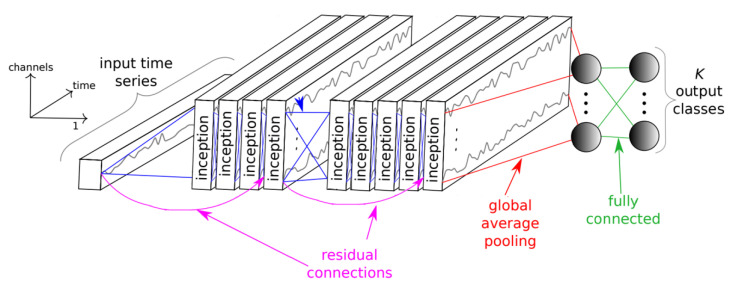
Despite the growing interest in the use of electroencephalogram (EEG) signals as a potential biometric for subject identification and the recent advances in the use of deep learning (DL) models to study neurological signals, such as electrocardiogram (ECG), electroencephalogram (EEG), electroretinogram (ERG), and electromyogram (EMG), there has been a lack of exploration in the use of state-of-the-art DL models for EEG-based subject identification tasks owing to the high variability in EEG features across sessions for an individual subject. In this paper, we explore the use of state-of-the-art DL models such as ResNet, Inception, and EEGNet to realize EEG-based biometrics on the BED dataset, which contains EEG recordings from 21 individuals. We obtain promising results with an accuracy of 63.21%, 70.18%, and 86.74% for Resnet, Inception, and EEGNet, respectively, while the previous best effort reported accuracy of 83.51%. We also demonstrate the capabilities of these models to perform EEG biometric tasks in real-time by developing a portable, low-cost, real-time Raspberry Pi-based system that integrates all the necessary steps of subject identification from the acquisition of the EEG signals to the prediction of identity while other existing systems incorporate only parts of the whole system.
尽管人们对将脑电图 (EEG) 信号用作潜在的生物识别特征的兴趣日益浓厚,并且最近在使用深度学习 (DL) 模型研究心电图 (ECG)、脑电图 (EEG)、视网膜电图 (ERG) 和肌电图 (EMG) 等神经信号方面也取得了进展,但由于个体在不同时间的 EEG 特征存在高度变异性,因此在基于 EEG 的主体识别任务中使用最先进的 DL 模型的探索还很少。在本文中,我们探索了使用最先进的 DL 模型,如 ResNet、Inception 和 EEGNet,来实现基于 BED 数据集的 EEG 生物识别,该数据集包含来自 21 个人的 EEG 记录。我们分别获得了 Resnet、Inception 和 EEGNet 的准确率为 63.21%、70.18%和 86.74%的有前景的结果,而之前报告的最佳准确率为 83.51%。我们还通过开发一个便携式、低成本、基于实时 Raspberry Pi 的系统来展示这些模型在实时执行 EEG 生物识别任务的能力,该系统集成了从 EEG 信号采集到身份预测的所有必要步骤,而其他现有系统仅集成了整个系统的一部分。