National Centre for Epidemiology and Population Health, College of Health & Medicine, Australian National University, Acton, ACT, Australia.
National Centre for Epidemiology and Population Health, College of Health & Medicine, Australian National University, Acton, ACT, Australia.
Lancet. 2022 Dec 10;400(10368):2084-2094. doi: 10.1016/S0140-6736(22)01639-7.
International and population-specific evidence identifies elevated psychological distress prevalence among those experiencing interpersonal discrimination. We aim to quantify the potential whole-of-population contribution of interpersonal discrimination to psychological distress prevalence and Indigenous-non-Indigenous gaps in Australia.
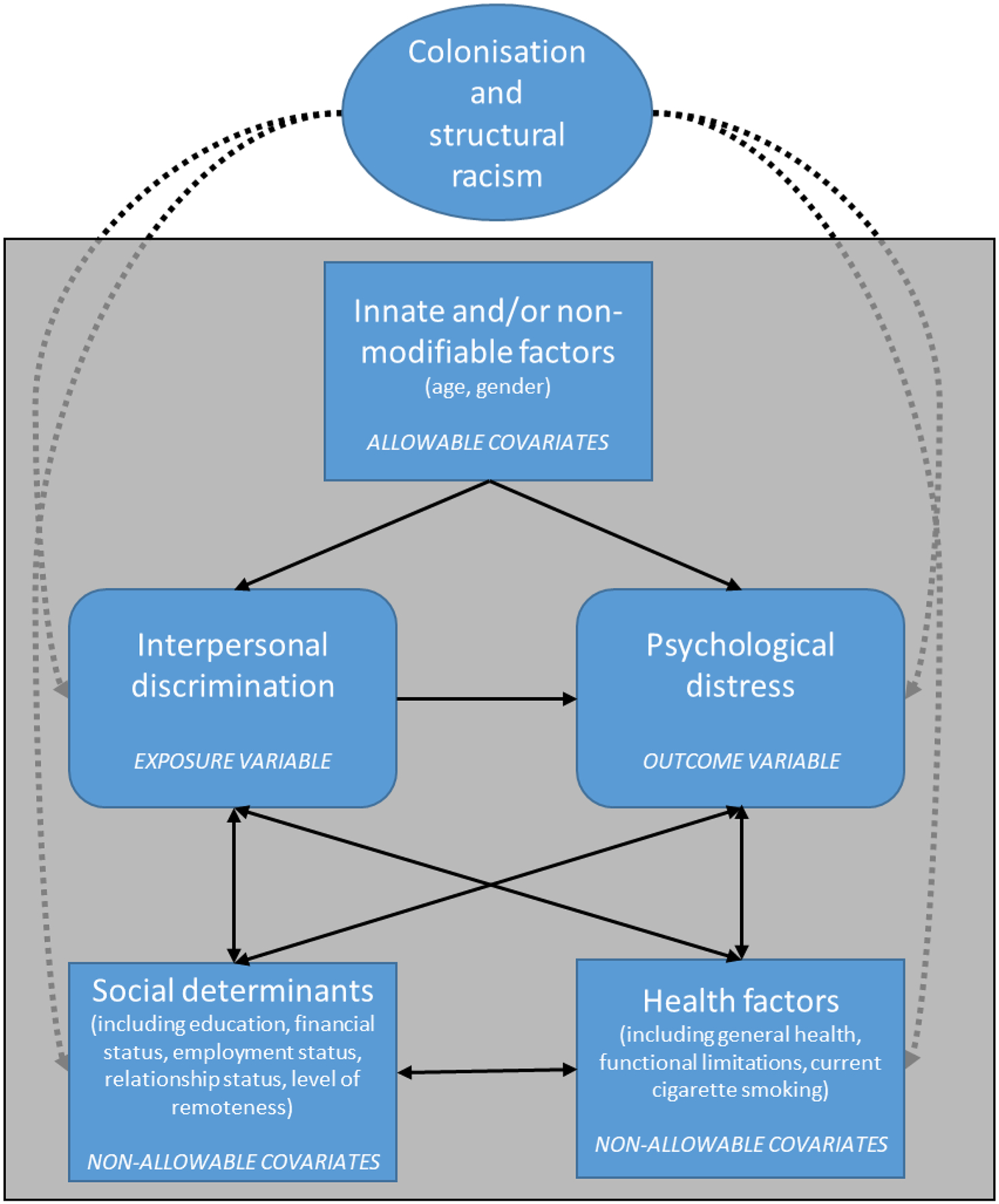
We did a cross-sectional analysis of data from Mayi Kuwayu: the National Study of Aboriginal and Torres Strait Islander Wellbeing. Baseline surveys were completed between June 8, 2018, and Sept 28, 2022. We analysed responses from participants who were aged 18 years or older at survey completion, whose surveys were processed between Oct 1, 2018, and May 1, 2021. Sample weights were developed on the basis of national population benchmarks. We measured everyday discrimination using an eight-item measure modified from the Everyday Discrimination Scale and classified experiences as racial discrimination if participants attributed these experiences to their Indigeneity. Psychological distress was measured using a validated, modified Kessler-5 scale. Applying logistic regression, we calculated unadjusted odds ratios (ORs), to approximate incident rate ratios (IRRs), for high or very high psychological distress in relation to everyday discrimination and everyday racial discrimination across age-gender strata. Population attributable fractions (PAFs), under the hypothetical assumption that ORs represent causal relationships, were calculated using these ORs and population-level exposure prevalence. These PAFs were used to quantify the contribution of everyday racial discrimination to psychological distress gaps between Indigenous and non-Indigenous adults.
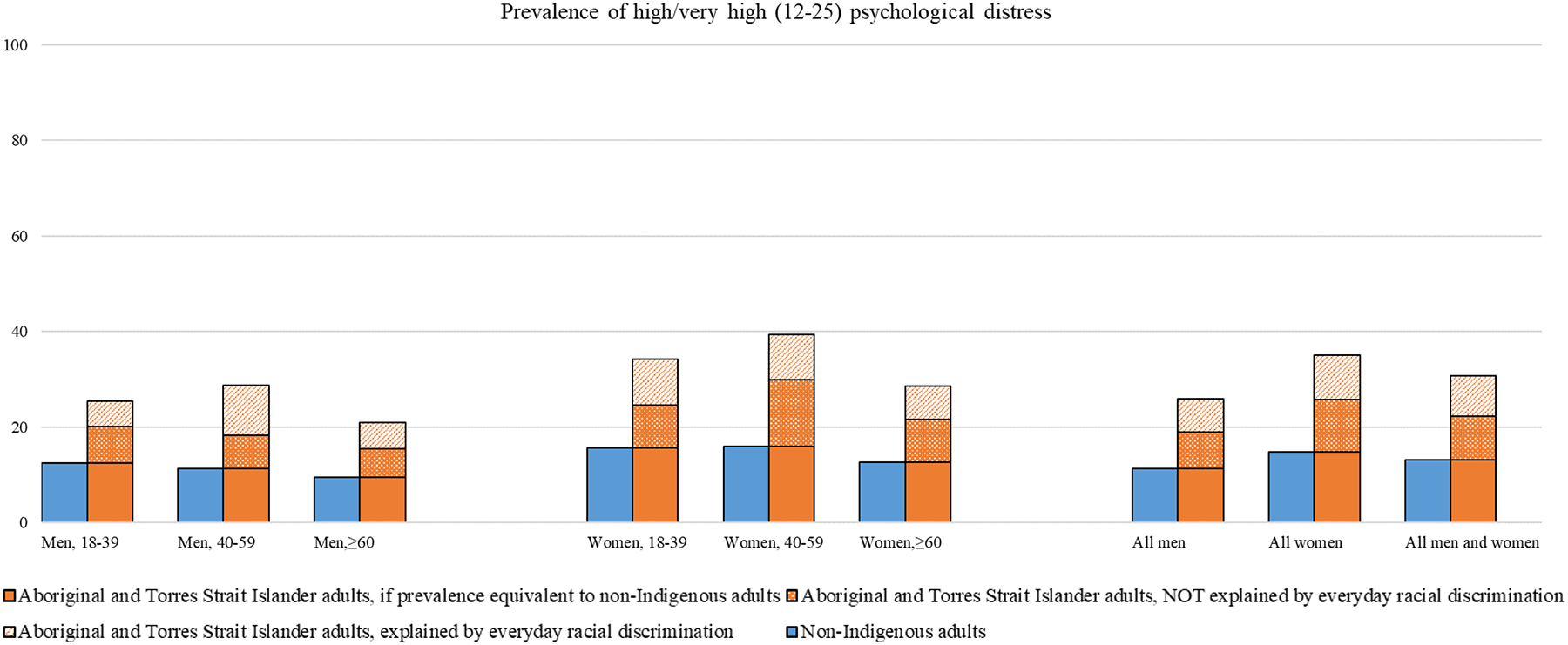
9963 survey responses were eligible for inclusion in our study, of which we analysed 9951 (99·9%); 12 were excluded due to responders identifying as a gender other than man or woman (there were too few responses from this demographic to be included as a category in stratified tables or adjusted analyses). The overall prevalence of psychological distress was 48·3% (95% CI 47·0-49·6) in those experiencing everyday discrimination compared with 25·2% (23·8-26·6) in those experiencing no everyday discrimination (OR 2·77 [95% CI 2·52-3·04]) and psychological distress prevalence was 49·0% (95% CI 47·3-50·6) in those experiencing everyday racial discrimination and 31·8% (30·6-33·1) in those experiencing no everyday racial discrimination (OR 2·06 [95% CI 1·88-2·25]. Overall, 49·3% of the total psychological distress burden among Aboriginal and Torres Strait Islander adults could be attributable to everyday discrimination (39·4-58·8% across strata) and 27·1% to everyday racial discrimination. Everyday racial discrimination could explain 47·4% of the overall gap in psychological distress between Indigenous and non-Indigenous people (40·0-60·3% across strata).
Our findings show that interpersonal discrimination might contribute substantially to psychological distress among Aboriginal and Torres Strait Islander adults, and to inequities compared with non-Indigenous adults. Estimated PAFs include contributions from social and health disadvantage, reflecting contributions from structural racism. Although not providing strictly conclusive evidence of causality, this evidence is sufficient to indicate the psychological harm of interpersonal discrimination. Findings add weight to imperatives to combat discrimination and structural racism at its core. Urgent individual and policy action is required of non-Indigenous people and colonial structures, directed by Aboriginal and Torres Strait Islander peoples.
National Health and Medical Research Council of Australia, Ian Potter Foundation, Australian Research Council, US National Institutes of Health, and Sierra Foundation.
国际和特定于人口的证据表明,经历人际歧视的人心理困扰的发生率较高。我们旨在量化人际歧视对澳大利亚心理困扰发生率和土著与非土著之间差距的整体人群贡献。
我们对来自 Mayi Kuwayu:澳大利亚原住民和托雷斯海峡岛民福祉全国研究的数据进行了横断面分析。基线调查于 2018 年 6 月 8 日至 2022 年 9 月 28 日进行。我们分析了在调查完成时年龄在 18 岁或以上、调查在 2018 年 10 月 1 日至 2021 年 5 月 1 日之间处理的参与者的回答。根据全国人口基准,制定了样本权重。我们使用从日常歧视量表修改而来的八项措施来衡量日常歧视,并将参与者归因于其土著身份的经验归类为种族歧视。使用经过验证的、经过修改的 Kessler-5 量表来衡量心理困扰。应用逻辑回归,我们计算了未调整的优势比(OR),以近似高或非常高心理困扰的发生率比(IRR),与年龄-性别分层的日常歧视和日常种族歧视有关。假设 OR 代表因果关系,使用这些 OR 和人群水平的暴露流行率计算人群归因分数(PAF)。这些 PAF 用于量化日常种族歧视对土著和非土著成年人之间心理困扰差距的贡献。
9963 份调查回复符合我们研究的条件,其中我们分析了 9951 份(99.9%);12 份因回复者识别为男性或女性以外的性别而被排除在外(由于该群体的回复太少,无法作为分层表或调整分析中的一个类别包括在内)。在经历日常歧视的人中,心理困扰的总体患病率为 48.3%(95%CI 47.0-49.6),而在没有经历日常歧视的人中,心理困扰的患病率为 25.2%(23.8-26.6)(OR 2.77 [95%CI 2.52-3.04]),在经历日常种族歧视的人中,心理困扰的患病率为 49.0%(95%CI 47.3-50.6),而在没有经历日常种族歧视的人中,心理困扰的患病率为 31.8%(30.6-33.1)(OR 2.06 [95%CI 1.88-2.25])。总体而言,土著和托雷斯海峡岛民成年人心理困扰负担的 49.3%可以归因于日常歧视(各层 39.4-58.8%),27.1%可以归因于日常种族歧视。日常种族歧视可以解释土著和非土著人群之间心理困扰总体差距的 47.4%(各层 40.0-60.3%)。
我们的发现表明,人际歧视可能会对土著和托雷斯海峡岛民成年人的心理困扰产生重大影响,并与非土著成年人之间存在不平等现象。估计的 PAF 包括社会和健康劣势的贡献,反映了结构性种族主义的贡献。虽然没有提供严格的因果关系证据,但这些证据足以表明人际歧视的心理伤害。研究结果进一步证明了打击歧视和结构性种族主义的必要性。非土著人民和殖民结构需要采取紧急的个人和政策行动,由土著和托雷斯海峡岛民人民领导。
澳大利亚国家卫生和医学研究委员会、伊恩·波特基金会、澳大利亚研究委员会、美国国立卫生研究院和塞拉基金会。