Healthcare-Associated Infections Group, Leeds Institute of Medical Research, Faculty of Medicine and Health.
School of Mechanical Engineering, University of Leeds, Leeds, U.K.
Curr Opin Gastroenterol. 2023 Jan 1;39(1):23-30. doi: 10.1097/MOG.0000000000000893. Epub 2022 Nov 3.
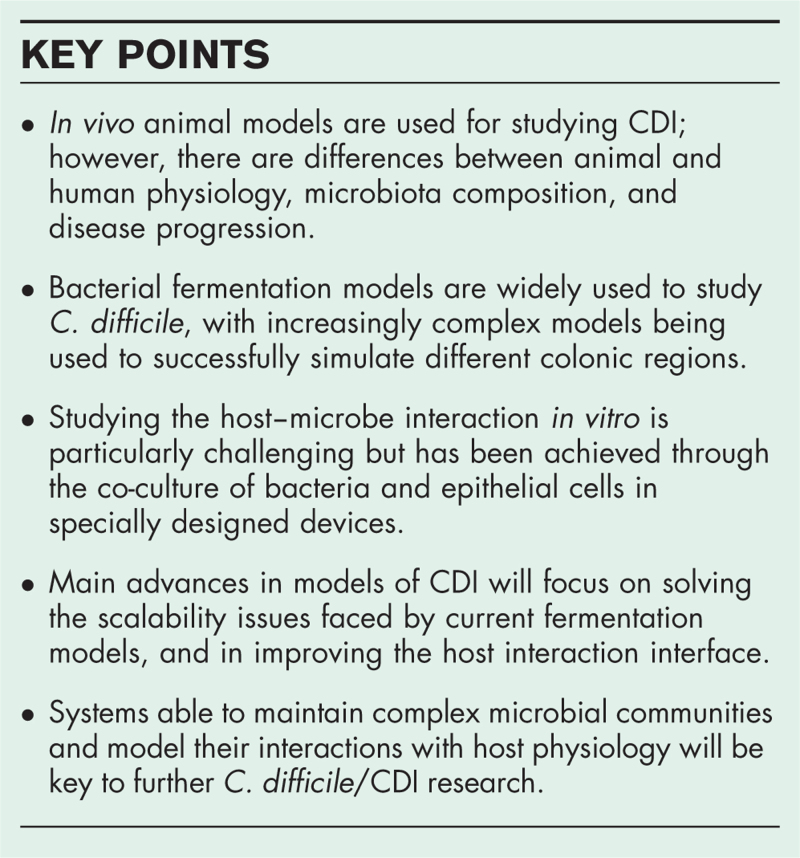
Clostridioides difficile infection (CDI) is the most common cause of healthcare-associated diarrhoea in western countries, being categorized as an urgent healthcare threat. Historically, researchers have relied on the use of in vivo animal models to study CDI pathogenesis; however, differences in physiology and disease prognosis compared with humans limit their suitability to model CDI. In vitro models are increasingly being used as an alternative as they offer excellent process control, and some are able to use human ex-vivo prokaryotic and/or eukaryotic cells.
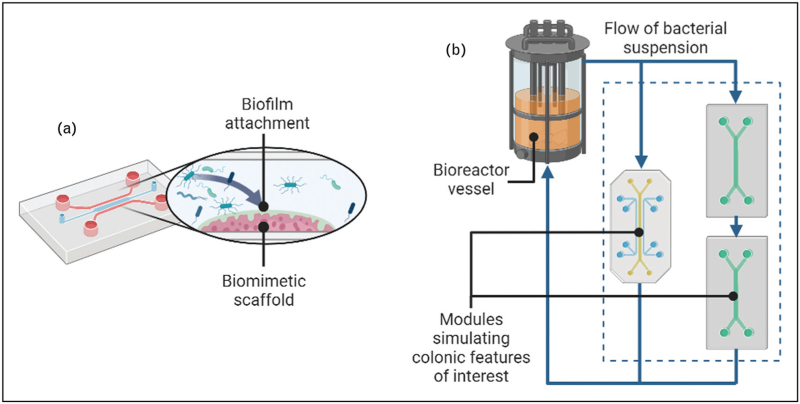
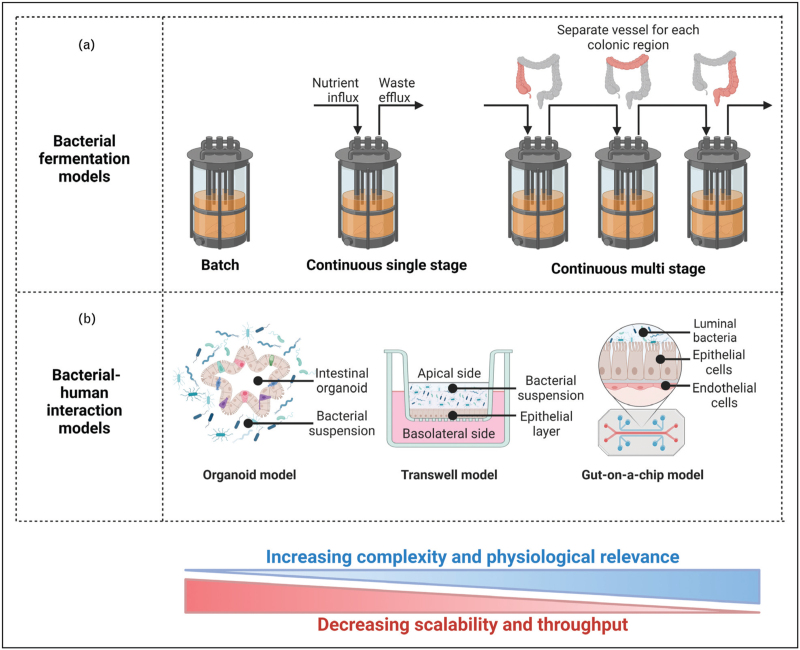
Simulating the colonic environment in vitro is particularly challenging. Bacterial fermentation models have been used to evaluate novel therapeutics, explore the re-modelling of the gut microbiota, and simulate disease progression. However, they lack the scalability to become more widespread. Models that co-culture human and bacterial cells are of particular interest, but the different conditions required by each cell type make these models challenging to run. Recent advancements in model design have allowed for longer culture times with more representative bacterial populations.
As in vitro models continue to evolve, they become more physiologically relevant, offering improved simulations of CDI, and extending their applicability.
艰难梭菌感染(CDI)是西方国家最常见的医源性腹泻病因,被归类为紧急的医疗保健威胁。从历史上看,研究人员依赖于使用体内动物模型来研究 CDI 的发病机制;然而,与人类相比,其在生理学和疾病预后方面的差异限制了它们对 CDI 模型的适用性。体外模型越来越多地被用作替代方法,因为它们提供了出色的过程控制,并且有些模型能够使用人离体原核和/或真核细胞。
体外模拟结肠环境特别具有挑战性。细菌发酵模型已被用于评估新型疗法、探索肠道微生物组的再重塑以及模拟疾病进展。然而,它们缺乏可扩展性,无法更广泛地应用。共培养人和细菌细胞的模型特别有趣,但每种细胞类型所需的不同条件使得这些模型难以运行。最近在模型设计方面的进展使得能够进行更长时间的培养并具有更具代表性的细菌群体。
随着体外模型的不断发展,它们变得更具生理学相关性,能够更好地模拟 CDI,并扩展其适用性。