Occupational Sleep Research Center, Baharloo Hospital, Tehran University of Medical Sciences, Tehran, Iran.
Bio-Intelligence Research Unit, Electrical Engineering Department, Sharif University of Technology, Tehran, Iran.
Front Public Health. 2022 Nov 25;10:997626. doi: 10.3389/fpubh.2022.997626. eCollection 2022.
The COVID-19 pandemic has considerably affected human beings most of whom are healthcare workers (HCWs) combating the disease in the front line.
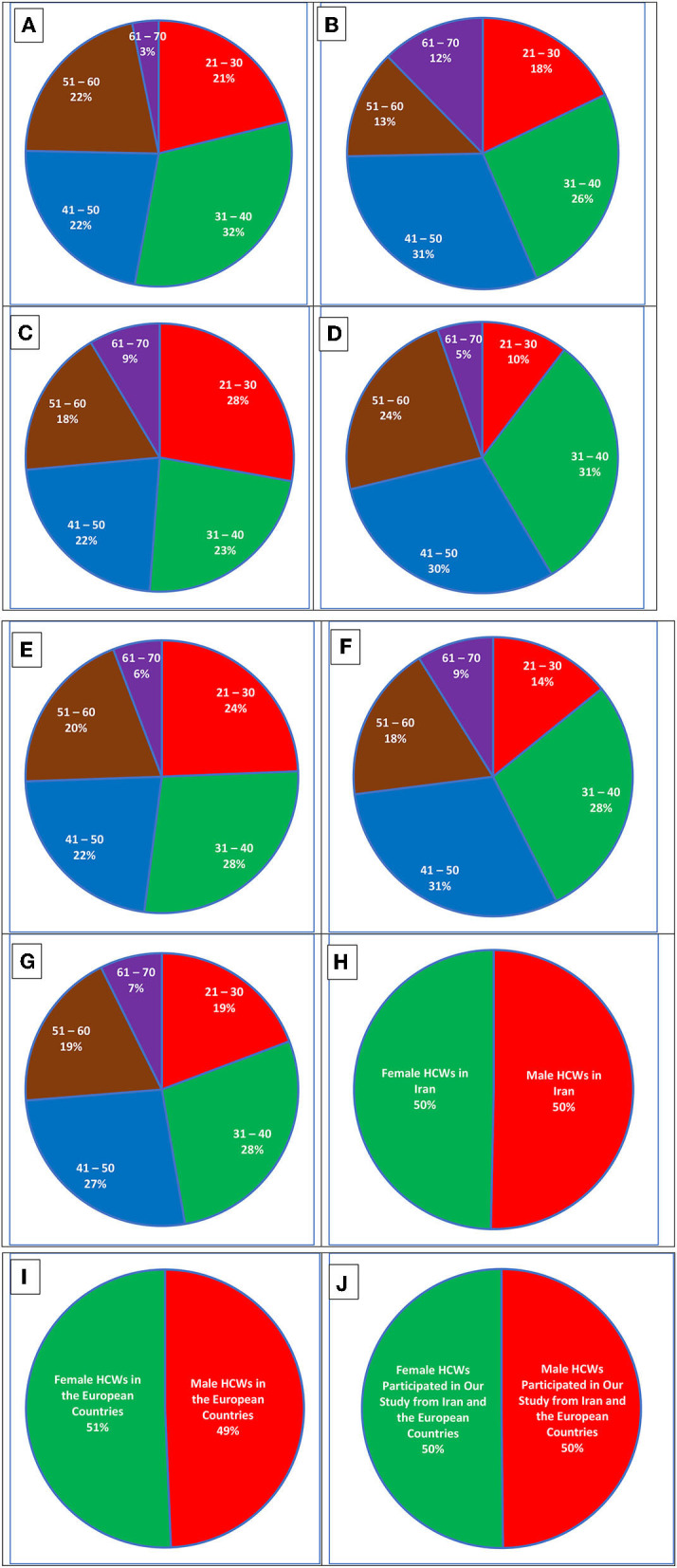
This cross-sectional study aims to explore the effects of stress and anxiety caused by COVID-19 on the quality of sleep and life in HCWs, including physicians, nurses, and other healthcare staff. In this global study, we asked 1,210 HCWs (620 and 590 volunteers from Iran and European countries, including Germany, the Netherlands, and Italy, respectively), who age 21-70, to participate in the test. Several measures of COVID-related stress, anxiety, sleep, and life quality, including the 12-item General Health Questionnaire (GHQ-12), Fear of COVID-19 scale (FCV-19S), Beck Anxiety Inventory (BAI), the Pittsburgh Sleep Quality Index (PSQI), and World Health Organization Quality of Life-BREF (WHOQOL-BREF) are recorded.
Volunteers reported high rates of stress and anxiety and poor sleep quality as well as lower quality of life. The correlation analysis between the measures is reported. According to the results, regardless of the location, HCWs, predominantly female nurses, developed anxiety and stress symptoms which consequently resulted in lower sleep and life quality. Both for Iranian and the European HCWs, significant differences existed between nurses and the other two groups, with the -values equal to 0.0357 and 0.0429 for GHQ-12, 0.0368, and 0.714 for BAI measure. Even though nurses reported the most stress, anxiety, fear of COVID-19, lower quality of life and sleep in both countries, and also an increase in other measures as well, there existed no statistically significant difference in FCV-19S, PSQI, and WHOQOL-BREF.
This study helps to expand our knowledge the effects of pandemics on HCWs and also for healthcare management to predict HCW's mental health conditions in similar situations.
COVID-19 大流行对人类造成了重大影响,其中大多数是在前线抗击疾病的医护人员(HCWs)。
本横断面研究旨在探讨 COVID-19 引起的医护人员(包括医生、护士和其他医护人员)的压力和焦虑对其睡眠和生活质量的影响。在这项全球性研究中,我们要求年龄在 21-70 岁之间的 1210 名 HCWs(分别来自伊朗和欧洲国家的 620 名和 590 名志愿者,包括德国、荷兰和意大利)参与测试。记录了与 COVID 相关的压力、焦虑、睡眠和生活质量的几个衡量标准,包括 12 项一般健康问卷(GHQ-12)、COVID-19 恐惧量表(FCV-19S)、贝克焦虑量表(BAI)、匹兹堡睡眠质量指数(PSQI)和世界卫生组织生活质量简表(WHOQOL-BREF)。
志愿者报告了高压力和焦虑率以及睡眠质量差和生活质量低。报告了这些措施之间的相关性分析。根据结果,无论地理位置如何,HCWs 主要是女性护士,都出现了焦虑和压力症状,从而导致睡眠和生活质量下降。对于伊朗和欧洲的 HCWs,护士与其他两组之间存在显著差异,GHQ-12 的-值等于 0.0357 和 0.0429,BAI 测量值为 0.0368 和 0.714。尽管护士在这两个国家报告的压力、焦虑、对 COVID-19 的恐惧、生活质量和睡眠最低,并且其他指标也有所增加,但在 FCV-19S、PSQI 和 WHOQOL-BREF 方面没有统计学上的显著差异。
本研究有助于扩展我们对大流行对 HCWs 影响的认识,也有助于医疗保健管理部门预测类似情况下 HCW 的心理健康状况。