Luo Lianmin, Li Fenghua, Gong Binbin, Xi Ping, Xie Wenjie
Department of Urology, The First Affiliated Hospital of Nanchang University, Nanchang, Jiangxi, China.
Department of Obstetrics and Gynecology, The First Affiliated Hospital of Nanchang University, Nanchang, Jiangxi, China.
Front Oncol. 2022 Nov 23;12:937951. doi: 10.3389/fonc.2022.937951. eCollection 2022.
Cellular senescence plays crucial role in the progression of tumors. However, the expression patterns and clinical significance of cellular senescence-related genes in bladder cancer (BCa) are still not clearly clarified. This study aimed to establish a prognosis model based on senescence-related genes in BCa.
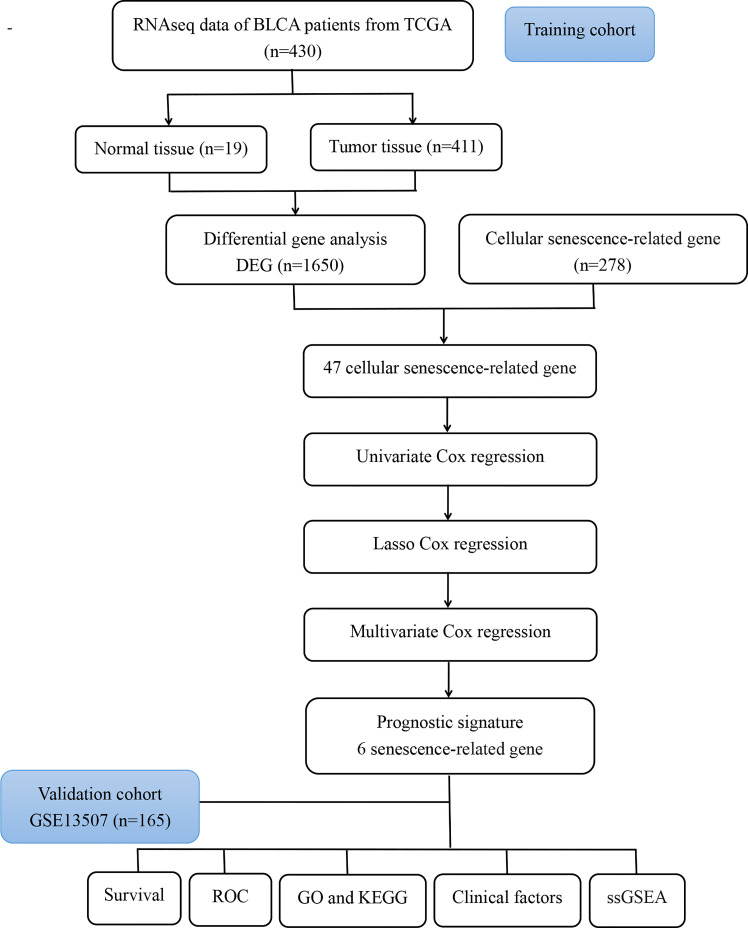
The transcriptional profile data and clinical information of BCa were downloaded from TCGA and GEO databases. The least absolute shrinkage and selection operator (LASSO), univariate and multivariate Cox regression analyses were performed to develop a prognostic model in the TCGA cohort. The GSE13507 cohort were used for validation. Gene ontology (GO), Kyoto Encyclopedia of Genes and Genomes (KEGG), and single-sample gene set enrichment analysis (ssGSEA) were performed to investigate underlying mechanisms.
A six-gene signature (CBX7, EPHA3, STK40, TGFB1I1, SREBF1, MYC) was constructed in the TCGA databases. Patients were classified into high risk and low risk group in terms of the median risk score. Survival analysis revealed that patients in the higher risk group presented significantly worse prognosis. Receiver operating characteristic (ROC) curve analysis verified the moderate predictive power of the risk model based on the six senescence-related genes signature. Further analysis indicated that the clinicopathological features analysis were significantly different between the two risk groups. As expected, the signature presented prognostic significance in the GSE13507 cohort. Functional analysis indicated that immune-related pathways activity, immune cell infiltration and immune-related function were different between two risk groups. In addition, risk score were positively correlated with multiple immunotherapy biomarkers.
Our study revealed that a novel model based on senescence-related genes could serve as a reliable predictor of survival for patients with BCa.
细胞衰老在肿瘤进展中起关键作用。然而,膀胱癌(BCa)中细胞衰老相关基因的表达模式及临床意义仍未明确阐明。本研究旨在建立基于BCa衰老相关基因的预后模型。
从TCGA和GEO数据库下载BCa的转录谱数据及临床信息。在TCGA队列中进行最小绝对收缩和选择算子(LASSO)、单因素和多因素Cox回归分析以建立预后模型。使用GSE13507队列进行验证。进行基因本体论(GO)、京都基因与基因组百科全书(KEGG)和单样本基因集富集分析(ssGSEA)以探究潜在机制。
在TCGA数据库中构建了一个六基因特征(CBX7、EPHA3、STK40、TGFB1I1、SREBF1、MYC)。根据中位风险评分将患者分为高风险和低风险组。生存分析显示,高风险组患者的预后明显更差。受试者工作特征(ROC)曲线分析验证了基于六个衰老相关基因特征的风险模型具有中等预测能力。进一步分析表明,两个风险组之间的临床病理特征分析存在显著差异。正如预期的那样,该特征在GSE13507队列中具有预后意义。功能分析表明,两个风险组之间的免疫相关通路活性、免疫细胞浸润和免疫相关功能存在差异。此外,风险评分与多种免疫治疗生物标志物呈正相关。
我们的研究表明,基于衰老相关基因的新型模型可作为BCa患者生存的可靠预测指标。