Whitney Laboratory for Marine Bioscience, University of Florida, St Augustine, Florida 32080.
Department of Biology, University of Florida, Gainesville, Florida 32611.
Genome Biol Evol. 2023 Jan 4;15(1). doi: 10.1093/gbe/evac172.
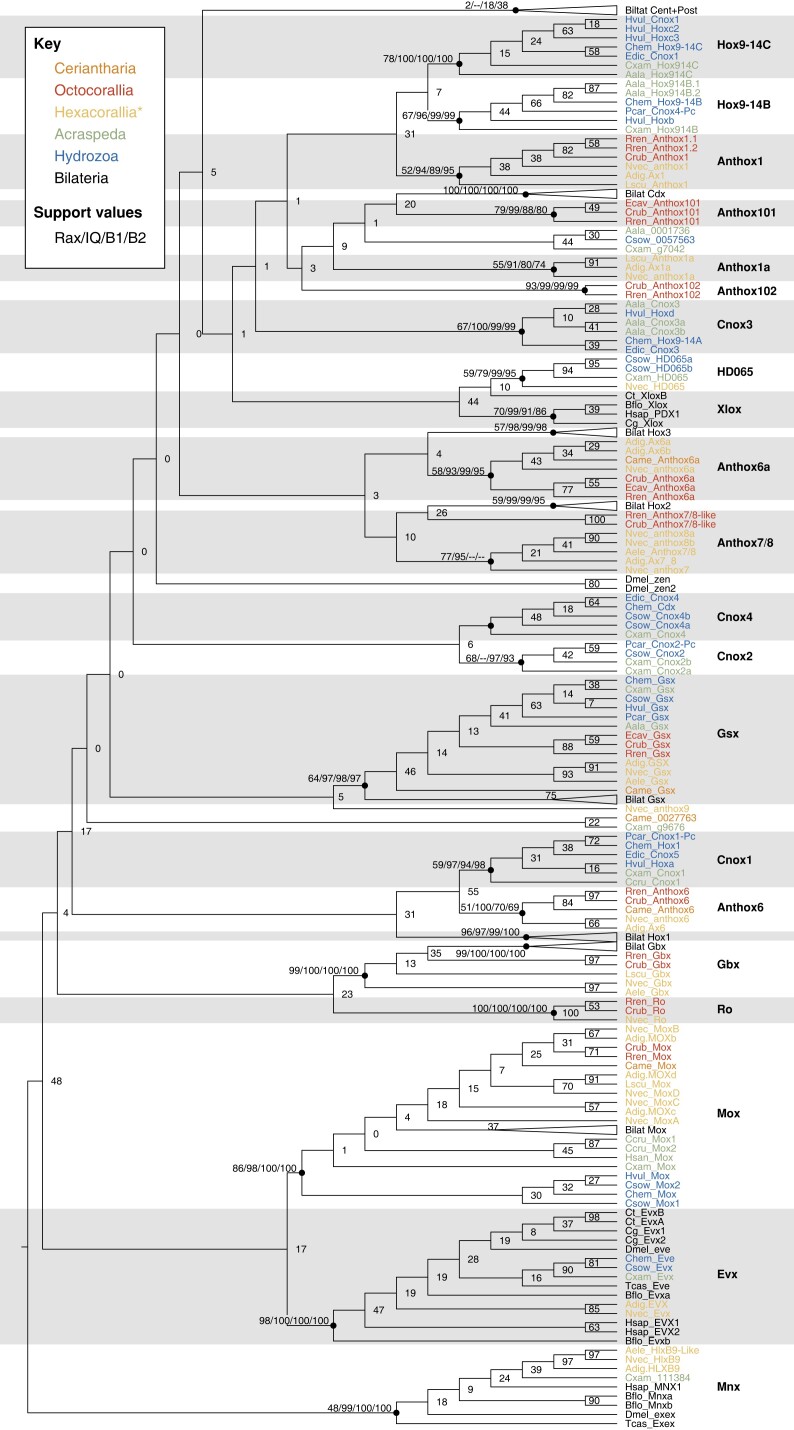
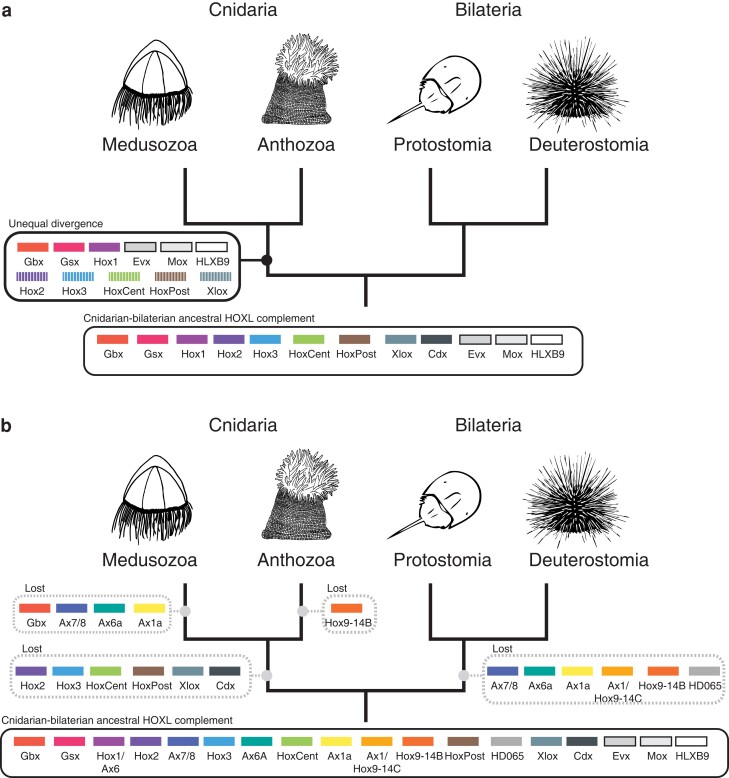
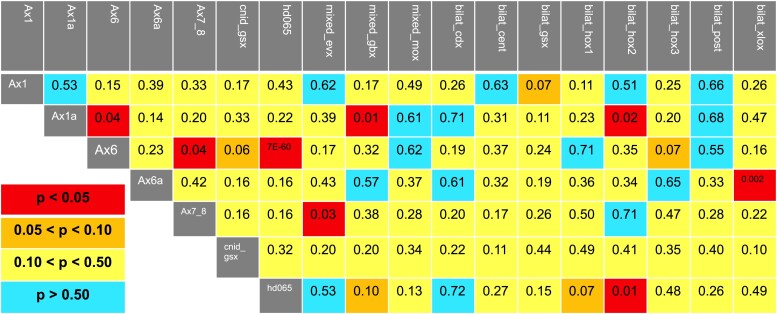
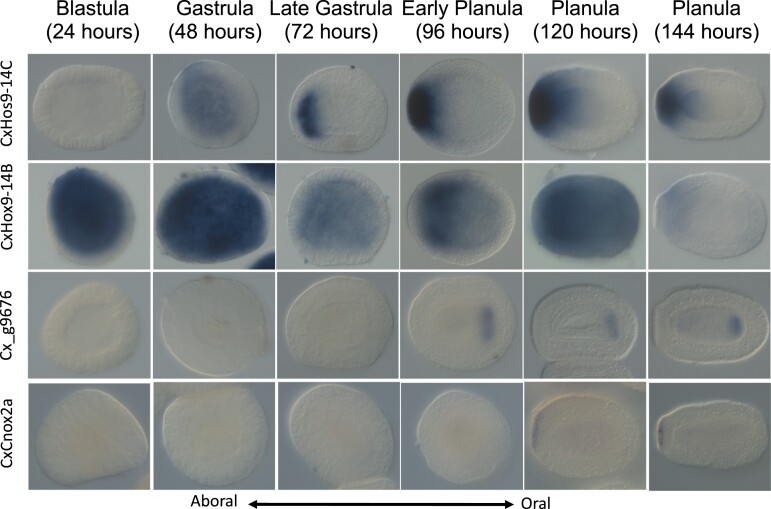
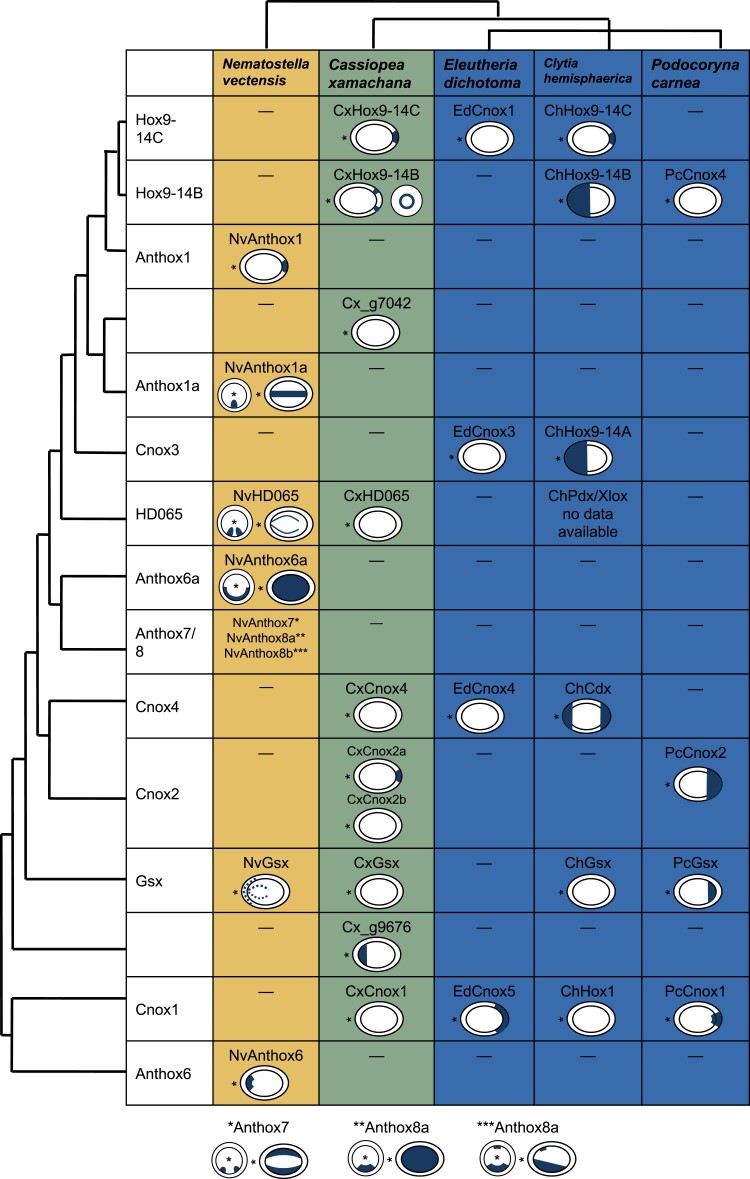
Hox and ParaHox transcription factors are important for specifying cell fates along the primary body axes during the development of most animals. Within Cnidaria, much of the research on Hox/ParaHox genes has focused on Anthozoa (anemones and corals) and Hydrozoa (hydroids) and has concentrated on the evolution and function of cnidarian Hox genes in relation to their bilaterian counterparts. Here we analyze together the full complement of Hox and ParaHox genes from species representing all four medusozoan classes (Staurozoa, Cubozoa, Hydrozoa, and Scyphozoa) and both anthozoan classes (Octocorallia and Hexacorallia). Our results show that Hox genes involved in patterning the directive axes of anthozoan polyps are absent in the stem leading to Medusozoa. For the first time, we show spatial and temporal expression patterns of Hox and ParaHox genes in the upside-down jellyfish Cassiopea xamachana (Scyphozoa), which are consistent with diversification of medusozoan Hox genes both from anthozoans and within medusozoa. Despite unprecedented taxon sampling, our phylogenetic analyses, like previous studies, are characterized by a lack of clear homology between most cnidarian and bilaterian Hox and Hox-related genes. Unlike previous studies, we propose the hypothesis that the cnidarian-bilaterian ancestor possessed a remarkably large Hox complement and that extensive loss of Hox genes was experienced by both cnidarian and bilaterian lineages.
Hox 和 ParaHox 转录因子对于大多数动物的体轴发育过程中细胞命运的特化非常重要。在刺胞动物门中,大量关于 Hox/ParaHox 基因的研究集中在 Anthozoa(海葵和珊瑚)和 Hydrozoa(水螅)上,重点研究了刺胞动物 Hox 基因的进化和功能与其双边动物对应物的关系。在这里,我们一起分析了来自代表所有四个水母类群(Staurozoa、Cubozoa、Hydrozoa 和 Scyphozoa)以及两个 Anthozoa 类群(Octocorallia 和 Hexacorallia)的物种的完整 Hox 和 ParaHox 基因。我们的研究结果表明,在导向刺胞动物水螅体的茎中不存在参与模式形成的 Anthozoa 水螅体的 Hox 基因。我们首次展示了倒置水母 Cassiopea xamachana(Scyphozoa)中 Hox 和 ParaHox 基因的时空表达模式,这些模式与 Medusozoa 中 Hox 基因的多样化一致,既来自 Anthozoa,也来自 Medusozoa 内部。尽管我们的系统发育分析进行了前所未有的分类群采样,但与之前的研究一样,大多数刺胞动物和双边动物的 Hox 和 Hox 相关基因之间缺乏明确的同源性。与之前的研究不同,我们提出了这样的假设,即刺胞动物-双边动物的祖先拥有一个显著庞大的 Hox 基因库,并且刺胞动物和双边动物的谱系都经历了 Hox 基因的广泛丢失。