CTAG, Centro Tecnolóxico de Automoción de Galicia, Porriño, Spain.
CNRS, ISM, Institut des Sciences du Mouvement: Etienne-Jules MAREY (UMR 7287), Faculté des Sciences du Sport, Aix-Marseille Université, Marseille, France.
PLoS One. 2022 Dec 12;17(12):e0278131. doi: 10.1371/journal.pone.0278131. eCollection 2022.
Identification of the seat features that could improve driving experience is a main issue for automotive companies.
Long duration real driving sessions were performed to assess the effect of three seats (soft-S1, firm-S2 and suspended-S3) on perceived discomfort and neuromuscular fatigue (NMF).
MATERIALS & METHODS: For each seat, the muscular activity of bilateral Trapezius Descendens (TD), Erector Spinae (ES) and Multifidus (MF) muscles of twenty-one participants was recorded during real driving sessions of 3-hours each lasting approximately 3 hours and following the same itinerary. During each driving session, participants were also regularly asked to self-evaluate their level of whole-body and local discomfort. In addition, an endurance static test (EST) was performed before (ESTpre) and after (ESTpost) each driving session to assess the seat effect on physical capacity.
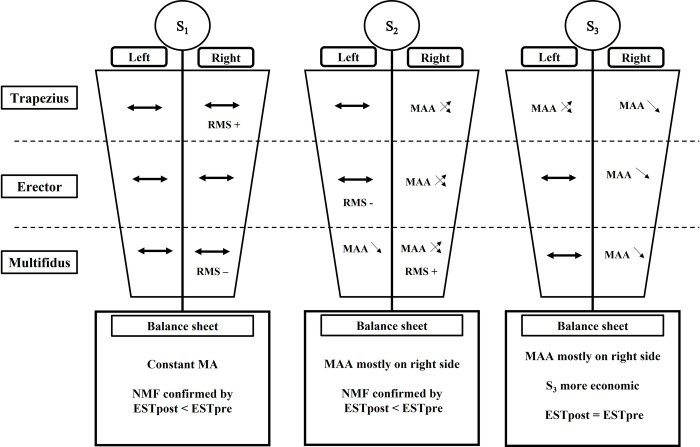
Whole-body discomfort increased with driving time for all seats, but this increase became significant latter for S3. The highest scores of local discomfort occurred for neck and lower back. Contrary to S1 and S2, the duration of ESTpost was not significantly lower compared to ESTpre with the S3. Interestingly, muscular activity of S1 remained stable throughout the driving task which could be attributed to sustained muscular contraction, while muscular recruitment adjustments occurred for S2 and S3 from 1H00 of driving. This muscular compensation concerns mostly the right side for S2 and S3 but with different profiles. On the left side, the muscular adjustments concern only the MF with S2 and the ES with S3.
Overall, our results demonstrated that S3 could be considered as the most suitable seat to delay discomfort and NMF appearance.
确定能改善驾驶体验的座椅特点是汽车公司的主要问题。
进行长时间的真实驾驶测试,以评估三种座椅(软 S1、硬 S2 和悬浮 S3)对感知不适和神经肌肉疲劳(NMF)的影响。
对于每种座椅,21 名参与者在 3 小时的真实驾驶测试中,记录双侧斜方肌下降部(TD)、竖脊肌(ES)和多裂肌(MF)的肌肉活动,每个测试持续约 3 小时,遵循相同的行程。在每次驾驶测试中,参与者还定期自我评估全身和局部不适程度。此外,在每次驾驶测试之前(ESTpre)和之后(ESTpost)进行耐力静态测试(EST),以评估座椅对体能的影响。
所有座椅的全身不适随驾驶时间的增加而增加,但 S3 在后半段的增加更为显著。颈部和下背部的局部不适评分最高。与 S1 和 S2 相反,S3 的 ESTpost 持续时间与 ESTpre 相比没有显著降低。有趣的是,S1 的肌肉活动在整个驾驶任务中保持稳定,这可能归因于持续的肌肉收缩,而 S2 和 S3 从驾驶 1 小时后开始调整肌肉募集。这种肌肉补偿主要涉及 S2 和 S3 的右侧,但具有不同的模式。在左侧,S2 仅涉及 MF,S3 仅涉及 ES 的肌肉调整。
总体而言,我们的结果表明,S3 可以被认为是最适合延迟不适和 NMF 出现的座椅。