Fred Hutchinson Cancer Center, Seattle, WA.
Department of Medicine, University of Washington, Seattle, WA.
Blood Adv. 2023 Sep 12;7(17):4728-4737. doi: 10.1182/bloodadvances.2022009164.
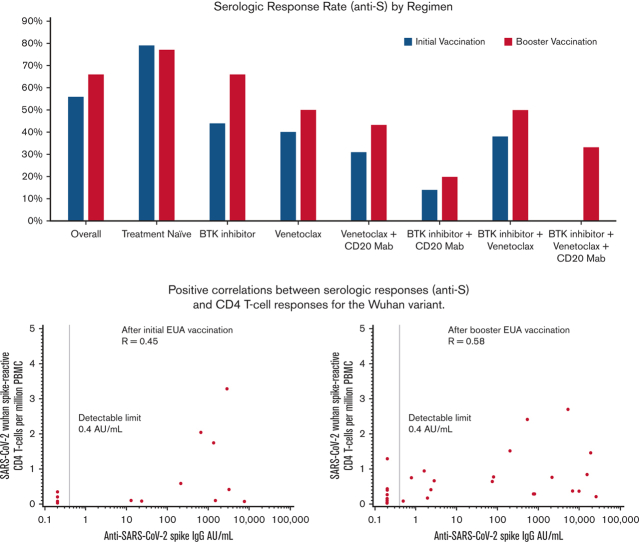
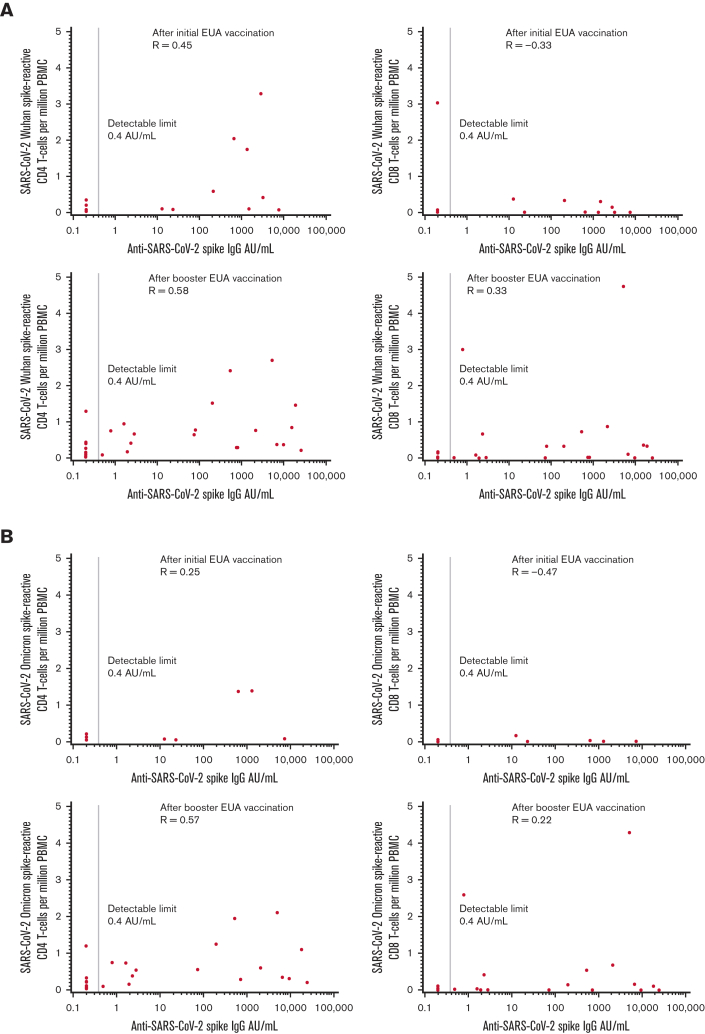
Previous studies have demonstrated low rates of seroconversion to severe acute respiratory syndrome coronavirus 2 (SARS-CoV-2) messenger RNA (mRNA) vaccines in patients with chronic lymphocytic leukemia (CLL). In this national collaboration of 11 cancer centers in the United States, we aimed to further characterize and understand vaccine-induced immune responses, including T-cell responses, and the impact of CLL therapeutics (#NCT04852822). Eligible patients were enrolled in 2 cohorts (1) at the time of initial vaccination and (2) at the time of booster vaccination. The serologic response rates (anti-S) from 210 patients in the initial vaccination cohort and 117 in the booster vaccination cohort were 56% (95% confidence interval [CI], 50-63) and 68% (95% CI, 60-77), respectively. Compared with patients not on therapy, those receiving B-cell-directed therapy were less likely to seroconvert (odds ratio [OR], 0.27; 95% CI, 0.15-0.49). Persistence of response was observed at 6 months; anti-S titers increased with the administration of booster vaccinations. In the initial vaccination cohort, positive correlations were observed between the quantitative serologic response and CD4 T-cell response for the Wuhan variant and, to a lesser degree, for the Omicron variant (Spearman P = 0.45 Wuhan; P = 0.25 Omicron). In the booster vaccination cohort, positive correlations were observed between serologic responses and CD4 T-cell responses for both variants (P = 0.58 Wuhan; P = 0.57 Omicron) and to a lesser degree for CD8 T-cell responses (P = 0.33 Wuhan; P = 0.22 Omicron). Although no deaths from coronavirus disease 2019 (COVID-19) have been reported after booster vaccinations, patients should use caution as newer variants emerge and escape vaccine-induced immunity. This trial was registered at www.clinicaltrials.gov as #NCT04852822.
先前的研究表明,慢性淋巴细胞白血病(CLL)患者对严重急性呼吸综合征冠状病毒 2(SARS-CoV-2)信使 RNA(mRNA)疫苗的血清转化率较低。在美国 11 家癌症中心的这项全国性合作研究中,我们旨在进一步描述和了解疫苗诱导的免疫反应,包括 T 细胞反应,以及 CLL 疗法的影响(#NCT04852822)。符合条件的患者被纳入 2 个队列(1)在初次接种疫苗时,(2)在加强接种疫苗时。210 例初始接种疫苗队列和 117 例加强接种疫苗队列的血清学反应率(抗-S)分别为 56%(95%置信区间[CI],50-63)和 68%(95%CI,60-77)。与未接受治疗的患者相比,接受 B 细胞靶向治疗的患者血清转化率较低(比值比[OR],0.27;95%CI,0.15-0.49)。在 6 个月时观察到反应的持久性;加强接种疫苗后,抗-S 滴度增加。在初始接种疫苗队列中,观察到武汉变异株的定量血清学反应与 CD4 T 细胞反应之间存在正相关关系,而与奥密克戎变异株的相关程度较小(Spearman P = 0.45 武汉;P = 0.25 奥密克戎)。在加强接种疫苗队列中,观察到两种变异株的血清学反应与 CD4 T 细胞反应之间存在正相关关系(P = 0.58 武汉;P = 0.57 奥密克戎),与 CD8 T 细胞反应的相关程度较小(P = 0.33 武汉;P = 0.22 奥密克戎)。尽管在加强接种疫苗后没有报告与 2019 年冠状病毒病(COVID-19)相关的死亡病例,但随着新的变异株出现并逃避疫苗诱导的免疫,患者仍应谨慎使用。该试验在 www.clinicaltrials.gov 上注册为 #NCT04852822。