Department of Neurosurgery, Shengjing Hospital of China Medical University, Shenyang, 110004, Liaoning, China.
Department of Oncology, Shengjing Hospital of China Medical University, Shenyang, 110004, Liaoning, China.
World J Surg Oncol. 2022 Dec 15;20(1):398. doi: 10.1186/s12957-022-02871-0.
Loss of G2-specific E3-like (G2E3) protein sensitizes tumor cells to chemotherapy. However, the role of G2E3 in breast cancer development and patient's prognosis is unclear. Here, we explored the expression, prognostic significance, and regulatory pathway of G2E3 in breast cancer.
TCGA and UALCAN database were utilized to explore G2E3 expression in breast cancer and normal tissues and its expression in breast cancer based on clinicopathological characteristics, respectively. The Kaplan-Meier plotter database was utilized to determine the effect of G2E3 on the prognosis of breast cancer patients. RT-PCR was utilized to validate the G2E3 expression in cancerous and normal breast tissues. Immunohistochemistry analysis was utilized to validate the prognostic effect of G2E3 expression in breast cancer patients and the relationship between G2E3 expression and lymphocyte infiltration levels. Receiver operating characteristic (ROC) curves were also generated to validate the diagnostic value of G2E3 expression in recurrence/distant organ metastasis and death. The STRING database, DAVID database, and Sanger-box tools were utilized to perform GO functional, KEGG pathway enrichment, and GSEA analysis. The TISIDB database was utilized to determine the relationship between G2E3 expression and tumor immunity. Finally, CTD database was utilized to screen for potential therapeutic compounds that could reduce the G2E3 mRNA expression.
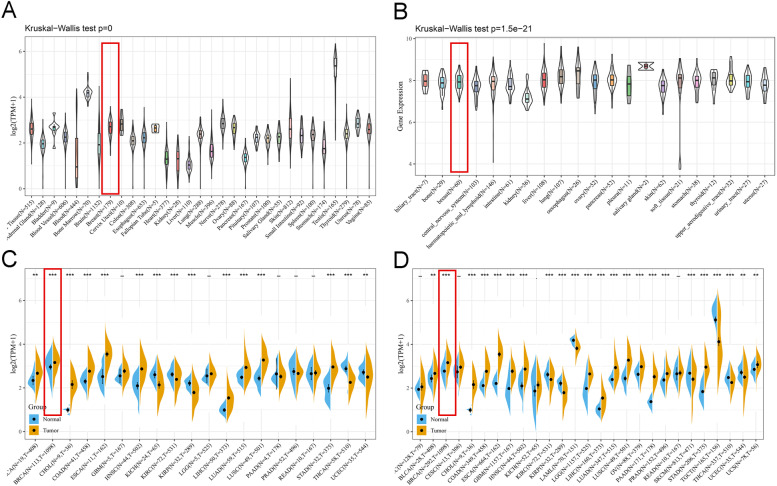
TCGA data presented that G2E3 expression was higher in breast cancer tissues than in normal breast tissues. This result was further validated by RT-PCR (P = 0.003). The Kaplan-Meier plotter database suggested that patients with high G2E3 mRNA expression had significantly shorter RFS and OS than patients with low G2E3 mRNA expression. Immunohistochemistry analysis of 156 breast cancer clinical specimens also validated patients with G2E3-positive expression had a significantly shorter DFS and OS than patients with G2E3-negative expression. Thus, G2E3 expression was an independent prognostic predictor of DFS and OS. The G2E3-positive expression also has a high diagnostic value for recurrence/distant organ metastasis and death. GSEA analysis revealed that G2E3 might be enriched in the E2F, PI3K/AKT/mTOR signaling, DNA repair pathways, and other cancer-related signaling pathways. The TISIDB database showed that G2E3 expression was significantly negatively associated with lymphocyte infiltration. This result was further validated in clinical breast cancer samples (P = 0.048; R = -0.158). Using the CTD database, we found that (+)-JQ1 compound, 1,2-dimethylhydrazine, and other compounds may decrease the G2E3 mRNA expression. These compounds could serve as potential therapeutic compounds for the clinical treatment of breast cancer.
G2E3 expression was higher in breast cancer tissues than in normal tissues. G2E3-positive expression was related to a worse survival outcome in patients with breast cancer. Genes co-expressed with G2E3 may be enriched in the breast cancer-related signaling pathways. The G2E3 expression was significantly negatively associated with lymphocyte infiltration. G2E3 may serve as a novel prognostic biomarker and therapeutic target for breast cancer.
G2 特异性 E3 样蛋白(G2E3)的缺失使肿瘤细胞对化疗敏感。然而,G2E3 在乳腺癌发展和患者预后中的作用尚不清楚。在这里,我们探讨了 G2E3 在乳腺癌中的表达、预后意义和调控途径。
利用 TCGA 和 UALCAN 数据库分别探讨了 G2E3 在乳腺癌和正常组织中的表达情况,以及其在乳腺癌中的表达与临床病理特征的关系。利用 Kaplan-Meier plotter 数据库确定了 G2E3 对乳腺癌患者预后的影响。利用 RT-PCR 验证了癌组织和正常乳腺组织中 G2E3 的表达。利用免疫组织化学分析验证了 G2E3 表达在乳腺癌患者中的预后作用及其与淋巴细胞浸润水平的关系。还生成了受试者工作特征(ROC)曲线,以验证 G2E3 表达在复发/远处器官转移和死亡中的诊断价值。利用 STRING 数据库、DAVID 数据库和 Sanger-box 工具进行 GO 功能、KEGG 通路富集和 GSEA 分析。利用 TISIDB 数据库确定 G2E3 表达与肿瘤免疫的关系。最后,利用 CTD 数据库筛选可能降低 G2E3 mRNA 表达的潜在治疗性化合物。
TCGA 数据显示,G2E3 在乳腺癌组织中的表达高于正常乳腺组织。这一结果通过 RT-PCR 进一步验证(P = 0.003)。Kaplan-Meier plotter 数据库提示,G2E3 mRNA 表达水平较高的患者的 RFS 和 OS 明显短于 G2E3 mRNA 表达水平较低的患者。对 156 例乳腺癌临床标本的免疫组织化学分析也验证了 G2E3 阳性表达的患者的 DFS 和 OS 明显短于 G2E3 阴性表达的患者。因此,G2E3 表达是 DFS 和 OS 的独立预后预测因子。G2E3 阳性表达对复发/远处器官转移和死亡也具有较高的诊断价值。GSEA 分析表明,G2E3 可能富集于 E2F、PI3K/AKT/mTOR 信号通路、DNA 修复途径等与癌症相关的信号通路中。TISIDB 数据库显示,G2E3 表达与淋巴细胞浸润呈显著负相关。这一结果在临床乳腺癌样本中进一步得到验证(P = 0.048;R = -0.158)。利用 CTD 数据库,我们发现(+)-JQ1 化合物、1,2-二甲基肼等化合物可能降低 G2E3 mRNA 表达。这些化合物可能成为治疗乳腺癌的潜在治疗性化合物。
G2E3 在乳腺癌组织中的表达高于正常组织。G2E3 阳性表达与乳腺癌患者的生存结局较差有关。与 G2E3 共表达的基因可能富集在乳腺癌相关的信号通路中。G2E3 表达与淋巴细胞浸润呈显著负相关。G2E3 可能成为一种新的预后生物标志物和治疗靶点,用于乳腺癌的治疗。