Lv Min-Yi, Chen Xi-Jie, Chen Jun-Guo, Zhang Bin, Lin Yan-Yun, Huang Tian-Ze, He De-Gao, Wang Kai, Chi Zeng-Jie, Hu Jian-Cong, He Xiao-Sheng
Department of Colorectal Surgery, The Sixth Affiliated Hospital, Sun Yat-sen University, Guangzhou, Guangdong, P. R. China.
Guangdong Institute of Gastroenterology, Guangzhou, Guangdong, P. R. China.
Gastroenterol Rep (Oxf). 2022 Dec 8;10:goac072. doi: 10.1093/gastro/goac072. eCollection 2022.
Prognosis varies among stage IV colorectal cancer (CRC). Our study aimed to build a robust prognostic nomogram for predicting overall survival (OS) of patients with stage IV CRC in order to provide evidence for individualized treatment.
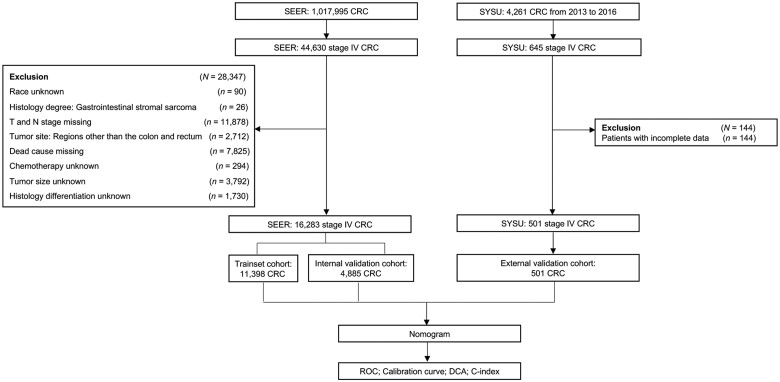
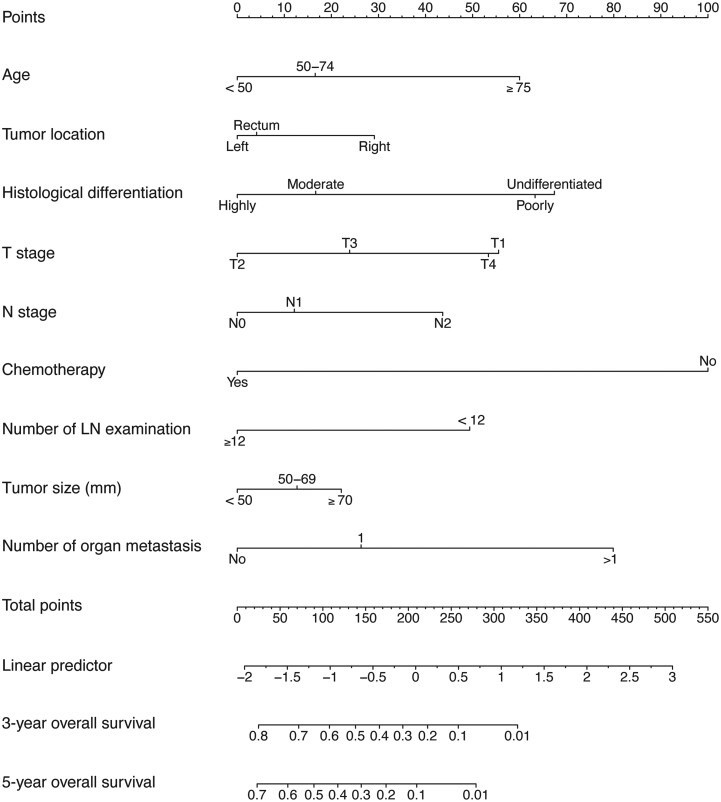
We collected the information of 16,283 patients with stage IV CRC in the Surveillance, Epidemiology, and End Results (SEER) database and then randomized these patients in a ratio of 7:3 into a training cohort and an internal validation cohort. In addition, 501 patients in the Sixth Affiliated Hospital of Sun Yat-sen University (Guangzhou, China) database were selected and used as an external validation cohort. Univariate and multivariate Cox analyses were used to screen out significant variables for nomogram establishment. The nomogram model was assessed using time-dependent receiver-operating characteristic curve (time-dependent ROC), concordance index (C-index), calibration curve, and decision curve analysis. Survival curves were plotted using the Kaplan-Meier method.
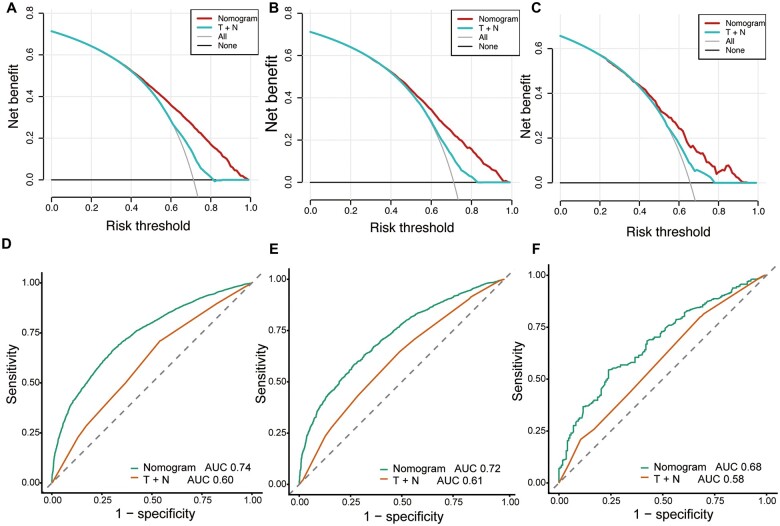
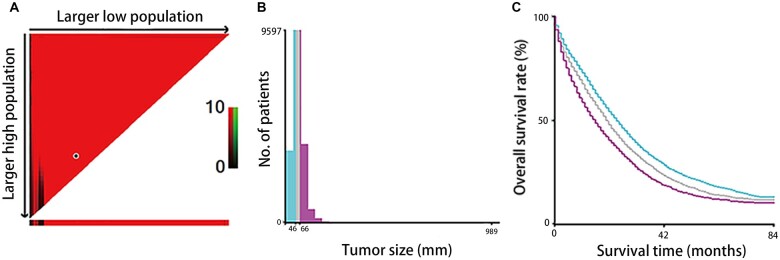
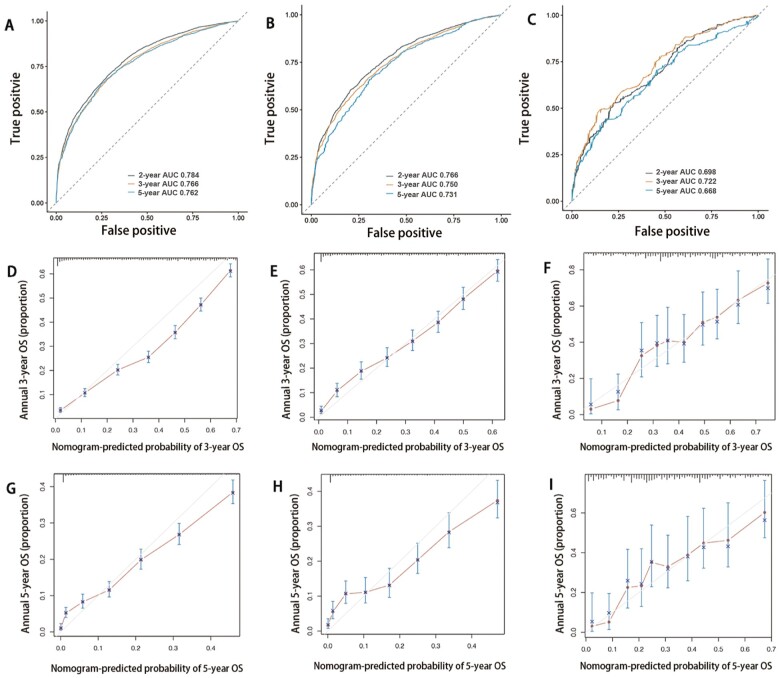
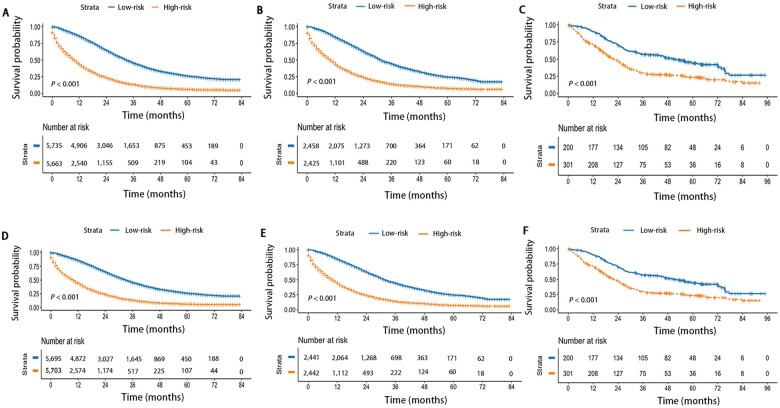
The C-index of the nomogram for OS in the training, internal validation, and external validation cohorts were 0.737, 0.727, and 0.655, respectively. ROC analysis and calibration curves pronounced robust discriminative ability of the model. Further, we divided the patients into a high-risk group and a low-risk group according to the nomogram. Corresponding Kaplan-Meier curves showed that the prediction of the nomogram was consistent with the actual practice. Additionally, model comparisons and decision curve analysis proved that the nomogram for predicting prognosis was significantly superior to the tumor-node-metastasis (TNM) staging system.
We constructed a nomogram to predict OS of the stage IV CRC and externally validate its generalization, which was superior to the TNM staging system.
IV期结直肠癌(CRC)患者的预后各不相同。我们的研究旨在构建一个强大的预后列线图,以预测IV期CRC患者的总生存期(OS),从而为个体化治疗提供依据。
我们收集了监测、流行病学和最终结果(SEER)数据库中16283例IV期CRC患者的信息,然后将这些患者按7:3的比例随机分为训练队列和内部验证队列。此外,选取中山大学附属第六医院(中国广州)数据库中的501例患者作为外部验证队列。采用单因素和多因素Cox分析筛选出用于构建列线图的显著变量。使用时间依赖性受试者工作特征曲线(时间依赖性ROC)、一致性指数(C指数)、校准曲线和决策曲线分析对列线图模型进行评估。采用Kaplan-Meier法绘制生存曲线。
训练队列、内部验证队列和外部验证队列中OS列线图的C指数分别为0.737、0.727和0.655。ROC分析和校准曲线表明该模型具有强大的判别能力。此外,我们根据列线图将患者分为高风险组和低风险组。相应的Kaplan-Meier曲线表明列线图的预测与实际情况一致。此外,模型比较和决策曲线分析证明,预测预后的列线图明显优于肿瘤-淋巴结-转移(TNM)分期系统。
我们构建了一个列线图来预测IV期CRC的OS,并在外部验证了其通用性,该列线图优于TNM分期系统。