Sichuan Key Laboratory of Conservation Biology for Endangered Wildlife, Chengdu Research Base of Giant Panda Breeding, Chengdu, Sichuan, China.
College of Veterinary Medicine, Sichuan Agricultural University, Chengdu, Sichuan, China.
Front Cell Infect Microbiol. 2022 Nov 28;12:1071988. doi: 10.3389/fcimb.2022.1071988. eCollection 2022.
Toxoplasma gondii, a globally zoonotic protozoan parasite, infects most warm-blooded animals including the giant panda, and poses a serious threat to the giant panda conservation. However, the seroprevalence and the risk factors for toxoplasmosis in giant pandas are unknown. Here we aimed to determine the seroprevalence of in the captive population of giant pandas and analyze the factors associated with the increased risk of infection.
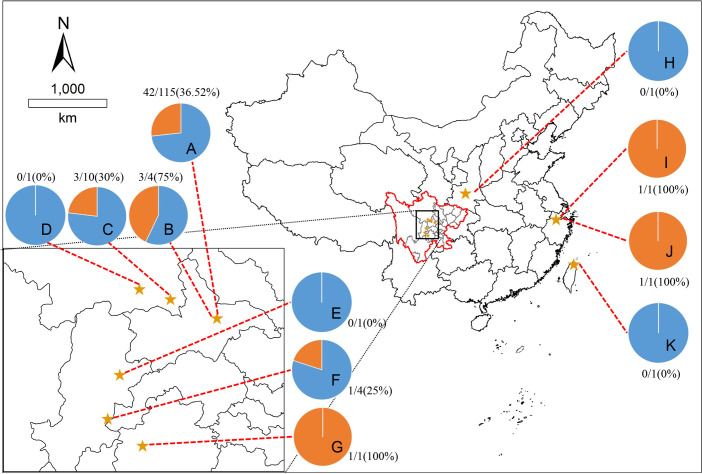
A total of 203 serum samples were collected from 157 (95 females and 62 males) captive giant pandas from 2007 to 2022, antibodies against were screened using commercial ELISA and MAT kits.
The results showed 56 (35.67%) giant pandas were seropositive, age and transfer history between institutions were identifified as risk factors for infection. It is suggested that age-related seroprevalence was the main factor, and housing multiple species in the same environment may increase the chance of cross-infection of .
This study can provide research data for developing policies for the prevention and control of and protecting the health of captive giant pandas and other wildlife.
刚地弓形虫是一种全球性的动物原虫寄生虫,感染包括大熊猫在内的大多数温血动物,对大熊猫的保护构成严重威胁。然而,大熊猫弓形虫病的血清流行率和危险因素尚不清楚。本研究旨在确定圈养大熊猫群体中的感染率,并分析与感染风险增加相关的因素。
从 2007 年至 2022 年,共采集了 157 只(95 只雌性和 62 只雄性)圈养大熊猫的 203 份血清样本,使用商业 ELISA 和 MAT 试剂盒检测针对弓形虫的抗体。
结果显示,56 只(35.67%)大熊猫呈血清阳性,年龄和机构间的转移史被确定为感染的危险因素。年龄相关的血清流行率是主要因素,而在同一环境中饲养多种物种可能会增加弓形虫交叉感染的机会。
本研究可为制定预防和控制弓形虫病以及保护圈养大熊猫和其他野生动物健康的政策提供研究数据。