Rong Weiqi, Xia Hui, Zhang Kai, Zhang Yihan, Tao Changcheng, Wu Fan, Wang Liming, Zhang Hong, Sun Guiju, Wu Jianxiong
Department of Hepatobiliary Surgery, National Cancer Center/National Clinical Research Center for Cancer/Cancer Hospital, Chinese Academy of Medical Sciences (CAMS) and Peking Union Medical College (PUMC), Beijing, China.
Key Laboratory of Environmental Medicine and Engineering of Ministry of Education, Department of Nutrition and Food Hygiene, School of Public Health, Southeast University, Nanjing, China.
Hepatobiliary Surg Nutr. 2022 Dec;11(6):834-847. doi: 10.21037/hbsn-21-116.
Liver cancer as the main leading cancer has caused heavy burdens globally. The prognosis of liver cancer is closely related with postoperative nutrition support. Corn oligopeptides (COPs) are protein hydrolysates produced by enzymatic treatments, which have shown potential bioactivities, such as inhibiting angiotensin I-converting enzyme, resisting lipid peroxidation and anti-oxidant. However, the correlation between COPs and liver cancer patients is still unknown and the potential mechanism of COPs on liver cancer is unclear as well. The aim of this study was to assess effects of 7-day intervention of COPs after surgery on liver function and serum metabolic profiles of liver cancer patients.
Patients were assigned into COPs intervention group (n=50) and control group (n=91) for 7 days. Investigations were scheduled at 1 day and 7 day after liver resection surgery respectively, mainly including anthropometric, biochemical indexes and liquid chromatography-mass spectrometry (LC/MS) analysis.
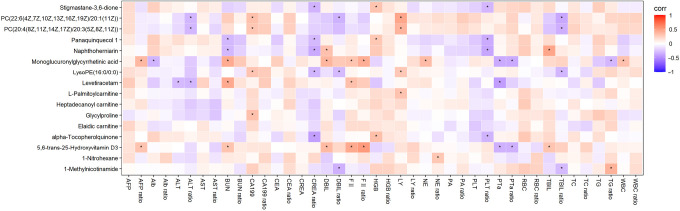
Seven-day supplementation of COPs on early post-surgery liver cancer patients down-regulated levels of alanine aminotransferase, aspartate aminotransferase, total bilirubin, direct bilirubin and up-regulated prothrombin time activity and prealbumin levels. LC/MS analysis revealed metabolic signatures including regulation of 16 metabolites, which was closely related with two metabolic pathways (nicotinate and nicotinamide metabolism, fatty acid metabolism).
COPs supplementation has displayed the potentials on alleviating the injury of liver function and it may be due to regulation of fatty acid metabolism, nicotinate and nicotinamide metabolism, lipid peroxidation and anti-inflammatory action. More researches are warranted in future to confirm the exact mechanisms.
肝癌作为主要的主导癌症在全球造成了沉重负担。肝癌的预后与术后营养支持密切相关。玉米寡肽(COPs)是通过酶处理产生的蛋白质水解产物,已显示出潜在的生物活性,如抑制血管紧张素I转换酶、抵抗脂质过氧化和抗氧化。然而,COPs与肝癌患者之间的相关性仍不清楚,COPs对肝癌的潜在机制也不明确。本研究的目的是评估术后7天COPs干预对肝癌患者肝功能和血清代谢谱的影响。
将患者分为COPs干预组(n = 50)和对照组(n = 91),干预7天。分别在肝切除手术后第1天和第7天进行调查,主要包括人体测量、生化指标和液相色谱 - 质谱(LC/MS)分析。
对术后早期肝癌患者补充7天COPs可下调丙氨酸氨基转移酶、天冬氨酸氨基转移酶、总胆红素、直接胆红素水平,并上调凝血酶原时间活性和前白蛋白水平。LC/MS分析揭示了包括16种代谢物调节在内的代谢特征,这与两条代谢途径(烟酸和烟酰胺代谢、脂肪酸代谢)密切相关。
补充COPs显示出减轻肝功能损伤的潜力,这可能归因于对脂肪酸代谢、烟酸和烟酰胺代谢、脂质过氧化和抗炎作用的调节。未来需要更多研究来证实确切机制。