Tang Sijie, Ling Zhongli, Jiang Jiajia, Gu Xiang, Leng Yuzhong, Wei Chaohui, Cheng Huiying, Li Xiaohua
Department of Urology, Affiliated Aoyang Hospital of Jiangsu University, Zhangjiagang, Suzhou, China.
Aoyang Cancer Institute, Affiliated Aoyang Hospital of Jiangsu University, Zhangjiagang, Suzhou, China.
Front Oncol. 2022 Nov 29;12:1037794. doi: 10.3389/fonc.2022.1037794. eCollection 2022.
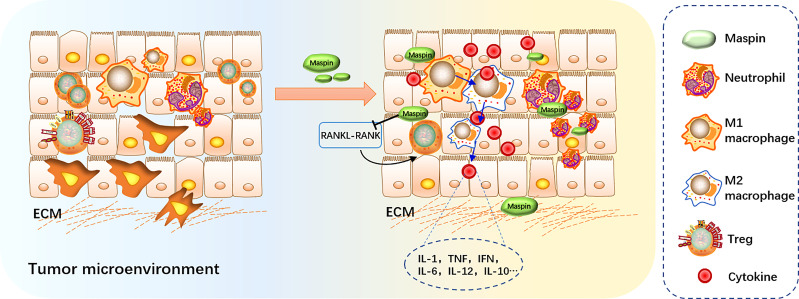
Epithelial malignant transformation and tumorous development were believed to be closely associated with the loss of its microenvironment integrity and homeostasis. The tumor-suppressive molecules Maspin and p53 were demonstrated to play a crucial role in body epithelial and immune homeostasis. Downregulation of Maspin and mutation of p53 were frequently associated with malignant transformation and poor prognosis in various human cancers. In this review, we focused on summarizing the progress of the molecular network of Maspin in studying epithelial tumorous development and its response to clinic treatment and try to clarify the underlying antitumor mechanism. Notably, Maspin expression was reported to be transcriptionally activated by p53, and the transcriptional activity of p53 was demonstrated to be enhanced by its acetylation through inhibition of HDAC1. As an endogenous inhibitor of HDAC1, Maspin possibly potentiates the transcriptional activity of p53 by acetylating the p53 protein. Hereby, it could form a "self-propelling" antitumor mechanism. Thus, we summarized that, upon stimulation of cellular stress and by integrating with p53, the aroused Maspin played the epigenetic surveillant role to prevent the epithelial digressional process and retune the epithelial homeostasis, which is involved in activating host immune surveillance, regulating the inflammatory factors, and fine-tuning its associated cell signaling pathways. Consequentially, in a normal physiological condition, activation of the above "self-propelling" antitumor mechanism of Maspin and p53 could reduce cellular stress (e.g., chronic infection/inflammation, oxidative stress, transformation) effectively and achieve cancer prevention. Meanwhile, designing a strategy of mimicking Maspin's epigenetic regulation activity with integrating p53 tumor-suppressive activity could enhance the chemotherapy efficacy theoretically in a pathological condition of cancer.
上皮恶性转化和肿瘤发展被认为与其微环境完整性和稳态的丧失密切相关。肿瘤抑制分子Maspin和p53被证明在机体上皮和免疫稳态中起关键作用。Maspin的下调和p53的突变常与各种人类癌症的恶性转化和预后不良相关。在本综述中,我们着重总结了Maspin分子网络在研究上皮肿瘤发展及其对临床治疗反应方面的进展,并试图阐明其潜在的抗肿瘤机制。值得注意的是,据报道Maspin表达受p53转录激活,并且p53的转录活性通过抑制HDAC1使其乙酰化而增强。作为HDAC1的内源性抑制剂,Maspin可能通过使p53蛋白乙酰化来增强p53的转录活性。因此,它可以形成一种“自我推进”的抗肿瘤机制。因此,我们总结认为,在细胞应激刺激下,Maspin与p53整合,发挥表观遗传监测作用,防止上皮细胞偏离过程并重新调整上皮稳态,这涉及激活宿主免疫监视、调节炎症因子以及微调其相关细胞信号通路。因此,在正常生理条件下,激活上述Maspin和p53的“自我推进”抗肿瘤机制可以有效降低细胞应激(如慢性感染/炎症、氧化应激、转化)并实现癌症预防。同时,设计一种模拟Maspin表观遗传调控活性并整合p53肿瘤抑制活性的策略,理论上可以在癌症病理状态下提高化疗疗效。