Reschke Agnes, Richards Rebecca M, Smith Stephanie M, Long Adrienne H, Marks Lianna J, Schultz Liora, Kamens Jennifer L, Aftandilian Catherine, Davis Kara L, Gruber Tanja, Sakamoto Kathleen M
Division of Hematology, Oncology, Stem Cell Transplantation and Regenerative Medicine, Department of Pediatrics, Stanford University School of Medicine, Stanford, CA, United States.
Division of Critical Care Medicine, Department of Pediatrics, Stanford University School of Medicine, Stanford, CA, United States.
Front Oncol. 2022 Nov 29;12:1033993. doi: 10.3389/fonc.2022.1033993. eCollection 2022.
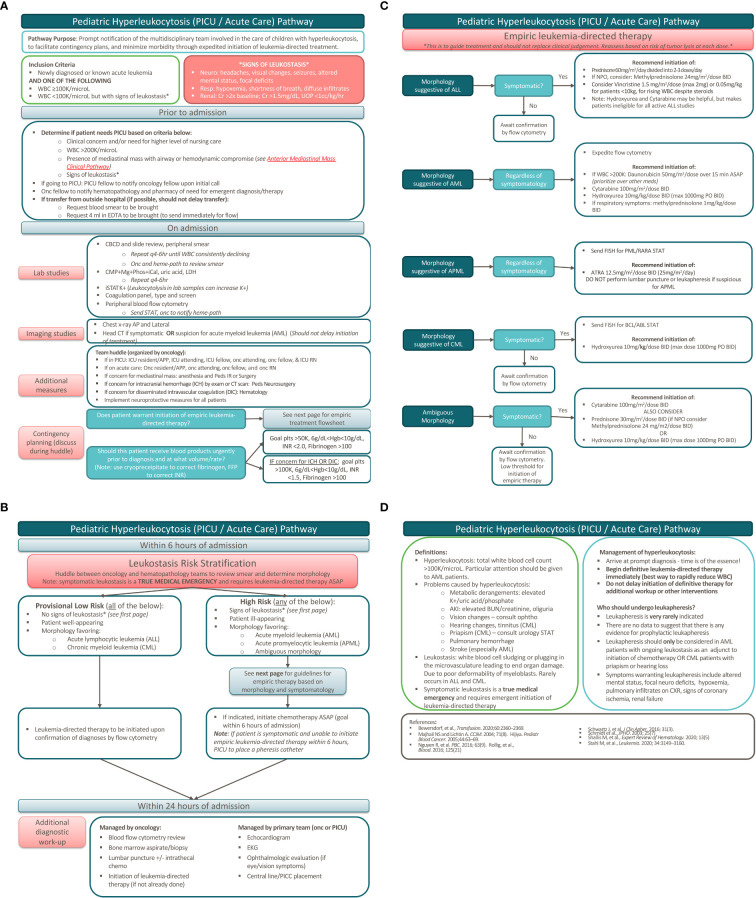
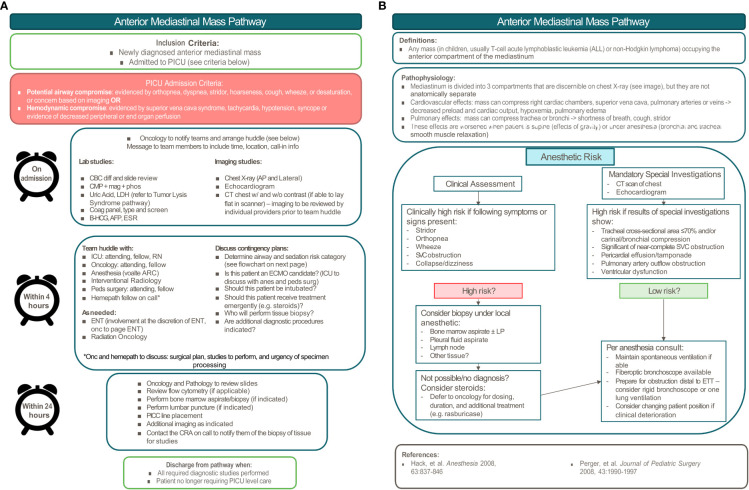
Clinical pathways are evidence-based tools that have been integrated into many aspects of pediatric hospital medicine and have proven effective at reducing in-hospital complications from a variety of diseases. Adaptation of similar tools for specific, high-risk patient populations in pediatric oncology has been slower, in part due to patient complexities and variations in management strategies. There are few published studies of clinical pathways for pediatric oncology patients. Pediatric patients with a new diagnosis of leukemia or lymphoma often present with one or more "oncologic emergencies" that require urgent intervention and deliberate multidisciplinary care to prevent significant consequences. Here, we present two clinical pathways that have recently been developed using a multidisciplinary approach at a single institution, intended for the care of patients who present with hyperleukocytosis or an anterior mediastinal mass. These clinical care pathways have provided a critical framework for the immediate care of these patients who are often admitted to the pediatric intensive care unit for initial management. The goal of the pathways is to facilitate multidisciplinary collaborations, expedite diagnosis, and streamline timely treatment initiation. Standardizing the care of high-risk pediatric oncology patients will ultimately decrease morbidity and mortality associated with these diseases to increase the potential for excellent outcomes.
临床路径是基于证据的工具,已融入儿科医院医学的许多方面,并已证明在减少各种疾病的住院并发症方面有效。针对儿科肿瘤学中特定的高危患者群体采用类似工具的速度较慢,部分原因是患者情况复杂以及管理策略存在差异。关于儿科肿瘤学患者临床路径的已发表研究很少。新诊断为白血病或淋巴瘤的儿科患者通常会出现一种或多种“肿瘤急症”,需要紧急干预和精心的多学科护理以防止严重后果。在此,我们展示了在单一机构中最近采用多学科方法开发的两条临床路径,旨在护理出现白细胞增多症或前纵隔肿块的患者。这些临床护理路径为这些通常入住儿科重症监护病房进行初始管理的患者的即时护理提供了关键框架。这些路径的目标是促进多学科协作、加快诊断并简化及时的治疗启动。规范高危儿科肿瘤学患者的护理最终将降低与这些疾病相关的发病率和死亡率,以增加获得良好预后的可能性。